
The
United Nations-Food and Agriculture Organization (FAO) has declared 2015 the
International Year of Soils. The year kicked off on December 5, 2014, with events
in Rome, New York and Chile, all in an effort to raise awareness and promote
more sustainable use of this critical resource. “Healthy soils are critical for
global food production, but we are not paying enough attention to this
important silent ally,” said FAO Director-General José Graziano da Silva.
The
specific FAO objectives for the Year of the Soils are to:
Raise
the awareness among society and policy makers about the importance of soil for
human life;
Promote
effective policies and actions for sustainable management and protection of
soil resources;
Promote
investment in sustainable soil management; and
Encourage
soil health information and monitoring at all levels of government.
The
U.S. Department of Agriculture (USDA) joined nations from across the globe to
kick off the International Year of Soils in an effort to highlight the
importance of soil in everyday life. Under Secretary for Natural Resources and
Environment Robert Bonnie will address members of the 68th United
Nations General Assembly, which designated 2015 for the yearlong celebration.
"We
are excited to be working with the United Nations to help raise awareness and
promote the importance of conservation of our soil resources," Bonnie
said. "USDA is embracing this unique opportunity to tell the world about
the importance of soil conservation and how we've worked with private
landowners since 1935 to protect and improve this priceless natural resource.”
USDA’s
Natural Resources Conservation Service published an interim rule on December
12, 2014, which outlines how it will improve the Environmental Quality
Incentives Program (EQIP), one of USDA's largest conservation programs. The
interim final rule includes program changes authorized by Congress in the 2014
Farm Bill.
Over
the last 50 years, the world’s population has increased from 3 billion to 7
billion people, but the amount of arable land has remained constant. Dr. Andreas Weber, of the Cluster of Excellence on Plant Science, has calculated that the amount of arable land per
person is currently .4 acres (40 meters x 40 meters per person). By the year 2050, there will be between 9-10
billion people on the planet, which means there will be 30 percent less arable
land available for food production.
Taking
Dr. Weber’s calculation a step further and recognizing that consumption
patterns are also changing with increased wealth, more calories will have to be
produced per unit of land to feed the planet.
Coupled with the FAO’s estimate that a third of all soils are currently degraded
due to erosion, compaction, soil sealing, salinization, nutrient depletion,
acidification, pollution and other processes caused by unsustainable land
management practices, we have a very serious global food security challenge.
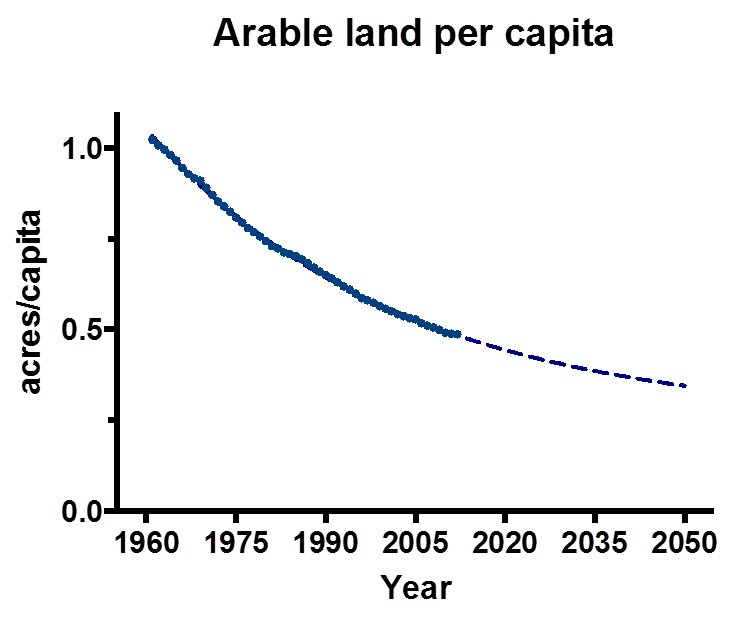
Chart
by Dr. Andreas Weber
In
short, we need to stop treating soil like dirt. Soil is a living thing; it
needs to be respected and cared for in order for soil to be sustainable.
Dr.
Bashir Jama is the Director of Soil Health Program at the Alliance for a Green
Revolution in Africa (AGRA). He recently
noted that “We have not been caring for soil as we should. As a result, in many
parts of the world, including Africa, soil has lost many of its important
biological and physical properties. Erosion from wind and rain has meant we
have lost valuable top soil, and as we have taken nutrients from the soil to
grow our food, we have not replaced them.”
Man
owes his existence to a 6-inch layer of topsoil. Just as a balanced diet is important for our
health and wellbeing, we need a balanced, integrated approach for managing our
soils.
There
is a scientific consensus that we need to double agriculture production by 2050
to meet the challenge of global food security. Further, it must be done while using fewer
resources….less water, fertilizer and inputs.
Simply stated, we cannot begin to meet this challenge without healthy
top soil.
As
you can see from the chart below, fertilizer use varies widely from country to
country. Some countries need improved seeds to reduce the use of other inputs;
other countries desperately need greater access to fertilizer, improved seeds,
and other inputs.

Access to these inputs must come with effective extension services to teach smallholder farmers how to use the modern tools of agriculture. It is important to develop agricultural technology, but it is equally important to reach out to small holder farmers through extension services and educate them on the proper use of inputs. Quoting Dr. Norman Borlaug, unless we “take it to the farmer,” the development of modern agriculture technology cannot reach its full potential.
During
2015, the FAO, in conjunction with allied nations, will be holding a series of
events to further the objectives outlined above, including:
3rd
International Conference on Natural Resource Management for Food and Rural
Livelihoods
First
Global Soil Biodiversity Conference
Global
Soil Security Symposium
Marshall
Matz, formerly Counsel to the Senate Committee on Agriculture, Nutrition and
Forestry, specializes in global food security at OFW Law. mmatz@ofwlaw.com
For
more news go to: www.agri-pulse.com
