
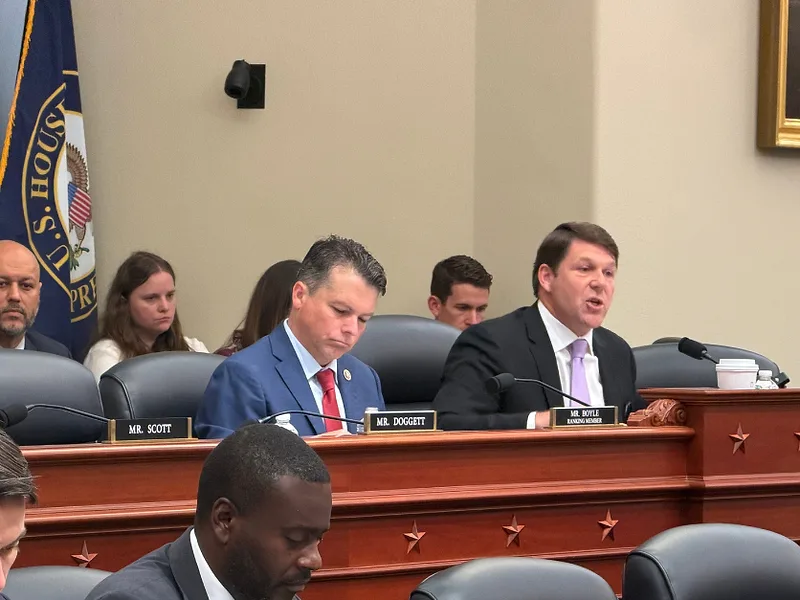
The House Budget Committee on Thursday advanced a $95 billion concurrent resolution, dubbed “reconciliation 3.0,” that would allow the House Agriculture Committee to increase the federal deficit by up to $12 billion to distribute aid to farmers.
Democrats pushed back on the reconciliation package, offering 14 amendments, all of which were rejected, as was the full package, along party lines. The final vote was 20-14.
Rep. Jimmy Panetta, D-Calif., proposed an amendment that would repeal the Trump administration’s global and targeted tariffs.
Specifically, it would eliminate the worldwide 10% tariffs imposed under Section 122 that replaced the administration’s initial global tariffs under the International Emergency Economic Powers Act, or IEEPA. The Supreme Court ruled against those tariffs in February.
The Sec. 122 tariffs are set to expire July 24, Office of the U.S. Trade Representative is readying levies on 60 nations ranging from 10 to 12.5% under Section 301 for forced labor violations.
While that investigation proceeds, USTR decided Wednesday to impose a Sec. 301 tariff of 25% on Brazilian products that will take effect July 22.
“Americans are being crushed by rising costs of housing, healthcare, food and fuel, which have only gotten worse since this president took office,” Panetta said. “Ideally, the budget should be an opportunity for us to reassert Congress's control of the power of the purse.”
Panetta's amendment said the administration’s trade policies have increased the effective tariff rate to 11.8%, and have cost the average household up to $940 annually, shrinking the size of the economy.
The amendment further said that it would require the wealthy and corporations to “pay their share,” a move that could include rolling back the tax cuts in the One Big Beautiful Bill Act.
Farm country increasingly is relying on ad hoc assistance due to unsteady trade, dangerous weather patterns and economic harm.
“This resolution allows up to $12 billion in assistance for farmers, which merely compensate for the consequences of a bad trade policy,” Panetta said, adding that reconciliation doesn’t address the underlying cause of farm instability.
Chairman Jodey Arrington, R-Texas, pushed back, saying the Biden administration had failed to follow through in implementing the first Trump administration's Phase One agreement with China. "He was weak on enforcing the China trade deal," Arrington said.
Arrington also said many of former President Joe Biden’s trade policies built off of Trump’s Sec. 301 levies.
“I think [Trump] upended conventional thinking on free trade, where we have been naively accepting the premise that as long as we're getting cheap stuff, then it's free trade and it's good for the American people," Arrington said. "Meanwhile, we've been scammed and cheated and had unfair practices perpetrated on us for decades, and it has put us in a big hole.”
The committee rejected the amendment, 14-20.
Democrats also pushed back on spending cuts and changes made to the Supplemental Nutrition Assistance Program, or SNAP, in last year’s One Big Beautiful Bill Act, a thorny partisan issue that threatens to derail Republican efforts to pass a farm bill this year.
Rep. Marcy Kaptur, D-Ohio, said the northwestern Ohio district she represents is seeing a flood of people in need of food.
“Every single food bank, and church outlet, and Salvation Army group that I represent, they are all having more and more people flock in, so something isn't working at the national level,” Kaptur said in introducing an amendment aimed at protecting SNAP eligibility and benefits.
Rep. Ben Cline, R-Va., said rolling back the SNAP changes would raise taxes, and that the overhaul was needed to protect the program for those who “truly need it.”
Rep. Ilhan Omar, D-Minn., offered an amendment to restore the nearly $200 billion in SNAP cuts in the OBBBA, the largest in the program’s history. Both SNAP amendments failed by a vote of 14-20.
The relatively fast-moving markup of about three hours served as a preview of the political battle ahead as Republicans scramble to secure passage of President Donald Trump’s top goal, overhauling federal voting rules through the Save America Act, Vice President JD Vance and House Speaker Mike Johnson, R-La., told reporters on Capitol Hill Wednesday.
Secondary objectives are to authorize tens of billions of dollars to replenish military funds as the U.S. war with Iran continues, and to get additional federal aid to farmers grappling with surging production costs.
Trump is scheduled to speak to the nation on Thursday at 9 p.m. Eastern.
Johnson called the reconciliation bill the Republicans' “best shot” at achieving these goals. The aim is to pass legislation before the House and Senate leave for an August recess.
Meanwhile, farm-state lawmakers have been talking for months about getting more rescue funds to farmers, especially specialty crop growers. That would be in addition to the Trump administration’s aid of about $11 billion to producers of row crops like corn and soybeans, and about $1.62 billion for farmers of specialty crops, which include fruits, vegetables and tree nuts.
Rep. Gabe Amo, D-R.I., whose amendment to restore clean energy programs and tax credits cut in OBBBA was voted down, 14-20, said the farmer money wouldn’t be needed if not for Trump administration policies.
“They're taking even more of your money to pay for a farm bailout that's only necessary because their high prices made it hard for America's farmers to stay afloat,” Amo said “I didn't think they could be any more indifferent to your pain, but as icing on the cake, they're trying to make it harder for you to vote too.”
For more news, go to Agri-Pulse.com.
.webp?t=1762183428)
