
President Donald Trump wrote to a spate of governments including South Korean and Japanese leaders on Monday to inform them that their countries’ exports will face higher tariff rates starting next month, while leaving the door open to further increases or negotiated tariff reductions.
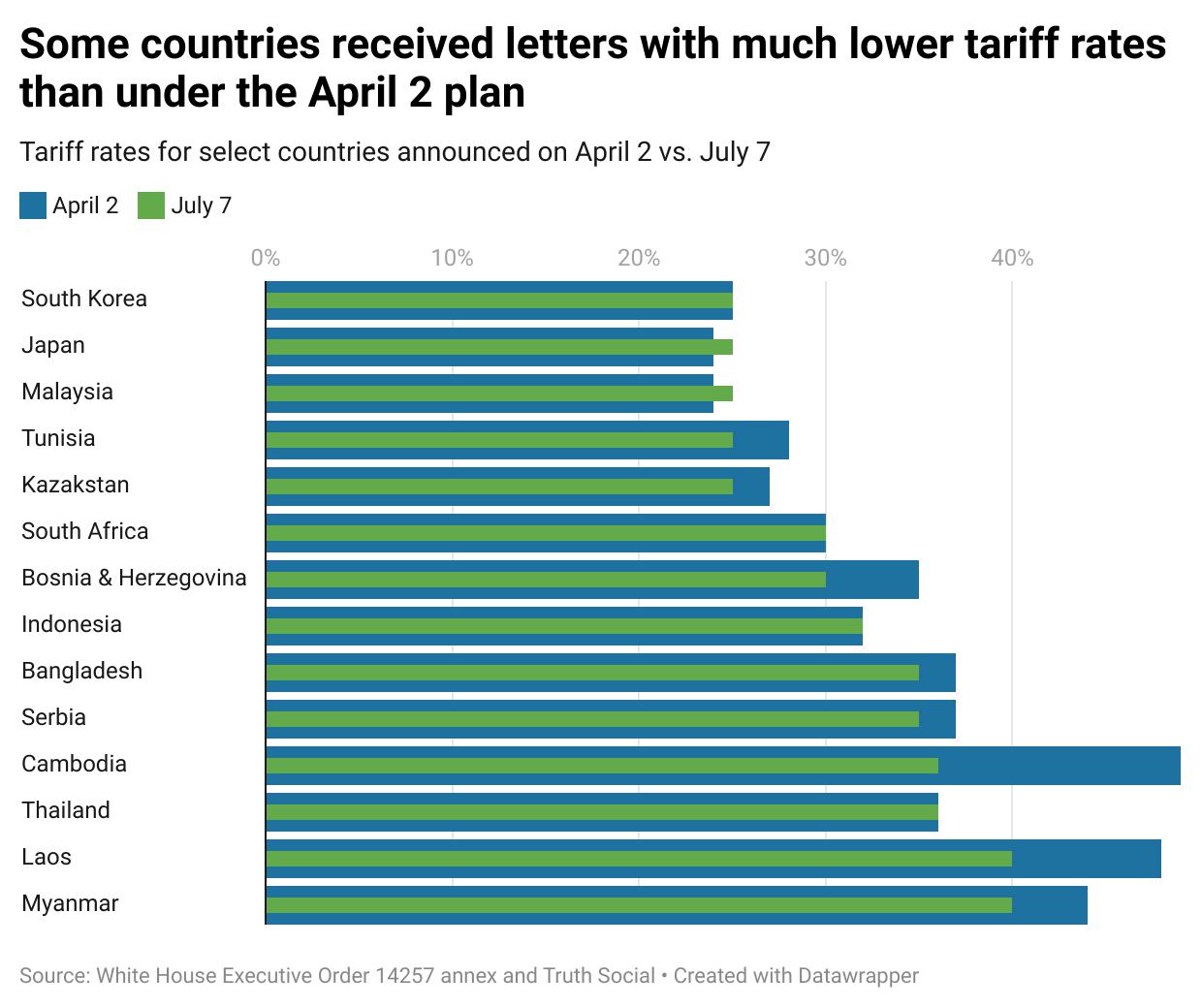
In letters shared on the president’s Truth Social account, Trump said South Korean, Japanese, Malaysian, Tunisian and Kazakh goods would face at least 25% duties from Aug. 1, up from the 10% baseline rate almost all countries have faced since April. South Africa and Bosnia and Herzegovina will also see new tariff rates of 30%, the president said, while Indonesia will face 32% duties. Bangladesh and Serbia will have rates of 35%, Cambodia and Thailand, 36%, with Laos and Myanmar at 40%.
“We have had years to discuss our Trading Relationship,” Trump wrote in near identical letters to global leaders. The U.S. has “concluded that we must move away from these longterm, and very persistent Trade Deficits,” he added.
For South Korea and South Africa, their tariff rates mark a return to the “reciprocal” tariff rate that the president unveiled during a Rose Garden event on April 2. Japan and Malaysia, however, were only set to face a 24% rate under those plans, so will face a small increase. Other countries saw significant declines in their threatened tariff rates.
The new tariffs will be separate from any applicable sector-specific tariffs, Trump said.
Trump also stressed to leaders that any new tariffs applied to U.S. exports in response to the duty increases would be met with further tariff increases.
“If for any reason you decide to raise your Tariffs then, whatever the number you choose to raise them by, will be added onto the 25% that we will charge,” Trump wrote to Japanese and Korean leaders, for example.
The president indicated he was open to dealmaking, pointing out that the tariff rates could be adjusted downward if countries adjust their “Tariff, and Non Tariff, Policies and Trade Barriers,” the letter reads.
 The letters come just two days before Trump’s self-imposed deadline for finalizing negotiations to avoid tariff hikes. Trump told reporters over the weekend that he would be sending letters out to some U.S. trading partners dictating the tariff rates they will face past Aug. 1.
"We're going to have a combination of letters, and some deals have been made," he told reporters on Sunday evening.
Interested in more news on farm programs, trade and rural issues? Sign up for a four-week free trial to Agri-Pulse. You’ll receive our content - absolutely free - during the trial period.
So far, deals have been in short supply. The U.S. has published the details of a single trade pact with the United Kingdom. The president has said the U.S. has also reached an agreement with Vietnam, but the administration has not released any deal text, and a Vietnamese spokesperson has since told reporters that both sides are “are coordinating and engaging in discussions to concretize the topics covered.”
White House Press Secretary Karoline Leavitt told reporters during a press briefing on Monday that the president would publish all of the letters sent to U.S. trading partners on his Truth Social page.
The Aug.1 deadline gives both countries some room for dealmaking, and Leavitt told reporters that the president intends to issue an executive order later on Monday that will formally extend the 90-day reciprocal tariff pause until that date.
But the president has already scolded Japan for the lack of concessions offered around market access for U.S. rice producers. Both Japan and South Korea have also been focused on domestic elections, with Korea’s taking place last month and Japan’s slated for later this month, adding an additional layer of complexity to any trade negotiations.
For some analysts, the new Aug. 1 deadline for higher tariffs is a tacit admission that the original aspirations of inking dozens of deals before July 9 was always unrealistic.
“The administration’s delay announcement should come as no surprise. We’ve known since April that quickly inking, no less implementing, complicated trade agreements with dozens of foreign governments was impossible, Scott Lincicome, vice president of general economics at the Cato Institute, said in an email.
But Lincicome warned that just because the administration had punted on its original deadline, doesn’t mean businesses can breathe a sigh of relief.
“The news isn’t exactly good here,” Lincicome said. “It means at least another month of uncertainty, a ‘best case’ of historically high U.S. tariffs, and thus significant headwinds for the U.S. economy going into the Fall… [B]arring a highly unlikely Congressional intervention here, Trump’s tariff wars are just getting started.”
The letters came just hours after Trump issued a new tariff threat for BRICS countries -- an international organization which includes Brazil, Russia, India, China, South Africa. He warned members on Sunday night that any country endorsing "anti-American policies" could face additional 10%. The president did not elaborate on what those policies might be, but the organization issued a statement on Sunday condemning the rising popularity of unilateral tariff action, without singling the U.S. out directly.
For more news, go to: Agri-Pulse.com

