
A trade preference program for sub-Saharan African countries lapsed on Wednesday, sending tariffs higher on a raft of U.S. ag imports from the region. Efforts are underway on Capitol Hill to reinstate the program, with the White House’s blessing.
The African Growth and Opportunity Act, known as AGOA, provided 32 eligible African countries duty-free access to the U.S. market for certain products but expired at the end of September after 25 years.
The program had come under strain in recent months after President Donald Trump imposed new duties on almost all U.S. imports. But advocates say the program still offered participants a competitive edge over other U.S. trading partners and helped lower prices for U.S. consumers.
“If you look at the imports, they are areas where the U.S. really can’t or doesn’t produce,” said Rosa Whitaker, one of the architects of AGOA, a former U.S. assistant trade representative for Africa and the co-chair of AGOA Alliance – a bipartisan advocacy group.
AGOA beneficiaries exported $2.5 billion of agricultural products to the U.S. in 2023, according to Tralac, a non-profit focused on African trade, with around a third arriving under the program. Cocoa paste and powder, nuts, tobacco, preserved fish and wine were among the top-traded products.
“Those products are largely used as inputs into other U.S., food and agriculture products,” Whitaker said, adding that higher tariffs on these products could lead to further price increases for agri-food manufacturers and consumers alike.
There have been multiple pushes to extend AGOA ahead of its expiration this week. The program enjoys broad support from lawmakers from both parties and industry, including the U.S. agriculture sector. But previous efforts stalled as both parties’ leaders sought to revamp the program in the image of their respective trade policies.
Under the Biden administration, U.S. Trade Representative Katherine Tai argued that the program could be reformed to help reduce inequality, strengthen supply chains and address the climate crisis.
Cut through the clutter! We deliver the news you need to stay informed about farm, food and rural issues. Sign up for a FREE month of Agri-Pulse here.
Meanwhile, the Trump administration has been leery of the non-reciprocal nature of the program, which extends market access provisions to developing African economies without offering the U.S. equivalent market access.
“Trump’s trade approach is that you should be very cautious about unilateral benefits,” said Mayur Patel, former chief trade counsel to the Senate Finance Committee Republicans. “That dynamic always ended up killing it.”
An effort to include AGOA reauthorization in July’s bill to keep the government funded sank when the White House pushed for its removal, Inside U.S. Trade reported at the time.
Republicans wouldn’t include the provision “without a sign that the president supports it,” someone familiar with the discussions told Agri-Pulse.
Expiry makes the heart grow fonder?
That sign may have come this week, however.
A White House official told Agri-Pulse on Monday that the administration supports a one-year extension to the program. Rosa Whitaker (LinkedIn photo)
Sen. Chris Coons, D-Del., who introduced legislation in the last Congress to reauthorize and reform AGOA, also told Agri-Pulse that “bipartisan conversations” are underway on its extension.
He added that he had spoken to “dozens” of lawmakers who acknowledge that the program’s expiry would cause “real harm to a dozen countries and tens of thousands of people.”
“We've had those discussions with African countries, and they're very open to that,” Whitaker said.
But Whitaker added that lawmakers still need to find a legislative vehicle to move any reauthorization legislation, and African nations are set to face immediate strain from higher tariffs.
Hurting the consumers of tomorrow
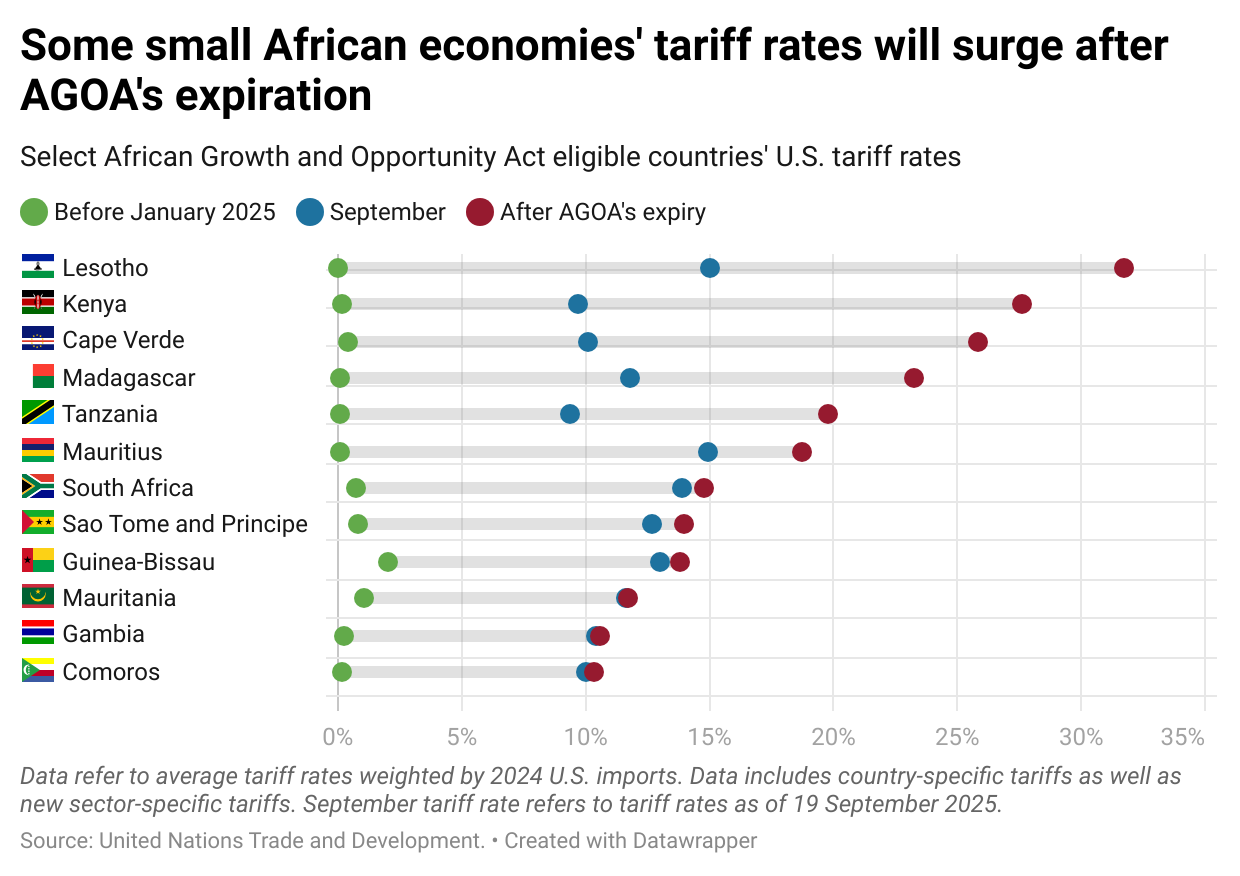
Starting Wednesday, African countries exporting to the U.S. will face a raft of new tariffs on individual agricultural products, in addition to their country-specific tariffs applied as part of Trump’s “reciprocal” tariff rollout in early August.
The new duties could reduce their competitiveness in the U.S. market compared to other developing economies, particularly those in Southeast Asia that compete with African exporters on a variety of agricultural products.
Madagascar – an AGOA beneficiary – saw its average tariff rate, once adjusted to account for its exported products, jump from zero before Trump took office to 11.8% after Trump’s sector and country-specific tariffs were applied this summer. Now, with AGOA’s expiry, it will face a trade-weighted average tariff rate of 23.2%, according to United Nations Trade and Development (UNCTAD) data.
For some African countries, the new tariffs could deal a crippling economic blow to some industries, Luz María De la Mora, UNCTAD’s director of international trade and commodities, told Agri-Pulse.
She said the tea industry in Kenya, Ethiopia and Uganda’s coffee sectors, South Africa’s wine producers and flower and vegetable growers across East Africa could potentially take a hit.
Failing to reauthorize the program won’t just hurt African beneficiary countries, it would also fray U.S. trade ties and stifle development in a region that is set to significantly grow its agricultural imports in the coming years.
Africa is the only region on the planet that will see its population continue growing beyond 2100, according to analysis from Terrain Ag. Its imports of many ag commodities, including grain, are set to soar in the coming years.
It is not in the long-term U.S. interest to hinder economic development in these countries, said Maria Zieba, vice president of government affairs for the National Pork Producers Council.
 Maria Zieba (NPPC photo)
A more affluent Africa means higher protein diets, she said. And that means more U.S. meat exports in the years to come.
Further, AGOA-eligible countries must adopt international worker protections and commit to making progress on eliminating barriers to U.S. exports and investment. NPPC has previously called for Congress to bolster AGOA’s enforcement, arguing South Africa’s sanitary and phytosanitary regulations hinder U.S. pork exports.
“It's a good tool,” Zieba said, to “bring countries to the table.”
Trump has preferred to use tariffs as sticks to cudgel countries into lowering their trade barriers, over sweeteners like AGOA. But Whitaker pointed out that African countries were overlooked when the administration was negotiating concessions in exchange for tariff reductions.
If fresh tariffs dent export opportunities for African countries, and the administration lacks the bandwidth to negotiate tariff reductions with smaller African nations, they will go looking for alternative markets, analysts warned. In many cases, that could see them deepen trade ties with China, a strategic U.S. adversary.
While the Trump administration has been busy raising tariffs on African trading partners, Whitaker said, China reduced tariffs to zero for 53 African countries.
“We are losing ground to China in so many ways,” Whitaker said.
There are also plenty on Capitol Hill who see AGOA's potential as a geopolitical tool, not just an economic one.
“AGOA offers major value to the U.S. and our trade partners in Africa. It encourages cooperation on critical supply chains, counters China’s malign influence, and demonstrates America’s commitment to Africa’s young, growing population and untapped economic potential,” Ways and Means trade subcommittee chair Adrian Smith, R-Neb., told Agri-Pulse in an email ahead of AGOA’s expiration.
“As the program’s expiration nears, I remain committed to advancing legislative solutions for its renewal and modernization, which I know is also a priority for our committee chairman,” he added.

