
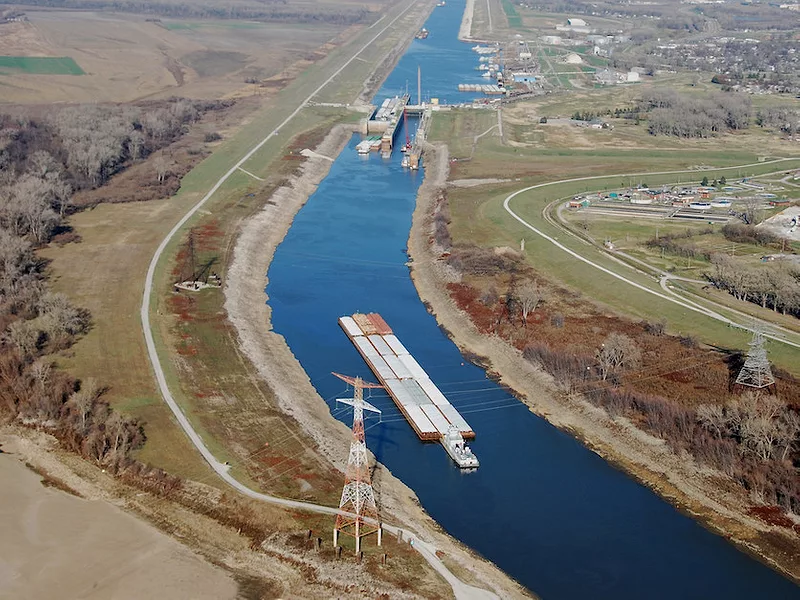
Water levels in parts of the Ohio and Mississippi rivers are likely to reach critically low stages soon, forcing shippers to light-load harvest-season grain barges for the fourth year in a row.
Sections of the two rivers saw water levels rebound over the weekend as parts of the Mid-South received up to four inches of rain or more, bolstering flows shrunken by drought in the weeks prior, according to Agriculture Department meteorologist Brad Rippey.
Still, the reprieve is likely to be short-lived. Readings on the Ohio River at Cairo, Illinois, have already fallen below that gauge's “low threshold,” while those on the Mississippi River at Memphis, are projected to do so by Tuesday. With harvest season already underway, agricultural shippers are being forced to load their barges lighter due to the threat of low water conditions developing in coming weeks.
 Mike Seyfert (NGFA photo)
“We’ve had low water levels for four years in a row now,” said Mike Seyfert, president and CEO of the National Grain and Feed Association. “What I would say is, it certainly doesn’t make things easier.”
The Mississippi River is a major highway for grain and other farm products, carrying roughly 92% of the nation’s agricultural exports, according to the U.S. Army Corps of Engineers. Mississippi water levels similarly fell during the 2022, 2023 and 2024 harvests, making the issue a recurring nuisance for agricultural shippers.
Much of the current situation is driven by dry conditions along the Ohio River, which typically contributes 50% of the Mississippi River’s overall water flow but only provided 8% as of last week, according to the National Integrated Drought Information System. The Upper Mississippi and Missouri Rivers are providing 57%, as opposed to the 30% they normally provide.
The Coast Guard is requiring that vessels heading south between Cairo and Caruthersville, Missouri, sit no deeper than 10 feet, six inches below the waterline, and tows be no more than six barges wide. Northbound vessels must be no wider than six barges, but must be positioned no deeper than 9 feet, six inches below the waterline. NGFA members have reported seeing capacity restrictions of up to 20% at various points on the river, according to Phillip Hayes, a spokesperson for the group.
Meanwhile, barge rates have risen, adding additional shipping costs for grain elevators that trickle back down to the farm level. Gary Williams, the director of the Upper Mississippi Waterway Association, said between current commodity prices and shipping costs, Midwestern corn and soybean farmers have been looking to store their grain in "every single nook and cranny” they can.
Cut through the clutter! We deliver the news you need to stay informed about farm, food and rural issues. Sign up for a FREE month of Agri-Pulse here.
Barge freight rates from Cairo to Memphis were $19.53 per ton on Sept. 23, a 31% increase from a month prior, according to USDA’s most recent Grain Transportation Report. However, they remain 14% lower than they were at the same time last year.
Barged grain movements fell from 2.4 million short tons to 502,000 short tons between the week of Aug. 4 and the week of Sept. 12, a 79% drop, said Daniel Munch, an economist for the American Farm Bureau Federation. In a recent analysis, Munch found that soybean movements sank 89%, corn movements dropped 72% and wheat movements fell 55%.
 Daniel Munch (X photo)
He attributes some of the drop to Coast Guard vessel loading restrictions, noting that “when barges can’t sink as far and pull as many tows or barges behind each boat, that means they are moving less volume for the same price.” Farmers who sell to grain elevators are indirectly paying the additional shipping costs by receiving lower prices for their grain, he said.
“This is kind of just adding on to the list of problems and market hurdles that crop producers, especially row crop producers, are facing this year,” Munch said.
Corn farmers this year are projected to produce a record 16.7 billion bushels of corn, the largest harvest on record. Meanwhile, China, typically the largest importer of U.S. soybeans, has not put in a single order for the crop. Prices for these commodities have weakened, and declining Mississippi River water levels present just one more challenge to farmers' profitability, said Mississippi agriculture commissioner Andy Gipson.
“With the farm crisis for grain and row crops that we are seeing nationwide, this is just another factor that our farmers don’t need to have to deal with,” Gipson said. “But it seems like we can’t get a break."

