
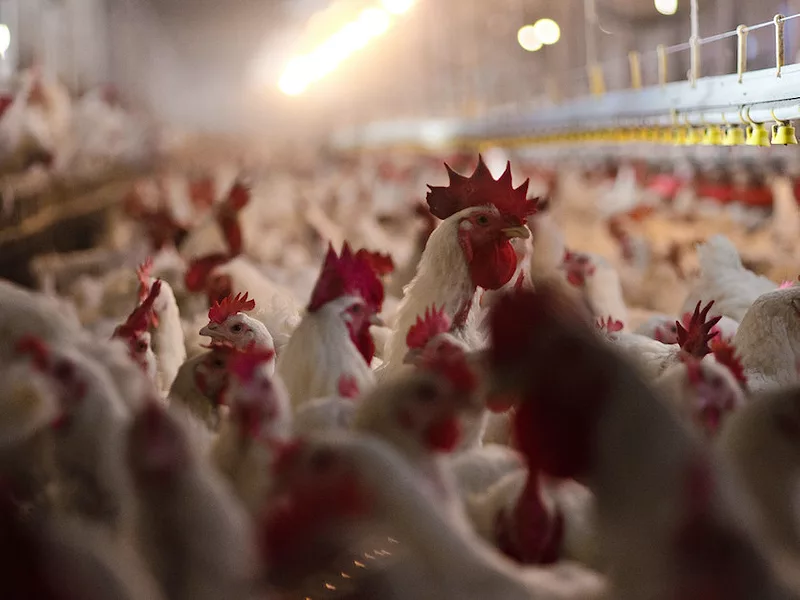
Highly pathogenic avian influenza is again spreading through U.S. poultry flocks, but on a smaller scale than past outbreaks. Still, experts warn an uptick in cases could occur this winter.
HPAI has been confirmed in 97 U.S. flocks in the last 30 days, affecting a total of 1.33 million birds. Forty-nine of these flocks are commercial, while 54 are backyard flocks.
One additional case was confirmed in Iowa on Tuesday, affecting 18,000 turkeys, according to Don McDowell, director of communications for the Iowa Department of Agriculture and Land Stewardship.
The current spread is not as severe as the outbreaks that surfaced last fall and early this year. Last year, a total of 7.3 million birds were affected by the virus from Nov. 3 to Dec. 3, according to USDA data.
A total of 737,410 birds from 53 Indiana flocks have been impacted by the disease in the last month, the most of any state. Michigan follows, with a total of 344,050 affected birds from nine flocks. In South Dakota, 123,200 birds from three flocks have been impacted.
The virus was confirmed in flocks in 19 other states along the West Coast, the northern and southern Great Plains, and the Northeast over the last 30 days.
Egg layers in particular have seen fewer cases than last year, said University of Arkansas agricultural economist Jada Thompson.
However, Thompson said case counts could increase in December and into next year, noting that from early last October to the end of this January, the virus hit more than 50 million birds. If egg-laying flocks saw an increase in cases over the coming months, egg prices could rise during the holiday baking season, she said.
Thompson said that in fall 2025, roughly 60% of the birds infected with HPAI were egg layers. Roughly 35% have been turkey meat birds.
 Jada Thompson (U-Arkansas photo)
“I think we’re seeing this very strong start to the season,” Thompson said, adding that case counts are limited enough that she’s not “concerned at this point that we’re getting to the same point as last year.”
Still, Michigan State University economist David Ortega said it’s hard to fully understand if the virus has recently affected egg prices due to the government shutdown’s impact on federal economic data collection. He said the consumer price index published by the Bureau of Labor Statistics is generally a good indicator of egg prices, but the agency has yet to release November data.
Still, Ortega said he doesn’t foresee major retail egg price increases given recent trends in wholesale prices. He said current wholesale prices look to be around $2.25 per dozen. In comparison, wholesale prices early last December were around $3.95, he said.
Turkey losses in particular can hit hard when it comes to product value, Thompson said. Turkeys are generally worth more than layer birds, because they are held longer in order to reach a large size. She said the price of frozen whole birds in September was up 65% year-over-year.
According to USDA data, 467,800 turkey meat birds have been impacted by the disease since Nov. 3. The virus affected a total of 839,900 turkey meat birds in October.
From Nov. 3 to Dec. 3, 2024, 962,700 turkey meat birds were affected.
Around 2 million turkeys have been lost due to HPAI this year, Ortega said. As a result, the Agriculture Department is forecasting prices to be 40% higher this year compared to last year, he added. However, he noted that this does not necessarily mean increases of that magnitude will appear at the retail level.
Don’t miss a beat! It’s easy to sign up for a FREE month of Agri-Pulse news! For the latest on what’s happening in Washington, D.C. and around the country in agriculture, just click here.
“Retail prices typically don't reflect the impact of high path avian influenza like wholesale prices do, because retailers often use turkeys as a loss leader,” Ortega said, referring to a pricing strategy used to price birds significantly lower to draw customers. “So that’s why a lot of the reports leading up to the Thanksgiving holiday were showing that retail prices in some cases were lower.”
Ortega stressed that these numbers come from industry estimates and that it’s hard to draw firm conclusions about retail price trends without recent national data.
On top of HPAI, turkey growers are also seeing flocks hit by avian metapneumovirus (aMPV), an upper respiratory disease. It’s less deadly to turkeys than HPAI, but infected flocks can still see 20% to 50% mortality, largely due to secondary infections, according to the National Turkey Federation. Notably, it also causes between 40% and 90% losses in egg production for breeders, limiting access to new stock at a time when barns are being emptied due to HPAI, according to the Minnesota Turkey Growers Association.
“What you have is this impact of HPAI getting rid of all the birds,” Thompson said. “And then you also have these hatchability issues and reproduction implications [from aMPV], which is going to slow down that supply chain.”
Recent HPAI ca Fred Gingrich (AABP photo)ses in dairy have been minimal. In the last month, only one California dairy farm has seen a confirmed case. Similarly, only one confirmed case occurred in October, while two occurred in September, one occurred in August, two occurred in July and three occurred in June.
“We have very few infected herds right now,” said Fred Gingrich, the executive director of the American Association of Bovine Practitioners. “All indications are that we will not get many cases — that it appears to have kind of run its course in dairy.”
Jamie Jonker, chief science officer and vice president of sustainability and scientific affairs for the National Milk Producers Federation, said this has “certainly been a much quieter fall than last year,” noting that the virus was “just beginning to explode in California” last December.
However, future mutations could lead to future upticks in cases, should they occur, Gingrich said. He said there are still unknowns when it comes to reinfections and how long herd immunity lasts.
“We don’t want to let our guard down right now,” Gingrich said. “It’s looking pretty good, but that means we just need to continue all of the efforts with herd biosecurity and national surveillance.”

