
WASHINGTON, Oct. 26, 2016 - A few days before heading to
Wisconsin to announce the latest round of Value Added Producer Grant (VAPG)
recipients, Sam Rikkers reflected on the quandary of running a popular
government grant program.
On one hand, it’s a good thing because as the
administrator for USDA’s Rural Business-Cooperative Service, he can use the
fact that the program is way oversubscribed to prove the interest in VAPGs. On
the other hand, having more demand than he has dollars means Rikkers and USDA
can’t assist some worthy enterprises.
“It’s always tough to turn away good applications,”
Rikkers said in an interview with Agri-Pulse. “But the more we can
demonstrate that there are great applications that could be turning farms into
real entrepreneurs, the Congress will see that and they’ll continue their
commitment to the program.”
While generating congressional support is something
Rikkers said is out of his control, he certainly has the ability to show
interest in VAPGs. He said the fiscal 2013 and 2014 signup had $36.4 million in
eligible applicant requests but just $24.9 million in available funding.
The shortfall shrank to about $2 million in 2015 when the available funding
jumped to $34 million for that year.
Rikkers didn’t get into specifics about how much money
will be allocated in the fiscal 2016 rollout on Thursday, but a Federal
Register notice says there is approximately $44 million in available
funding.
“We just see an appetite of eligible applications that is
brewing out there,” Rikkers said.
The grants are available in two forms: planning grants,
which can be used for things like feasibility studies and developing a business
plan, and working capital grants, which can cover things like processing,
marketing, and some salary and inventory costs. According to an analysis of
recent VAPGs obtained by Agri-Pulse, of the 1,115 grants that have been
awarded since fiscal 2009, about 77 percent (860 grants) have gone toward
working capital.
The planning grants are capped at $75,000, and the working
capital grants at $250,000. Grants go toward a wide array of projects, but
recipients fall into six priority areas: small and medium sized family farms,
beginning producers, socially disadvantaged producers, cooperatives, mid-tier
value chain projects, and veteran producers.
One example that jumped out to Rikkers was the $104,000 working capital grant that went to the Wisconsin Food Hub Cooperative. During a visit last year, Rikkers said Tim Zander, a fruit and vegetable grower and a member of the co-op, described how the grant helped his operation. “I’m really good at growing my fruits and vegetables, but what I’m not great at is figuring out how to package and market those products,” Zanders said, according to Rikkers. And that’s where the grant came in, with assistance in packaging.
“They are trained and excited and ready to grow the
products,” Rikkers added, “but to actually get it in to those other type of
markets, they can’t just show up with a box of their blueberries.”
The value added aspect of the grants is designed to help
producers who are interested in “getting off the commodity treadmill,” said
Ferd Hoefner, policy director with the National Sustainable Agriculture
Coalition. NSAC, Hoefner says, has been one of the mainstays in generating VAPG
support on Capitol Hill.
At this point, the program is received on Capitol Hill
much like it is across the country: It’s popular, but funding remains an issue.
Hoefner said that in the 2014 farm bill, which covered a five-year period,
Congress allocated the $63 million in mandatory spending that supports the
grants in a lump sum rather than annual allotments. Hoefner said despite NSAC
pushing to spend that money in 20 percent allotments (with additional funds
supporting the grants coming through the appropriations process), it looks like
that money will be gone by fiscal 2017.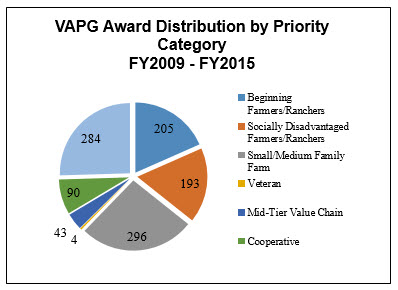
“Everybody has their own opinion about it,” he said. “I
think (USDA’s) opinion was that it was the last year of the administration,
let’s go out with a roar. Our opinion is different since we’re not going
anywhere.”
He said the mandatory money that has yet to be used will
cover proposals requested in December for fiscal 2017 grants. While that may be
helpful for the near future, any delay in getting a new farm bill would not be
good for the program.
“It hurts us to go into a year – FY 2018 – with zero
dollars left,” he said. The appropriations process has been kicking in about
$10 million-$15 million per year, and getting more from appropriators might be
a heavy lift.
As for the upcoming farm bill, Hoefner said NSAC hopes to
see mandatory funding increased to $20 million per year for the life of the
bill and a technical clarification that could help more cooperatives qualify
for grants. That clarification could come through a new administration, but
Hoefner notes that if that isn’t the case, NSAC will likely take its request to
Congress.
#30
