
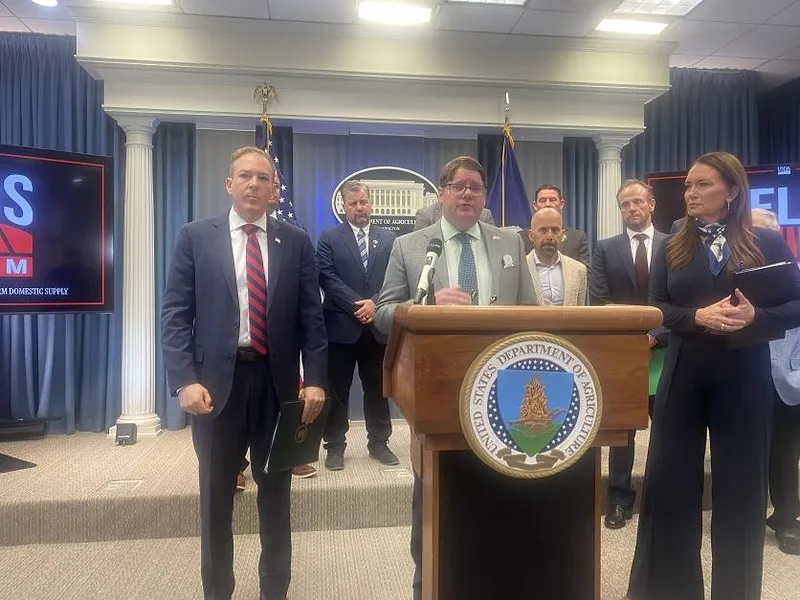
USDA unveiled a new $500 million grant program Wednesday to boost domestic manufacturing of fertilizer that will be focused on projects that are “shovel-ready.”
The Fertilizer Investment and Expansion for Long Term Domestic Supply (FIELDS) program is designed to boost domestic manufacturing of fertilizer at a time when farmers are dealing with elevated fertilizer prices and slumping crop values.
Agriculture Secretary Brooke Rollins was joined at a press conference at USDA’s Whitten building by EPA Administrator Lee Zeldin, USDA Deputy Secretary Stephen Vaden and fertilizer manufacturers.
Rollins and Vaden said the program would differ from the Biden administration’s Fertilizer Production and Expansion Program, under which about $800 million went to 121 projects. That program offered grants of $1 million to $100 million, whereas FIELDS will offer grants between $15 million and $150 million.
"Award requests are subject to a matching requirement equal to 50% percent of total eligible project costs," according to the Notice of Funding Opportunity. "For example, for a project with $50 million in total eligible costs, an applicant may request up to $25 million and must provide at least $25 million in matching funds."
“Of the 121 projects that were announced under the Biden administration, only eight have been completed,” Rollins said. “There were several in there looking at worms and flower pots and kombucha, lots of climate language craziness.”
The funding will come from the Commodity Credit Corporation.
“Applications, which will be open for 45 days, must demonstrate financing plans, market demand, project execution capabilities, and measurable benefits for our farmers,” Rollins said. “Our goal is simple: We want fertilizer plants built in America, and we are willing to prioritize it.”
Grants can be used for new and existing facilities, Rollins said.
Cut through the clutter! We deliver the news you need to stay informed about farm, food and rural issues. Sign up for a FREE month of Agri-Pulse here.
“We will look at private investments that's already in the project or coming into the project, and of course, measurable production outlines,” she said.
Vaden added, “We know the fertilizer issue didn't just crop up when there was a conflict in the Middle East. Farmers have been dealing with this for at least the past five to six years, and we're here to see to it that they will not be talking about it five and six years hence, because we're going to solve the problem by making strategic investments in projects that are shovel-ready and that will produce fertilizers of all types in amounts that will be market-significant and that will ensure that we have domestic production here in the United States.”
Vaden said the effort is necessary “so we are not worried about ships on some strait that most people have never heard of, and whether or not they're going to be able to make it through.”
He also emphasized the administration’s probe of consolidation and potential collusion in the domestic fertilizer industry.
“We're not just looking at supply, we're working with our friends at the Department of Justice and the Federal Trade Commission to ensure the markets are free and fair and the prices are transparent,” he said.
Joshua Westling, founder and CEO of fertilizer manufacturer J. Westling & Co., said the FIELDS program matters because “it's what closes the gap between a project that sounds nice and a project that actually gets built, between capacity built in the Midwest and capacity built somewhere else in the world.”
Westling is in the process of developing Project Meadowlark, “a new domestic fertilizer complex in Gothenburg, Nebraska, representing more than $1 billion in total project investment,” he said at a Senate Agriculture Committee hearing in May.
Rollins said fertilizer prices have been dropping recently but are still too high.
“It's just going to take a little while to get those inputs down as we're opening up the markets around the world, and we begin to solve for some of these very long-term structural issues,” she said.
Trump administration moves to shore up rural support
As midterm elections draw closer, the Trump administration is making a series of moves aimed at bolstering rural communities and helping financially-strapped farmers.
With expectations of more global fertilizer trade moving out of the Middle East following months of war-triggered blockages, urea, a key nitrogen crop nutrient, traded at its lowest level all year earlier this month. That’s welcome news for Northern Hemisphere farmers who soon must start planning purchases for next season. Still, North American prices remain elevated and it’s unclear if the U.S. and Iran will reach a permanent peace deal.
Another major fertilizer, phosphate, has remained high. The nutrient as of this month was up nearly 30% year-to-date as China, a major supplier, limits exports. A global squeeze on supply of sulfur, a main feedstock for producing phosphate fertilizer, is also an issue, according to Bloomberg Intelligence fertilizer analyst Alexis Maxwell.
Trump this week suspended duties on Moroccan phosphate through executive order. Farm groups are hopeful reopening that supply channel will lead to lower prices for growers. The problem, though, is that diammonium phosphate, or DAP, a widely used phosphorus fertilizer, is costly for America’s farmers but on a global basis, U.S. values are at the “cheapest major price point in the world,” says StoneX Vice President of Fertilizer Josh Linville.
That means, economically, “there is very little reason for anyone to send phosphate here unless they have no other options,” Linville said.
For more news, go to Agri-Pulse.com.
.webp?t=1762183428)

