
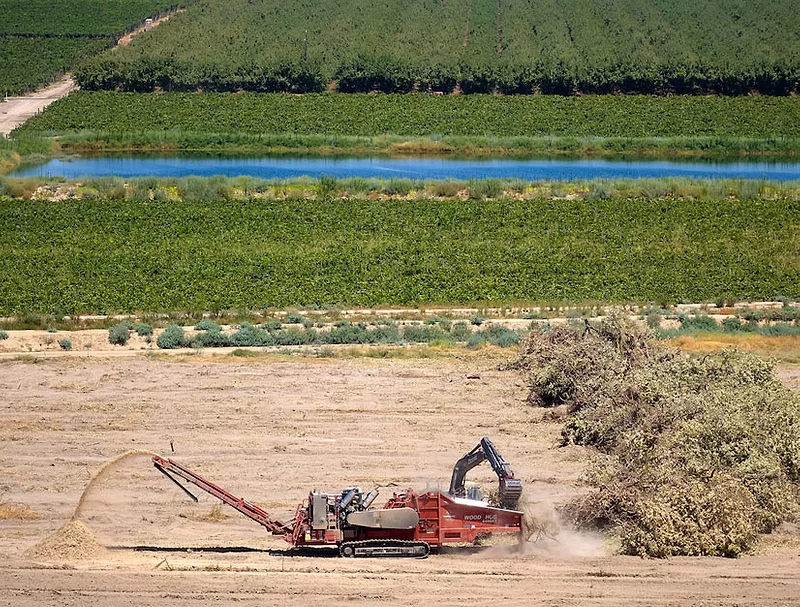
With its ban on open agricultural burning, California has few options left for the pulled trees and vines accumulating in piles throughout the Central Valley. The mounting waste is the result of a rapid downsizing for the almond and winegrape industries, after lagging prices and fallowing in response to the implementation of the Sustainable Groundwater Management Act.
State lawmakers are attempting to tackle the problem through two new bills in the Legislature.
Sen. Jerry McNerney, D-Pleasanton, hopes to create more flexibility for farmers to compost the waste on site — an “eco-friendly alternative” to burning in a region already suffering under the nation’s worst air pollution. Proponents argue that ramping up composting would return nutrients to the soil, build climate resilience, enhance productivity and support the state’s climate goals, since diverting waste from landfills reduces methane emissions.
Composting large amounts of green waste at the farm would also avoid the steep transportation costs for delivering the material to facilities hundreds of miles away, a longstanding impediment to scaling up composting efforts in California.
The bill addresses the shortage of composting facilities in the state as well. The California Department of Resources, Recycling and Recovery, known as CalRecycle, issued a report last fall indicating the state needs as many as 100 additional organic waste recycling facilities to meet the demand.
The Bay Area lawmaker’s proposal has resonated with farm groups as well as environmental groups like Californians Against Waste.
“Growers neither collect garbage rates nor tipping fees. For the purposes of this bill, on-farm composting is not a daily, ongoing operation, but a way to responsibly manage large biomass events every 25 to 30 years, like a whole orchard or vineyard removal,” said Erica Parker, policy associate at Californians Against Waste, during a committee hearing last week on SB 279. “Treating small composters and growers like waste facilities creates unnecessary barriers and prevents them from being part of this solution.”
The California Association of Winegrape Growers and the Western Tree Nut Association are sponsors on Senate Bill 279.
 Sen. Jerry McNerney, D-Pleasanton (photo: McNerney's office)
“Winegrape growers have long been committed to sustainability, including healthy soils and carbon sequestration through composting and other means,” said Michael Miiller, director of government relations at CAWG, in a statement. “As California faces the reality that we need to remove tens of thousands of acres of vineyards this year, composting onsite is an option that is especially important in the Central Valley, where open ag burn is no longer an option.”
WTNA President and CEO Roger Isom added that large-scale composting would “take sustainability to the next level.” The cost for hiring a third-party to chip and reincorporate the biomass into the soil has skyrocketed from a few hundred dollars per acre to nearly $2,000, at a time when the grower is not earning money from that property, he explained.
Appealing to ag and enviro groups but concerns to composters
SB 279 would also allow growers composting a large amount of waste to combine it with byproducts from offsite, such as clippings from pruning trees or manure from dairies. Isom assured the lawmakers the bill is narrow in scope and would not impact the existing commercial facilities.
It’s easy to be “in the know” about agriculture news from coast to coast! Sign up for a FREE month of Agri-Pulse news. Simply click here.
Urban farms and schools would benefit as well, enabling such community projects to compost up to 500 cubic yards of green waste, a five-fold increase over the current cap. It would extend the cap on selling compost by just as much, bumping it to 5,000 cubic yards a year. SB 279 would incentivize composting food waste at small- and medium-sized facilities by allowing food scraps to account for up to 10% of the composted mass. The provisions would produce high-quality compost closer to public parks and other places it is commonly applied, according to Kourtnii Brown, CEO and co-founder of California Alliance for Community Composting.
Despite Isom’s assurances, SB 279 has gained strong opposition from the established composting industry. Neil Edgar, lobbying on behalf of the California Compost Coalition, argued the bill’s language is too broad and would enable unregulated composting operations to compete with the coalition members, which have invested heavily in measures to protect the environment. One Yolo County facility is shouldering about $70 million in compliance costs for air and water quality regulations, he pointed out.
“These agricultural operators are allowed to already receive compost and use unlimited amounts of agricultural materials,” said Edgar. “What this bill does is allow them to become active participants in the market.”
He estimated the 5,000-ton cap would be enough to fill about 125 truckloads with compost. He warned that relaxing the regulations would allow up to a million pounds of food material coming into a single site, creating vectors for disease and significant environmental and public health concerns.
Edgar added that several agricultural counties are building new composting facilities to handle the increased waste, some costing as much as $30 million. He noted that the almond industry alone removed 1.6 million acres last year, resulting in up to five million tons of woody material, while 40,000 vineyard acres were removed last year.
“This is about as much material in agriculture as our entire composting system manages across the state,” he said. “So this is not a small, one time, nebulous event.”
SB 279 proponents were open to taking amendments that would limit the composting to around the 25-year horizon of the orchards and vineyards.
“We're in the business of producing nuts,” responded Isom. “We're not in the business of producing compost. If we're to pull out 83,000 acres every year, we would no longer be in business.”
He stressed that 70% of almond growers in California farm on 100 acres or less, though he acknowledged “the perfect storm” of SGMA, low commodity prices and the burning ban have led to a surge in pull outs.
Lawmakers receptive to ag waste issues
The bill gained bipartisan and nearly unanimous support in the Senate Environmental Quality Committee. Sen. Caroline Menjivar, D-San Fernando Valley, sympathized with the opponents and abstained from voting.
Lawmakers have grown more receptive in recent years to the growing concerns over handling organic waste. The state’s wildfire crisis has put more pressure on managing forests and led to more issues with disposing of debris from those projects. Progressive policymakers have been reluctant to endorse conservative calls to revive the cogeneration industry to convert the organic material into electricity. Yet the deepening problem with agricultural waste has prompted lawmakers to think differently about the next generation of energy production.
Sen. Anna Caballero, D-Merced, has for years defended the use of biomethane derived from dairy digesters to generate hydrogen fuel. Repurposing the agricultural waste prevents methane emissions, a highly potent climate pollutant, from escaping into the atmosphere.
Caballero is taking a different approach this session with SB 88, which seeks to better understand the problem. It would task the California Air Resources Board with quantifying the amount of greenhouse gas emissions the state prevents by sending forest debris and agricultural waste to biomass facilities instead of burning it in the open. SB 88 would also direct CARB to consider carbon credits or offsets for biomass projects.
“By converting biomass into useful products, such as biofuels, biochar and low-carbon energy, we can not only avoid these emissions, but create new economic opportunities in rural areas,” said Caballero, introducing her bill during the same committee hearing last week. “Colleagues, we have to create a future where we convert waste into valuable products, reduce harmful emissions and protect the state from the devastating impacts of climate change.”
The bill gained bipartisan and unanimous support from the committee. Several farm groups have registered their support, while the Center for Biological Diversity was the sole party in opposition. The Senate Natural Resources and Water Committee will take up the bill next, while SB 279 has advanced to Appropriations.
For more news, go to Agri-Pulse.com.

