
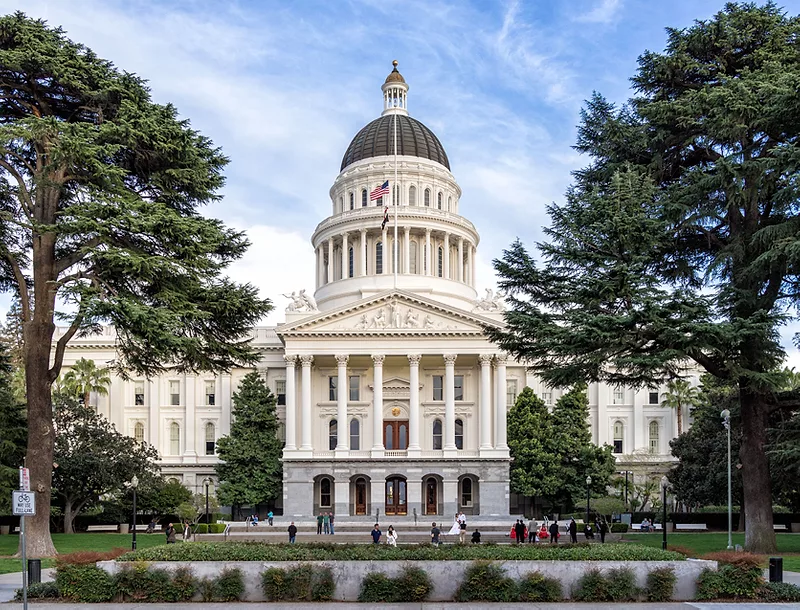
The Bureau of Reclamation announced another 5% boost for south-of-Delta water allocations, now at 40% of contracted amounts.
Westlands Water District General Manager Allison Febbo said the small increase begs the need for continued state and federal coordination to bolster California’s water supply. However, she also acknowledged the update would assure farm operations for the time being.
Also: Reclamation raised Class 1 water allocations to 100%. Friant Water Authority expressed gratitude for the increase and praised the agency for its quick reaction to hydrologic conditions.
However, Class 2 allocations — which primarily serve contractors engaging in groundwater recharge — remain at 0%.
California snowpack is slightly below average
Statewide snowpack is now at 90% of average, lagging slightly behind last year. Friday marked the final Department of Water Resources snow survey ahead of the expected April 1 peak.
“We hope to add a few more inches before the year is out,” said DWR Snow Surveys and Water Supply Forecasting Unit Manager Andy Reising. He acknowledged that Lake Oroville and Shasta reservoirs are sitting at 120% and 111%, respectively — well above their historical average.
The department will provide an additional update on April 1 following the weekend’s expected storm conditions, but staff told reporters not to expect much change.
Almond growers renew federal marketing order
Roughly 90% of the Almond Board’s voting members agreed to continue the federal marketing order for another five years.
The U.S. Department of Agriculture’s continuance referendum has been renewed every five years since 1950. It requires approval from at least two-thirds of voting growers.
Will reciprocal tariffs cover all or just ‘dirty 15’?
Welcome to another tariff deadline week in Washington. President Donald Trump says Wednesday is “the big one.” That’s when he’s expected to unveil his plan for reciprocal duties on U.S. trade partners that apply higher tariff rates than the U.S., although the messaging around the scope of the new duties has been mixed.
Treasury Secretary Scott Bessent suggested earlier this month that the initial tranche of reciprocal duties could focus on just 15 trade partners with which the U.S. has persistent trade deficits – a so-called “dirty 15.”
But Trump told reporters last week that this week’s tariff announcement would, in fact, cover every country.
It’s easy to be “in the know” about agriculture news from coast to coast! Sign up for a FREE month of Agri-Pulse news. Simply click here.
Keep in mind: Trump also expected to say whether he will increase existing tariffs on Canada and Mexico.
Also this week: The chairs of the House and Senate Ag committees will meet to discuss their plans for a budget reconciliation bill that Republicans are trying to craft.
For more on that and the president’s tariff plans, read our Washington Week Ahead.
Produce sector appeals for tariff carveouts for seasonal imports
The International Fresh Produce Association is calling on the Trump administration to exempt seasonal imports from upcoming tariffs to avert price hikes on consumers.
IFPA CEO Cathy Burns has written to senior administration officials to stress that some products cannot be grown in the U.S. In those instances, tariffs would add costs to consumers without protecting U.S. jobs.
Other produce can only be grown in the U.S. during specific times, Burns said.
“U.S. growers and suppliers rely on imports to supplement domestic production and meet year-round demand for fruits and vegetables,” Burns wrote to Commerce Secretary Howard Lutnick, Agriculture Secretary Brooke Rollins and U.S. Trade Representative Jamieson Greer.
Fresh produce group sends recommendations to MAHA panel
The International Fresh Produce Association is recommending the Make America Healthy Commission reform federal nutrition programs to promote more fruits and vegetable consumption. The group also suggests including produce prescriptions as a covered benefit under federal healthcare programs.
In a letter, the organization details seven recommendations to increase food and vegetable consumption, in line with the administration’s goal of addressing diet-related diseases. Rollins, HHS Secretary Robert F. Kennedy Jr. and FDA Commissioner Martin Makary all sit on the commission.
One of the suggested policies would financially incentivize produce through a federal tax credit for fruits and vegetables that meet dietary guideline recommendations. Additionally, IFPA suggests making produce an authorized expense under Health Savings and Flexible Savings Accounts.
IFPA also is pushing for greater nutrition labeling, expanding produce purchases through the Supplemental Nutrition Assistance Program and analyzing purchasing through federal feeding programs to ensure it aligns with healthy eating goals.
Meanwhile: Kennedy is encouraging state leaders to request SNAP waivers to limit soda purchases. On Friday, West Virginia’s governor said he planned to request this waiver, and explore additional work requirements for SNAP participants. The governor also recently signed a bill banning certain food chemicals.
Kennedy celebrated the state’s MAHA moves and said the Trump administration would grant the waivers.
Take note: The authority to grant the waivers lies with USDA. Rollins said she looks forward to receiving the request and will ensure the state has the “technical assistance and expertise to move forward.”
AFGE vows to fight executive order eliminating bargaining rights
A major federal employee union is vowing to fight an effort by President Trump to strip its members of bargaining rights.
An executive order issued last week targets over 1 million federal workers, the American Federation of Government Employees said. Among them: employees at the Bureau of Land Management, Food and Drug Administration, Food Safety and Inspection Service and Animal and Plant Health Inspection Service.
The executive order cites “national security requirements and considerations” in explaining why employees at those agencies should not have bargaining rights.
AFGE President Everett Kelley says the union is preparing “immediate legal action and will fight relentlessly to protect our rights, our members, and all working Americans from these unprecedented attacks.”
AFGE notes that federal unions cannot bargain over wages but are limited to negotiating employment conditions. Wages, benefits, and job classifications are set by law.


