
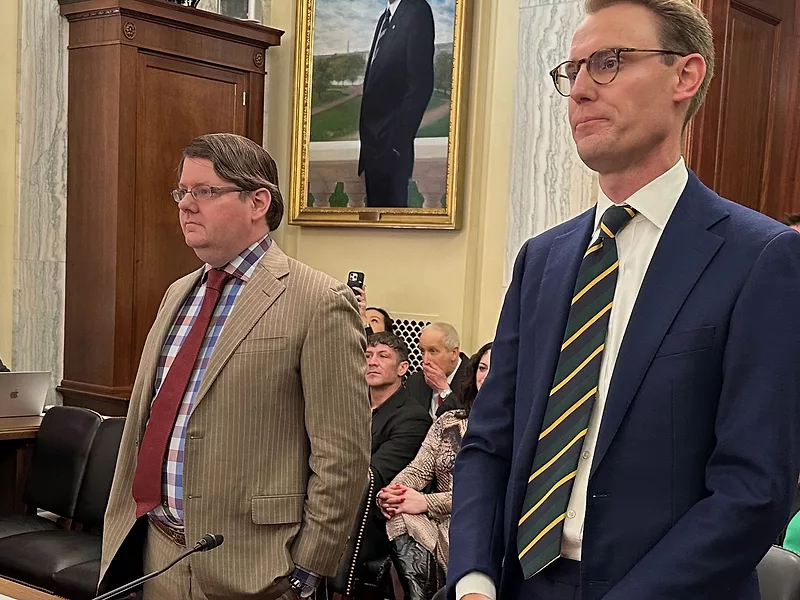
President Donald Trump’s nominee to be deputy agriculture secretary, Stephen Vaden, sought to assure senators Tuesday that USDA would be a strong advocate for ensuring that tariff negotiations seek to remove barriers to farm exports.
“If we're going to be throwing punches on behalf of America's economy, there are some punches that need to be thrown on behalf of American farmers, too,” Vaden told the Senate Agriculture Committee at his confirmation hearing.
Vaden said U.S. ag exports often face unjustified health and environmental restrictions, including on technology.
“Because while tariffs are the headline, what blocks so many American agricultural products from other countries are phony phytosanitary concerns, supposedly raising health or other welfare concerns about American products. … This is protectionism by another name,” he told Sen. Amy Klobuchar, D-Minn.
He said USDA needs to provide “a constant reminder to the president's trade team that we need to be on offense when it comes to American agriculture, because ultimately what we're going to be judged on is how many new markets we have opened up for our producers where they could not previously sell.”
After Sen. Mitch McConnell, R-Ky., joined Klobuchar in raising concerns about Trump’s reciprocal tariffs, Vaden said, “We've got to be a voice to let all the policymakers know what the policies that they are considering will do in rural America, and suggest ways that those policies can better help rural America.”
As deputy secretary, Vaden would effectively serve as the department’s chief operating officer, overseeing USDA’s day-to-day operations.
The Trump administration is preparing plans to significantly downsize the department, but there was little discussion about the issue at the hearing.
However, Vaden at one point assured the committee’s chairman, John Boozman of Arkansas, the department would keep Congress apprised of reorganization plans.
It’s easy to be “in the know” about agriculture news from coast to coast! Sign up for a FREE month of Agri-Pulse news. Simply click here.
“The United States Department of Agriculture has no independent authority separate of Congress. It's not established by the Constitution. It is a creature of statute, and so you have my word that we will be in constant communication,” he said.
Vaden, who served as USDA’s general counsel during the first Trump administration, assured Sen. Roger Marshall, R-Kan., the department would be an advocate with other agencies when it comes to regulating the use of farm chemicals, including herbicides important to no-till farming. The Environmental Protection Agency approves the use of pesticides.
“If confirmed I look forward to continuing to work with other agencies to ensure that farmers have the tools that they need,” Vaden said.
He also provided some support for increased spending on commodity programs, although that is something that will have to do through a new farm bill or through the budget reconciliation process Republicans are using to move other spending and tax priorities.
“The farm safety net needs to reflect the actual cost of production. It doesn't come anywhere close to that. Currently, I agree with you that it needs updating, and I look forward, if confirmed, to working with you on that,” Vaden told Sen. John Hoeven, R-N.D.
The committee also is considering the nomination of Tyler Clarkson to be general counsel, the department’s chief legal officer. Clarkson served as deputy general counsel during the first Trump administration.
Under questioning by Marshall, Clarkson expressed concern about the Biden administration’s use of the Commodity Credit Corporation, a revolving account that the first Trump administration used to compensate farmers for the impact of retaliatory tariffs and is preparing to use again for the same purpose. The Biden administration used the CCC to fund a variety of programs, including the $3.1 billion Partnerships for Climate-Smart Commodities initiative.
“I do think that the prior administration's use of CCC required quite a bit … of legal creativity that strained the statutory text and practice in a manner that I don't think I anticipate countenancing were I confirmed as general counsel,” he told Marshall.
Clarkson told Boozman the Supreme Court’s Loper Bright decision narrowing the authority of agencies to interpret laws meant USDA would “have to be all the more exacting in hewing to the statutory text" when writing regulations.
In the Loper Bright case, the high court last year scrapped a 1984 ruling that said courts should defer to federal agencies' "reasonable" interpretations of unclear federal laws.
For more news, go to Agri-Pulse.com.

