
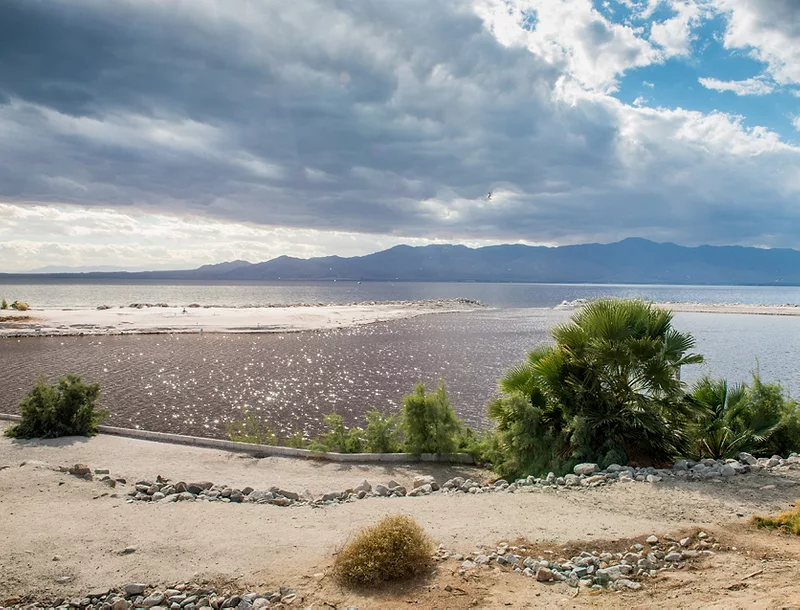
Federal, state and local agencies are trying to figure out how to use new legal authority and an influx of cash to restore the Salton Sea, which has been depleted by reductions in agricultural irrigation runoff from the Imperial Valley.
A total of $250 million in state and federal funds was dedicated to Salton Sea restoration in 2024, making it the largest single year for management funding in program history, according to the 2025 Salton Sea Management Program update.
And California state legislation signed by Gov. Gavin Newsom last year may establish long-term local authority of the restoration process, if the Salton Sea Authority’s leadership can figure out how to coexist with a separate governing body. The SSA is a joint powers authority, established in 1993, that works in tandem with partner agencies to advocate local priorities for the Salton Sea and directly oversees restoration projects.
Sitting just outside the Lower Colorado River Basin, the century-old, highly saline lake today serves as an important habitat for fish and migratory birds on the Pacific Flyway. Similar to rice fields in the Sacramento Valley, it acts as a supplement to California’s lost wetlands.
The Salton Sea was once sustained by agricultural irrigation runoff flowing down from the Imperial Valley. But a University of California, San Diego and UC Agriculture and Natural Resources study published last year in the American Journal of Agricultural Economics found that reduced agricultural flows into the lake have worsened air pollution in the area.
That stems from a quantification settlement agreement signed by the Imperial Irrigation District two decades ago in an effort to reduce California’s overreliance on the Colorado River. Farmers in Imperial County now pursue precision irrigation agreements with the San Diego County Water Authority as a result of IID’s 200,000 acre-feet per year water transfer.
The UC researchers wrote that the agreement ultimately led to increased dust pollution as the lakebed became more exposed over time. That was exacerbated again in 2012; SDCWA changed the method and amount of its water transfers, which overall left the lake with a sinking waterline and extremely saline conditions.
The study noted similar patterns in other terminal saline lakes, such as the Great Salt Lake in Utah.
Another research paper from University of Southern California last fall found that 24% of children in the seven mile radius around the lake have asthma. Nationally, average child asthma rates sit at only 8.4% for boys and 5.5% for girls.
New funding
Roughly half of the last year’s Salton Sea funding was allocated through the U.S. Bureau of Reclamation, which committed $175 million through the Inflation Reduction Act on top of another $70 million already committed to lake restoration.
It is unclear whether that will change under President Donald Trump, who has yet to appoint a Reclamation commissioner. His administration has already canceled climate-related programs across other federal departments.
"Under President Donald J. Trump’s leadership, the Department of the Interior is working to cut bureaucratic waste and ensure taxpayer dollars are spent efficiently,” a Reclamation spokesperson wrote in an email to Agri-Pulse.
The spokesperson confirmed that $35 million of Reclamation’s total Salton Sea contribution had been expensed, adding that the bureau will work with California “to fund projects as they are initiated."
Another $160 million was dedicated to Salton Sea restoration through Proposition 4, passed by California voters in November. The climate bond shored up an additional $10 million to create the Salton Sea Conservancy, which will take over long-term implementation of the restoration projects.
Salton Sea management updates are coordinated among the California Natural Resources Agency, California Department of Water Resources and California Department of Fish and Wildlife. Implemented through the Salton Sea Management Program, restoration projects were set through a 10-year plan in 2018. The program team intends to construct 30,000 acres of habitat and dust suppression projects by 2028.
Last year the program made headway on many of its planning milestones and worked closely with the U.S. Army Corps of Engineers to develop an aquatic ecosystem restoration feasibility study. USACE ultimately approved a broadened scope of the study to speed up the process “due to the substantial engineering data necessary to address the complex issues associated with the Salton Sea study area.”
The management team predicts the feasibility study will be completed by 2029 at an estimated $22.5 million.
The update also noted the 750-acre expansion of the Species Conservation Habitat Project over the last year. The team projects that federal funding will allow for an additional 4,500 acres of conserved habitat in the near future and expects new ponds “to be filled and operational” this year.
It’s easy to be “in the know” about agriculture news from coast to coast! Sign up for a FREE month of Agri-Pulse news. Simply click here.
And on Nov. 27 the program obtained federal environmental permits through the USACE that will expedite restoration projects across the 10-year-plan.
Salton Sea management
Senate Bill 583, led by Sen. Steve Padilla, D-San Diego, established the Salton Sea Conservancy and carved out space for the Salton Sea Authority president to sit on the conservancy board. But no other instructions were left for how the authorities should coexist, or whether the SSA should be dissolved altogether.
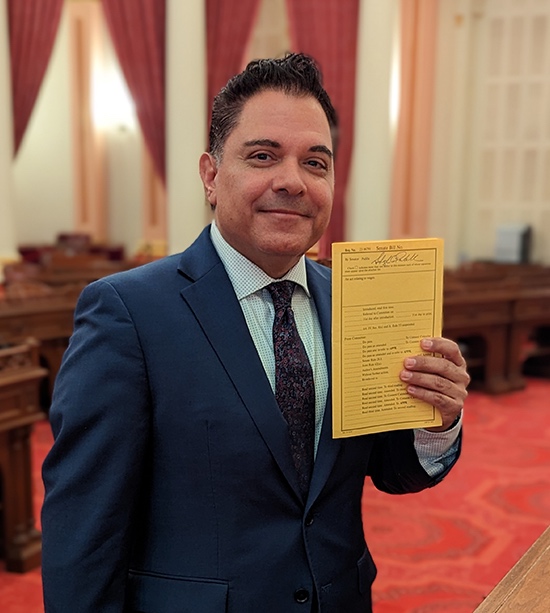 Steve Padilla (Senator photo gallery)
In signing the bill Newsom described his vision for a conservancy "led by the state, with extensive local community involvement and partnership," that will prioritize "extensive local community involvement and partnership."
During the March SSA board meeting, Executive Director G. Patrick O'Dowd assured members the authority would comprise a third of the future conservancy’s board.
He also ventured into potential uses for Proposition 4 funding, interpreting that SSA would be able to use some of those dollars for communication strategies, conducting restoration feasibility studies, creating the conservancy and “dealing with Colorado River issues.”
With O’Dowd’s recommendation, the board voted to form a task force dedicated to developing SSA’s Sacramento advocacy arm. He noted they were already receiving inquiries to weigh in on Padilla’s Salton Sea-related bill but do not yet have a mechanism to do so.
Lisa Moore, a policy advocate with Cultivating Conservation, explained her ongoing federal relationships while advocating on behalf of the SSA.
Given the Salton Sea projects are satisfied on funds through 2027, Moore said she is prioritizing relationship building with folks across federal agencies at the start of the new administration. While USACE has remained on board during the feasibility study process, Moore said she will be keeping an eye on future project implementation.
“We want to make sure that we put ourselves in the best position with the Corps to enable those projects to unfold more quickly than they might otherwise” Moore said.
She noted that under the first Trump administration, the authority was able to initiate the feasibility study as a joint local sponsor.
“There was a time when the federal government sort of believed that they didn't really have a financial responsibility for some of these things, like mitigation in the Colorado River,” Moore said. “We've turned the page on that.”
The State Water Resources Control Board is hosting a public workshop on May 21 to discuss the status of the Salton Sea Management Program. CNRA will provide an update on the 10-year plan oriented around Phase 1 and reflect on the last six years of implementation.
For more news, go to Agri-Pulse.com. For a free month of Agri-Pulse, click here.

