
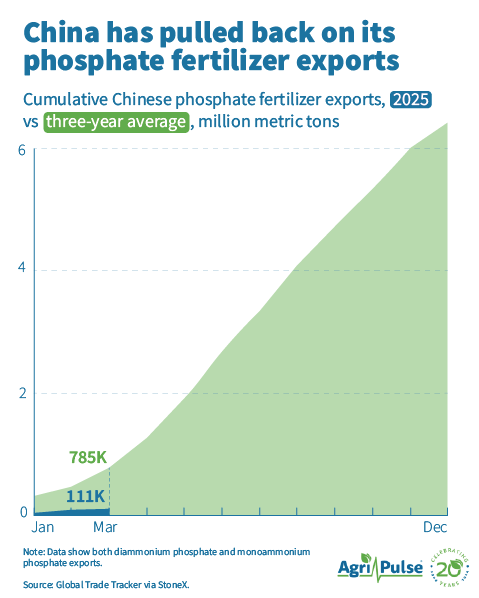
Phosphate fertilizer exports from China are severely lagging where they would normally be at this point in the year amid export restrictions and rising domestic demand for phosphate rock, prompting experts to warn that fertilizer prices will remain high.
In the first three months of 2025, China exported just 111,000 metric tons of phosphate fertilizer – a drop from the previous three-year average of 785,000. The reduction is particularly jarring considering just four years ago, between January and March 2021, China exported more than 1.5 million metric tons – more than 10 times the 2025 volume.
U.S. farmers are coming off the back of a nervy few months for fertilizer supplies. As planting season got underway, uncertainty around new U.S. tariffs on Canadian imports spurred a price hike on potash imports. A tariff exemption for U.S.-Mexico-Canada Agreement-covered products and a reduction for Canadian potash quelled some jitters, just as demand began to cool.
But analysts tell Agri-Pulse that the factors driving China’s retreat from global phosphate markets may not be so easily solved and could keep input prices high for the next couple of years.
“Someone joked with me, they're like, ‘What's the next piece of the sky that's going to fall in the fertilizers market?’” said Mark Milam, senior editor for fertilizers at Independent Commodity Intelligence Services. For farmers, he said, 2025 has meant “looking up going, ‘What's the next chunk that's going to hit me?’”
That next chunk could come from phosphate, Milam and others said. Just four countries – China, Morocco, Russia and Saudi Arabia – account for around 80% of global diammonium phosphate (DAP) and monoammonium phosphate (MAP) exports, the International Food Policy Research Institute says. China was the second largest exporter in 2023, behind Morocco, according to Observatory of Economic Complexity trade data.
Accordingly, strangled phosphate supplies from China, analysts said, will have an outsized impact on global prices.
Mining for answers
The reasons behind subdued fertilizer exports in recent months are not totally clear, said Josh Linville, vice president of fertilizers at StoneX, given China’s opaque markets and frequent government intervention. But Linville and others believe multiple factors could be at play.
Domestic demand for phosphate is climbing. China added more than 351,000 hectares to its grain-sown areas in 2024, according to its National Bureau of Statistics.
Further, a boom in the country’s electric vehicle sector is increasing demand from other industries, Linville said.
Phosphate is often used in lithium-ion batteries made for electric vehicles and other consumer electronics. The country’s automobile sector is growing rapidly; 2025 production has outpaced 2024 and 2023 numbers in every month so far, according to MarkLines, an automotive industry intelligence firm.
Amid rising domestic demand, input costs are rising sharply, leading to supply shocks, said Wendong Zhang, an assistant professor in food and ag economics at Cornell University’s College of Business. In early March, S&P Global reported that Chinese ammonium phosphate producers had halted offers to buyers in an effort to manage costs amid rising sulfur prices.
Cut through the clutter! We deliver the news you need to stay informed about farm, food and rural issues. Sign up for a FREE month of Agri-Pulse here.
When prices rise for domestic users and supply is tight, Zhang said, Beijing’s impulse is to limit exports to protect domestic industries. China has managed phosphate fertilizer exports since 2021 and has since tightened export quotas.
As a result, exports had been trending lower even before this year’s precipitous drop-off.
“China has imposed strict export restrictions to ensure adequate domestic supply and stabilize internal prices,” Zhang told Agri-Pulse in an email.
Beijing is set to make a decision on whether to extend, adjust or drop those export restrictions in the coming days. But Milam was doubtful China would opt to loosen them.
“No government officials showed up at a recent meeting in China to determine phosphate exports,” he said, leaving the industry to speculate that more stringent export restrictions, or a complete export pause, may be coming.
“We might see this continue on for not only the short term, but maybe possibly through the rest of this year,” he added.
Zhang agreed that the industry is expecting tighter export quotas for 2025, if producers are allowed to export at all.
“It seems that China is unlikely to significantly relax its phosphate export restrictions in the near term, especially with heightened geopolitical risks,” Zhang said.
Farmers to look at other options
Global DAP prices are already responding. Since December 2024, prices have climbed from $568 per metric ton to $615 in March 2025, according to the World Bank. Linville said he has observed even higher sale prices on the global market.
 Josh Linville (X photo)
Low grain prices are helping to keep prices from “skyrocketing,” as it has tempered demand, Milam said. But he said that prices could jump further if grain prices climb.
Even with prices somewhat restrained, the fertilizer-to-corn price ratio for DAP arriving through New Orleans is still the second worst in recent history for this time of the year, according to Linville, beaten only by 2008.
“2025 looks like it's going to be a rough year for farmers,” Linville said. With farmers “looking to try and squeeze every input they possibly can,” he argued phosphate may be one area farmers look at to try to reduce their input costs. Linville said that he is expecting up to 15% lower application rates this year.
Milam also pointed out that phosphate usage has held steady in recent years, suggesting farmers may be able to pivot to other fertilizer options for a season and rely on phosphate already in the ground.
But fertilizer consultant Doug Wright told Agri-Pulse much will depend on the individual grower’s application history, fertilizer management and crop performance.
“With strong crop performance, they've used more nutrients out of the field and those nutrients should be replaced,” Wright said.
Linville also pointed out that phosphate prices have been elevated since 2023, and some growers had already been drawing down phosphate levels.
“I don't think anybody has really been on the front foot trying to build their soil levels of phosphate,” Linville said. “We'll see.”
Tighter global supply could also impact manufacturers' decisions, Linville added, arguing they may “drag their feet and decide not to come out with a fill program for a little while.”
The best cure for high prices, so the adage goes, is high prices. And there are signs that phosphate producers outside of China are looking to cash in on constrained supply, Linville said.
Australia’s Northern Territory recently granted a company two mineral leases to mine one of the world’s largest undeveloped phosphate resources near Alice Springs. Norway also is working to develop its reserves and Saudi Arabia and Morocco are eyeing expanded production.
“Unfortunately, it doesn't help us today,” Linville said. Some projects, Linville added, are on new sites which could take years to develop.
“But it's kind of the light at the end of the tunnel,” Linville said. “This nightmare might come to a close after a few years if all these plants do come online.”
For more news, go to www.Agri-Pulse.com.

