
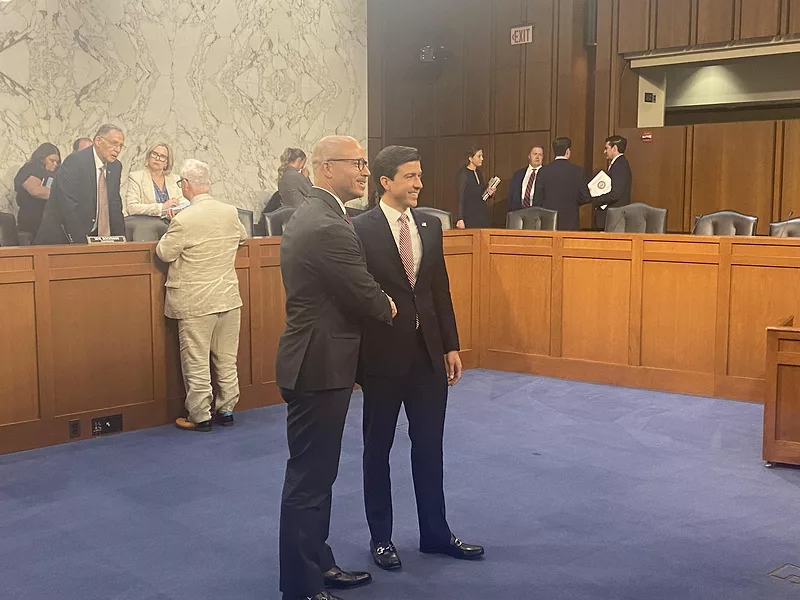
The Trump administration’s pick for the top trade position at the Agriculture Department stressed to senators on Tuesday that penning international trade deals will be key to reducing the agricultural trade deficit and spurring U.S. ag exports.
“We need to do big deals, little deals, medium deals, and all kinds of deals to make sure that we get that market access,” Luke Lindberg, Trump’s nominee for USDA undersecretary for trade and foreign agricultural affairs, told the Senate Agriculture Committee during his hearing on Tuesday. This aggressive push for dealmaking, he argued, characterizes the “America First Trade Agenda” that President Donald Trump is crafting.
Lindberg – who would join the administration from the Trump-aligned America First Policy Institute, if confirmed – outlined an approach to agricultural trade policymaking that would use the agricultural trade deficit as its lodestar, he said.
If confirmed, he said he would enter office on day one and write the number -$49 billion on a whiteboard – the projected U.S. agricultural trade deficit for the 2025 fiscal year.
Then, he said, he would invite “all of the different commodity groups from around the country to come in and have conversations with us.”
The U.S., he said, has to get back to a trade surplus.
“It’ll be a very iterative and consultive process,” Lindberg added.
Among the priority markets for new deals, Lindberg said, are India and the European Union. The U.S. should have a larger footprint in India, given its vast population and areas of opportunity. Meanwhile, the EU warrants additional scrutiny and focus because of its agricultural trade surplus with the U.S. and limited market access for certain U.S. agricultural goods.
“The basket of goods they produce is too eerily similar, and the trade deficit is too wide that we should have more market access for our producers in the European Union,” Lindberg said.
The Trump administration has already launched negotiations on a pact with Prime Minister Narendra Modi’s government; the president told reporters on Tuesday that he expects a deal.
Lindberg’s professional background drew praise from both sides of the aisle. In addition to his role at the America First Policy Institute, co-founded by Ag Secretary Brooke Rollins, Lindberg is president and CEO of South Dakota Trade, which helps South Dakota businesses navigate the international trade landscape. He also served as chief of staff at the Export-Import Bank during the first Trump administration. He was joined at the hearing by his wife, Brittany, who is Senate Majority Leader John Thune's daughter.
Cut through the clutter! We deliver the news you need to stay informed about farm, food and rural issues. Sign up for a FREE month of Agri-Pulse here.
“Your experience is really quite perfect for the job,” Democratic Sen. Peter Welch, D-Vt., said.
In his Ex-Im role, Lindberg said he worked on several key first-term Trump trade and diplomatic priorities, including trade competition with China and the Abraham Accords. His experience also fostered a working relationship with U.S. Trade Representative Jamieson Greer, who was then serving as USTR's chief of staff.
But multiple Democrats expressed concerns that even someone with Lindberg’s experience might struggle to cut deals, given the Trump administration has shown a willingness to run roughshod over previous agreements.
“Existing trade agreements are getting torn up, sometimes over issues that have nothing related to trade itself,” Sen. Tina Smith, D-Minn., said. “How do you do the hard work of making agreements in that kind of environment?”
Similarly, Welch told Lindberg that even if he is the “best negotiator possible,” the administration’s actions have made negotiating an “uphill climb.”
Lindberg, however, downplayed the challenges, pointing to agreements signed under Trump’s first term as evidence that the president has an appetite for new deals.“My faith is in the fact that we are going to get better deals for farmers, and that's what he's tasked me to do,” Lindberg insisted.
In addition to committing to dealmaking, Lindberg said that he would use U.S. engagement with international agricultural standard-setting body Codex Alimentarius to preserve market access for U.S. agricultural products.
Codex, he said, could help eliminate foreign trade barriers that are not rooted in science – including China’s ongoing trade restrictions on some U.S. poultry products in areas that are free from bird flu.
“Through that avenue, I would make sure that we set the appropriate standards that benefit our farmers and ranchers,” he said.
Lindberg's comments on Codex are particularly timely given the Trump administration is reevaluating U.S. engagement with international organizations, including the United Nations Food and Agricultural Organization, which established Codex with the World Health Organization and limits participation to WHO or FAO members.
Although Tuesday's hearing was dominated by trade issues, Devon Westhill, the president’s pick to serve as assistant secretary of agriculture for civil rights, appeared before senators at the same hearing. Westhill led USDA’s civil rights office during Trump’s first term.
“There's a long history of discrimination at USDA,” Westhill said. “If there are official or arbitrary barriers that are preventing anyone from doing business with USDA, customers, employees or otherwise, we want to make sure that those are broken down.”
Sen. Raphael Warnock, R-Ga., however, pointed out that discrimination may not have occurred too far back into history. He cited an NPR study from 2022 that found Black farmers received a disproportionately low share of direct USDA loans.
When Westhill said he was not aware of the report, Warnock said, “I want you to become aware of it.”
For more news, go to Agri-Pulse.com.

