
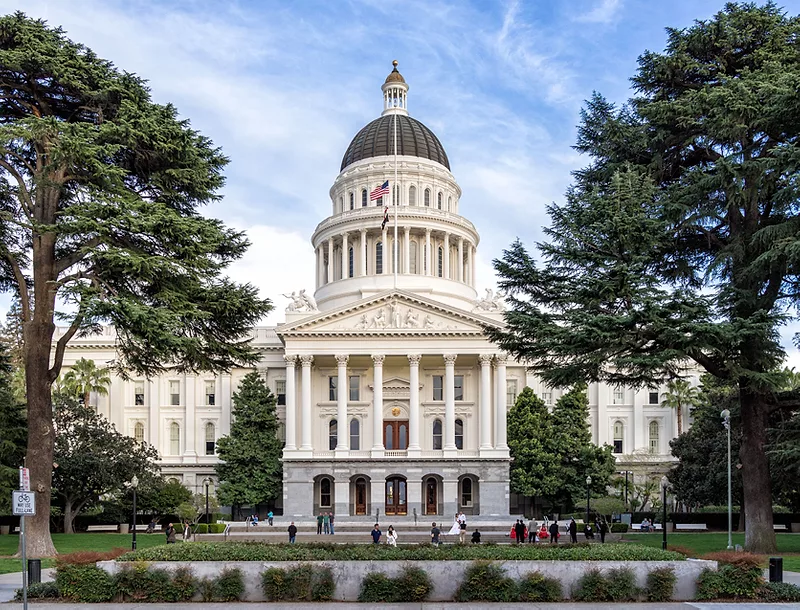
The Department of Water Resources is giving a 10% bump to State Water Project allocations, to 50% of contracted amounts. The change mirrors the Bureau of Reclamation’s 10% modification for Central Valley Project allocations on Monday and is likely the final adjustment for the year.
As California transitions to the dry season, reservoirs are sitting at 118% of normal, with the four largest nearly full. Lake Oroville is anticipated to release water to prevent overtopping the reservoir. The statewide snowpack, meanwhile, is 90% of average.
According to weather analyst Colin McCarthy, it has been a few decades since the state last saw multiple years in a row with healthy reservoir levels like this.
State Water Contractors General Manager Jennifer Pierre lamented that, despite the positive conditions, California has maintained conservative allocations each year and the Delta pumps are functioning at half capacity. Pierre called for “immediate attention and science-based action” to address the “mismatch in hydrology and supplies.”
Labor secretary gets Central Valley tour
GOP Rep. Vince Fong of California hosted Labor Secretary Lori Chavez-DeRemer in his district Monday for a tour of Central Valley businesses.
They met with the Fresno County Economic Development Corp. to discuss job growth and training strategies in the region. They also spoke with the California Resources Corp. to learn about local energy facilities and receive “an exclusive preview of upcoming projects.”
“From demand-focused job training to strengthening our energy security, the Central Valley is at the cutting edge of economic development,” the secretary said in a statement.
The visit marks another stop along Chavez-DeRemer’s "America at Work" tour.
Thompson eyes adding farm bill provisions to reconciliation, says spending cut could be 'modified'
House Ag Republicans are looking at including in the budget reconciliation bill the same commodity and crop insurance proposals that were in the committee's farm bill last year, committee Chairman Glenn Thompson told a group of agricultural journalists on Tuesday.
Cut through the clutter! We deliver the news you need to stay informed about farm, food and rural issues. Sign up for a FREE month of Agri-Pulse here.
Thompson, R-Pa., confirmed that the committee planned to debate its portion of the reconciliation bill next week.
Read our full report at Agri-Pulse.com.
USDA providing specialty crop producers $1.3B in marketing assistance
The Agriculture Department will provide specialty crop producers with up to $1.3 billion through the Commodity Credit Corporation, continuing a Biden-era program aimed at helping the industry amid cost pressures.
Ag Secretary Brooke Rollins said Tuesday the agency would provide a second round of payments under the Marketing Assistance for Specialty Crops program.
The program, launched in December, aims to "assist specialty crop growers with rising input costs and aid in the expansion of domestic markets," according to a USDA release. FSA delivered close to $900 million in payments to producers during the first round, the release said.
Read our full report at Agri-Pulse.com.
Trump ag trade pick: U.S. agriculture needs deals, deals, deals
The Trump administration’s pick for the top trade position at the Agriculture Department stressed to senators on Tuesday that penning international trade deals will be key to reducing the agricultural trade deficit and spurring U.S. ag exports.
“We need to do big deals, little deals, medium deals, and all kinds of deals to make sure that we get that market access,” Luke Lindberg, Trump’s nominee for USDA undersecretary for trade and foreign agricultural affairs, told the Senate Agriculture Committee during his hearing on Tuesday. This aggressive push for dealmaking, he argued, characterizes the “America First Trade Agenda” that President Donald Trump is crafting.
Read our full report at Agri-Pulse.com.
Could House Ag budget target be reduced?
Republicans on the House Ag Committee are planning to move their piece of the giant GOP budget reconciliation bill next week. But they’ve still got to agree on how they are going to achieve the savings they need.
Chairman Glenn “GT” Thompson, R-Pa., told members of the North American Agricultural Journalists on Tuesday that the instruction to the committee to cut $230 billion could be “modified.” He cited White House opposition to cutting SNAP benefits. Thompson also has run into opposition to the idea of requiring states to share the cost of SNAP.
“We just don't have that much in our jurisdiction, to tell you the truth, to reach that level,” Thompson said of the $230 billon target the committee was assigned.
Senate race opens door for new House Ag Democratic leader
The top Democrat on House Ag, Rep. Angie Craig of Minnesota, has officially announced her run to fill retiring Democrat Sen. Tina Smith’s seat. Smith announced in February that she would not seek re-election at the end of her term.
Others have also entered the race, including state Lt. Gov. Peggy Flanagan and former state Sen. Melisa López Franzen.
Craig was elected as the ranking member of the Ag Committee over then-ranking member David Scott, D-Ga., and longtime committee member Rep. Jim Costa, D-Calif. With Craig now running for Senate, the ranking position on the committee will reopen. Rep. Jill Tokuda, D-Hawaii, said there’s a “heavy” bench of members that could take on that role.
Bessent touts ‘strategic uncertainty’ in trade talks, lawmakers are skeptical
Treasury Secretary Scott Bessent says uncertainty surrounding U.S. tariffs is a source of leverage in trade talks with foreign officials – what he is branding “strategic uncertainty.”
“President Trump creates what I call ‘strategic uncertainty’ in the negotiations,” Bessent told reporters in a Tuesday morning briefing. “Certainty is not necessarily a good thing in negotiations.”
Bessent’s comments echo those he made on Sunday during an appearance on ABC, in which he argued keeping trading partners in the dark over U.S. tariff policy creates negotiating leverage.
But, but, but: Lawmakers don’t see it that way, and nor, it seems, do the wider public. Multiple lawmakers told Agri-Pulse that during recess conversations with constituents, tariff uncertainty was a recurring complaint.
“I don’t know what [Bessent] is talking about,” Senate Finance Committee ranking member Ron Wyden, D-Ore., said. “My constituents do not like the uncertainty and the chaos.”
Similarly, Ways and Means ranking member Richard Neal, D-Mass., said administration officials are “trying to spin their way out of the problem that they got themselves into.”
Take note: Even Texas GOP Sen. Ted Cruz said he’s been fielding complaints. He said Tuesday that “without exception” small business owners he’s been speaking to “would prefer greater certainty” on tariffs.
USDA weighs domestic facility to combat screwworm
USDA is considering opening a facility on U.S. soil to fight New World screwworm.
“In addition to continuing discussions with Mexico - a pivotal partner - USDA will work to consider a domestic facility,” a USDA spokesperson told Agri-Pulse in an email. The spokesperson added that the department looks forward “to determining next steps with Congress and the Administration.”
The U.S. has not had a screwworm case since 2016. But the parasite has reemerged in Mexico. Texas & Southwestern Cattle Raisers Association President Carl Ray Polk Jr. said Agriculture Secretary Brooke Rollins had committed to opening a facility during a closed-door meeting.
In a statement, the group said the secretary had committed to opening a U.S.-based sterile fly facility.
“The introduction of New World screwworm would devastate cattle markets, cripple supply chains and cause billions in economic losses,” Polk said following the meeting. “Protecting America’s livestock, wildlife, and food supply must be a national priority.”
Climate researchers told they can stop working on national report
The Trump administration has dismissed scientists working on a comprehensive analysis of the impacts of climate change, including on agricultural production.
Numerous news outlets reported that researchers on the National Climate Assessment, received an email saying the report is being “re-evaluated” and telling them their contributions were no longer needed.
No list of researchers was available, but USDA scientists have been key contributors to past reports. The assessment is supposed to be conducted at least every four years; the 1990 law mandating the report says it analyzes the impact on the “natural environment, agriculture, energy production and use, land and water resources, transportation, human health and welfare, human social systems, and biological diversity.”
EPA insecticide strategy garners praise from ag groups
Ag groups are praising EPA’s final strategy to guide application of insecticides in endangered species’ habitats.
The agency strategy, released Tuesday, earned plaudits from National Association of State Departments of Agriculture CEO Ted McKinney. He said EPA had made “numerous pragmatic improvements” to the draft strategy. The final document, he noted, is more easily implemented, “while also protecting threatened and endangered species.”
The Center for Biological Diversity’s environmental health director, Lori Ann Burd, said she was “heartened” to see the support from ag groups, which she called “an extremely important step forward.” But she said she wished it were stronger. “We’ll push hard for stronger protections in the upcoming decisions applying the strategy to individual chemicals,” she said.
Final word
“When we talk about immigration, it’s personal to me, as it’s personal to all of you.” — Assembly Speaker Robert Rivas, hosting a community meeting last week with United Farm Workers and two dozen advocacy groups on protecting undocumented residents from federal immigration crackdowns.


