
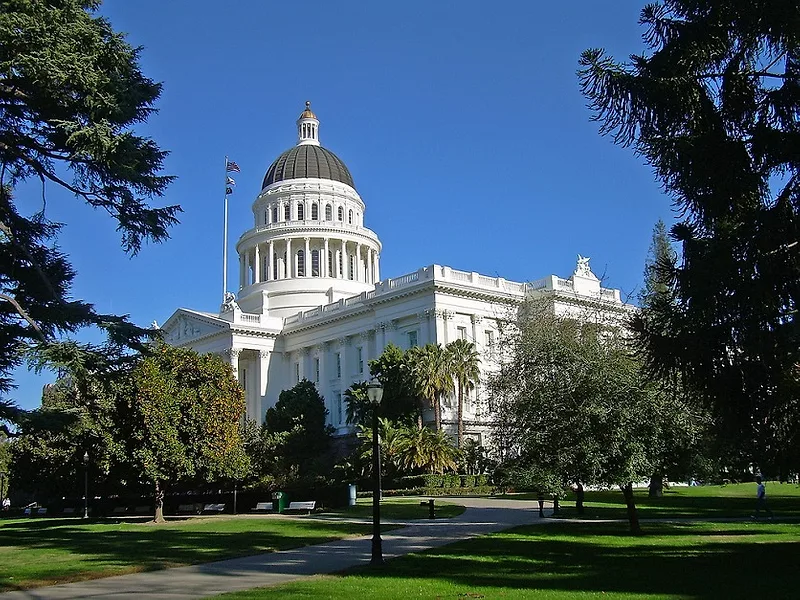
Gov. Gavin Newsom is pushing to streamline permits and expedite litigation for the Delta tunnel project.
The project is well into those processes, with the Department of Water Resources finalizing its environmental plan last year and gaining some permits already. But the administration fears the “path forward is burdened by complicated regulatory frameworks and bureaucratic delays.” The project has also been navigating legal challenges from environmental groups and Delta farmers.
At a press conference Wednesday, Newsom called his tunnel proposal “one of the most important projects in the United States of America and one of the most important climate adaptation projects in this country.”
Cheers: State Water Contractors General Manager Jennifer Pierre celebrated Newsom’s proposal, describing the review process as “hampered by red tape and frivolous delay tactics for decades.” SWC claims the proposal would save $354 million for every year of delays the state would avoid. CalChamber also shared praise for speeding up critical infrastructure projects to strengthen the economy.
But: Democrats in Delta districts have grown increasingly appalled by the tunnel project over the years. Representing the Delta Caucus, Sen. Jerry McNerney of Pleasanton blasted Newsom’s proposal as “poorly conceived.” He decried the tunnel’s $20 billion price tag and warned it would destroy 4,000 acres of farmland and lead to skyrocketing utility bills.
Asm. Rhodesia Ransom of Tracy claimed the proposal would override legal protections, violate property and water rights, and bypass public oversight. She vowed to launch an audit into DWR in partnership with Restore the Delta. The often combative environmental group piled on to the criticism as well, labeling the plan “a reckless attack on democracy” to support industrial ag and wealthy water agencies. Sportfishing groups were just as incensed.
Sound familiar? In 2023 Newsom pushed through the Legislature an infrastructure package with the same goals in mind. That sped up approvals and court reviews for the Sites Reservoir project. But Delta lawmakers convinced their colleagues to insert language barring the tunnel from the benefits.
Cut through the clutter! We deliver the news you need to stay informed about farm, food and rural issues. Sign up for a FREE month of Agri-Pulse here.
Newsom warns of trade impacts to economy
The governor rolled out the streamlining proposal as part of his revised budget plan for the coming fiscal year. He took to the podium to blame the Trump administration for tilting the state budget out of balance once again.
Unexpected revenue gains had raised the projected budget by $7 billion following Newsom’s initial plan in January. But a “Trump slump” has changed that to a $12 billion shortfall due to tariffs, market volatility and a drop in tourists to the Golden State.
The governor plans to deploy many of the same budgeting mechanisms the state tapped into during previous deficits.
But: GOP Sen. Roger Niello of Fair Oaks shifted the blame to Newsom, dubbing the deficit “Gavin’s gap” and arguing it would lead to “long-term pain for his short-term presidential gain.” Assembly Minority Leader James Gallagher railed against Newsom’s “finger pointing” as “the biggest load of crap I’ve ever seen from a politician.”
 DWR Deputy Director of Sustainable Groundwater Management Paul Gosselin and state water board Chief Deputy Director Erik Ekdahl discussed flood diversion strategies during the Association of California Water Agencies spring 2025 conference in Monterey.
 Applications open for Salinas-based agtech robotics incubator
Western Growers and The Reservoir are looking for members to join a first-in-the-nation on-farm robotics incubator. The Salinas Valley-based facility will connect WGA members with startups looking at a variety of agricultural applications.
Reservoir Farms will house accepted startup developers and provide them specialty crop fields and workshop space. The goal is to accelerate products to commercialization through a farmer informed feedback process.
The first 12 companies will ideally focus on specialty crop robotic harvesters, mobility across uneven terrain, precision soil analytics and more. WGA President and CEO Dave Puglia said the project is “putting growers in the driver’s seat” and meets “the real-world complexity of our farms.”
The initial membership cohort will be announced in August.
DWR starts Oroville mussel inspection program in defense of SWP infrastructure
The Department of Water Resources is beginning mandatory golden mussel inspections in Lake Oroville to protect State Water Project infrastructure. DWR will inspect all watercrafts entering Lake Oroville, Thermalito Forebay and Thermalito Afterbay.
The invasive species was first discovered in the Port of Stockton last October. California has since coordinated a response strategy to mitigate the mussel’s impact. The Lake Oroville Reservoir is a critical part of SWP operations, providing flood control and hydropower services and delivering water to roughly 750,000 acres of farmland annually.
Trade concerns could push U.S. ag to 1980s-style crisis, senators told
U.S. trade policies are compounding preexisting economic challenges, putting farmers on course for a crisis at a scale not seen since the 1980s, American Soybean Association President Caleb Ragland warned senators on Wednesday.
“Agriculture in general is in a difficult spot,” Kentucky-based Ragland told the Senate Finance Committee during a hearing on supply chains and trade challenges. He described several years of falling prices and rising input costs.
Read our full report at Agri-Pulse.com.
Republicans fend off attacks on SNAP cost-share, work requirements
Republicans on the House Agriculture Committee fought off Democratic attacks Wednesday on a plan to make states pay a portion of Supplemental Nutrition Assistance Program benefits for the first time in the program’s history.
The committee debated its portion of the Republicans’ budget reconciliation bill Tuesday night and all day Wednesday. It would cut about $290 billion from SNAP and use $60 billion of the savings to pay for some farm bill programs, including an increase in Price Loss Coverage reference prices and more funding for trade promotion programs.
Read our full report at Agri-Pulse.com.
House Republicans make progress on reconciliation
Democrats are making the process as painful as possible, but Republicans are pushing major pieces of their giant budget bill toward votes on the House floor.
After an all-night session, the House Ways and Means Committee approved the tax piece of the bill. It includes several valuable tax benefits for farmers and small businesses, including an increase in the Section 199A deduction for business income. Democrats used the long markup to highlight tax provisions that they say would benefit the ultrawealthy.
In the House Ag Committee, Democrats forced votes on amendments highlighting the cuts to projected nutrition assistance funding. But House Ag Chair Glenn “GT” Thompson, R-Pa., had made notable progress in winning moderates over to a state cost-share requirement for SNAP. Rep. Don Bacon, R-Neb., said his state’s cost-share is much lower than it would have been if moderates hadn’t spoken up. “I'll take that as a victory,” he said.
All Democratic amendments to the bill were ultimately defeated, and the Ag Committee approved the legislation on a party-line vote, 29-25, Wednesday night.
What’s next: The committee measures will be merged into a single bill for House floor consideration. Some major provisions, including the state cost-share for SNAP, will face Senate GOP opposition.
Dietary guidelines will be streamlined, Kennedy says
The next edition of the Dietary Guidelines for Americans will be only four pages long, Health and Human Services Secretary Robert F. Kennedy Jr. revealed to House and Senate committees Wednesday.
As he has previously, Kennedy criticized the scientific report prepared by the Dietary Guidelines Advisory Committee, describing it before the House Appropriations Committee as “incomprehensible” and “written by industry.”
The new guidelines, which he projected would be out by August, will tell people to “eat whole food. You eat the food that’s good for you.” The secretaries of USDA and HHS work together to develop the final guidelines from the scientific report.
NIOSH comes up: Kennedy conceded that some cuts at HHS have been “painful,” including those at the National Institute for Occupational Safety and Health, which lost 90% of its staff. He said he had restored staff at three sites, but none that focus on how to prevent injuries to farmers, farmworkers or firefighters.
USDA bringing back climate-related webpages
USDA expects to restore climate-related content and pages to its websites in about two weeks in response to a lawsuit by environmental and farm groups.
Early in the Trump administration, USDA began removing websites and information related to climate change. This included a summary of projects receiving funds through the Partnerships for Climate-Smart Commodities as well as Natural Resources Conservation Service sites.
Earthjustice and the Knight First Amendment Institute at Columbia University filed a lawsuit challenging the action on behalf of environmental groups and the Northeast Organic Farming Association of New York.
In a letter to the Southern District of New York Court, USDA said it has begun the process of restoring sites and expects to complete this in about two weeks.
Lawmakers and industry push for domestic screwworm facility
A bipartisan group of House and Senate lawmakers are launching an effort to open a U.S.-based facility to protect U.S. livestock from New World screwworm. The STOP Screwworms Act would allocate $300 million for the construction of a sterile fly rearing facility in an at-risk area of the country.
Senate Agriculture Committee members Sens. Ben Ray Luján, D-N.M, and Cindy Hyde-Smith, R-Miss., are among the five senators who introduced the bill Wednesday. Texas GOP Rep. Tony Gonzales is introducing the House version.
USDA has revived import restrictions on Mexico but groups representing U.S. ranchers also are pushing for a U.S. fly facility. The National Cattlemen’s Beef Association and the Texas and Southwestern Cattle Raisers Association welcomed the legislation.
Take note: Agriculture Secretary Brooke Rollins reportedly expressed enthusiasm for the idea of a U.S.-based facility in a closed-door roundtable last month with members of the Texas group.
China opens market to more Brazilian ag products
Brazilian exporters of duck and turkey meat, chicken offal, peanut meal and corn ethanol byproducts like dried distillers grains will now be able to export to the Chinese market.
During a visit by Brazilian President Luiz Inácio Lula da Silva to Beijing this week, the two governments inked multiple cooperation agreements and bilateral deals to boost agricultural trade.
These developments, plus last month’s agreement to allow Brazilian wild-caught fish exports, give Brazilian producers access to markets worth around $20 billion, the Brazilian Agriculture Ministry says.
China also lifted suspensions on five Brazilian soybean exporters ahead of Lula’s visit, Reuters reported at the time.
Take note: At the end of his five-day China trip, Lula stressed Brazil is “not concerned about competing with the United States,” insisting only that trade is a net positive for everyone.
He said he hoped that “both Brazil and the U.S. can improve the welfare and quality of life of their citizens through international trade,” according to an informal translation.
Final word
“[It] impacts my language and my speech — not my intelligence.” — Republican Sen. Megan Dahle of Bieber, who took to the Senate floor this week, likely for the first time since suffering a stroke in late 2023.
Struggling to speak clearly due to resulting aphasia, Dahle told her colleagues she has recovered from paralysis on her right side after hard work but still cannot feel her hand. She thanked her husband, former Bieber Sen. Brian Dahle, for his support along the journey and introduced a resolution honoring National Stroke Awareness Month.


