
Foreign governments tout the benefits of international trade and investment for U.S. businesses and communities as they try to get relief from President Donald Trump's sweeping new tariffs.
The Chilean ambassador to the U.S., Juan Gabriel Valdés, was recently in Grayling, Michigan, visiting a facility owned by Chilean wood producer Arauco. The nearly half-billion-dollar facility opened in 2019 and employs around 250 people, Valdés told Agri-Pulse in a phone interview.
“It has changed the life of this place,” Valdés said. “I wanted to underline it in a moment in which Chile is beginning to negotiate with the United States in matters of trade.”
Last week Valdés visited Philadelphia to commemorate the importance of the U.S. as a buyer of Chilean fruit products. A reception included members of Congress and representatives of the local chamber of commerce.
Chile and the U.S. have had a free trade agreement since 2004 that established duty-free treatment for 85% of bilateral trade in consumer and industrial products, according to the Congressional Research Service. But Trump slapped a new 10% tariff on Chilean exports April 2 – the lowest rate applied under the reciprocal tariff actions.
Valdés said Chilean officials have met with counterparts from the Office of the U.S. Trade Representative and hope to meet again soon. During that meeting, USTR Jamieson Greer and other officials raised several nontariff barriers to U.S. exports, Valdés said, but he added that as of mid-May, the U.S. had not followed up with a formal letter of intent with concrete requests.
The United States maintains a $1.7 billion surplus in goods trade with Chile, according to USTR. U.S. exports to the country have grown substantially under the FTA, from around $9 billion in 2009, a few years after the deal went into effect, to more than $18 billion in 2024, according to Commerce Department data.
Valdés said Chilean representatives are working particularly to highlight the benefits of tariff-free trade for U.S. agriculture.
“They have increased their agricultural exports by eight[fold],” Valdés told Agri-Pulse about U.S. shippers. “The treaty has worked perfectly well.”
Chile’s playbook of emphasizing the benefits to U.S. agricultural producers and consumers from mutual trade and investment has been adopted by multiple U.S. trade partners since Trump took office and began hiking duties.
At a joint press conference with Trump in the Oval Office, South Africa's President Cyril Ramaphosa highlighted that more than 20 South African companies have made investments in the U.S., "creating a number of jobs."
"Our links are really long lasting, and we would like to recalibrate those relations between our two countries," Ramaphosa said.
Last month the minister for agriculture for Canada’s province of Alberta, RJ Sigurdson, told Agri-Pulse during a trip to Washington that he has been meeting with U.S. officials to tout the benefits of a North American free trade deal for U.S. producers.
It’s easy to be “in the know” about agriculture news from coast to coast! Sign up for a FREE month of Agri-Pulse news. Simply click here.
Similarly, the European commissioner for economy and productivity, Valdis Dombrovskis, told Agri-Pulse and other reporters during a week of meetings with international economic officials in Washington last month that his message to Treasury Secretary Scott Bessent had been that the brunt of new U.S. tariffs would be felt by the American economy.
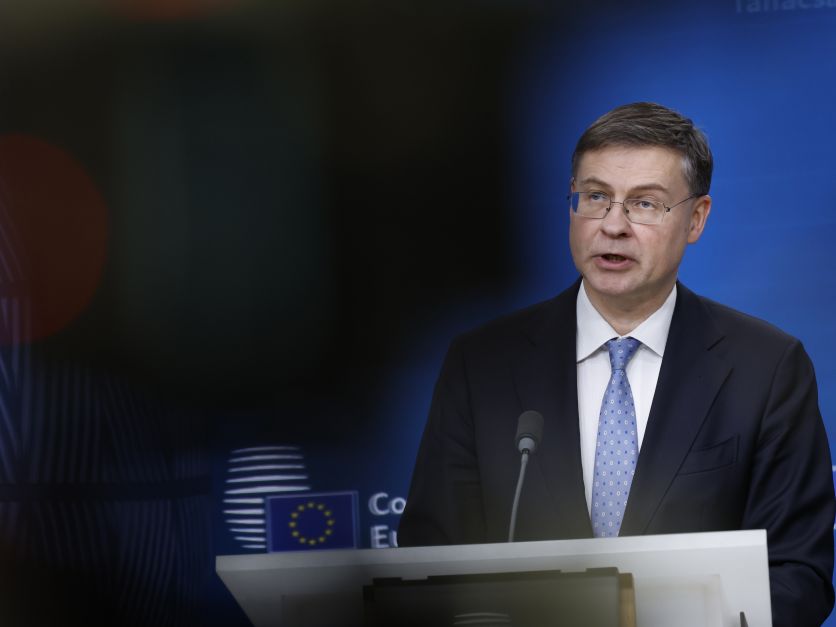 European Commissioner for Economy and Productivity, Implementation and Simplification Valdis Dombrovskis speaks during a media conference after a meeting of EU finance ministers at the European Council building in Brussels, Tuesday, Jan. 21, 2025. (AP Photo/Omar Havana) | AP
The European Union also published its “trade and investment footprint” showcasing the jobs in each U.S. state supported by trade with the bloc and EU investment figures.
Valdés said that he left the first meeting with U.S. trade officials hopeful that Chile could return to tariff-free trade. Early U.S. trade discussions with other countries, however, have failed to return to a pre-Trump landscape.
The president exempted Canadian products covered under the U.S.-Mexico-Canada Agreement from the 25% duties that went into effect March 4 but it covers only around 38% of U.S. imports from Canada, according to the Congressional Research Service. The bulk of Canadian exports is still subject to either the 25% duties or the 10% rates for Canadian energy and potash exports.
The only trade pact unveiled as part of Trump’s reciprocal tariff negotiations so far has been with the United Kingdom and that deal left the 10% baseline tariff rate intact.
But Valdés said that if his government can secure an exemption for goods covered under the U.S.-Chile FTA, it will be in a much better position than the U.K.
If Mexico and Canada can get a carveout for their USMCA-covered exports, Valdés said he doesn’t see why Chile should have different treatment.
“It would be a very important thing,” Valdés said.
One potential sticking point could be lumber. Wood products are Chile’s fourth-largest export to the U.S., according to United Nations trade data. Trump has launched a probe into the national security implications of relying on imported lumber that could result in new tariffs.
“I insist on the fact that we assume that there will be no tariffs on copper and for lumber, which is something that we still have to wait for,” Valdés said.
U.S. officials have maintained in public and private conversations that U.S. agriculture will be part of any deal the administration cuts to provide tariff relief to countries. But Valdés said he hasn't yet studied potential opportunities to expand U.S. agricultural exports to Chile.
“We would have to examine that,” Valdés said. “What we want is stability in our in our relations. And I think that this is something that Chile wants, and I am sure that the United States also desires.”
For more news, go to: Agri-Pulse.com.

