
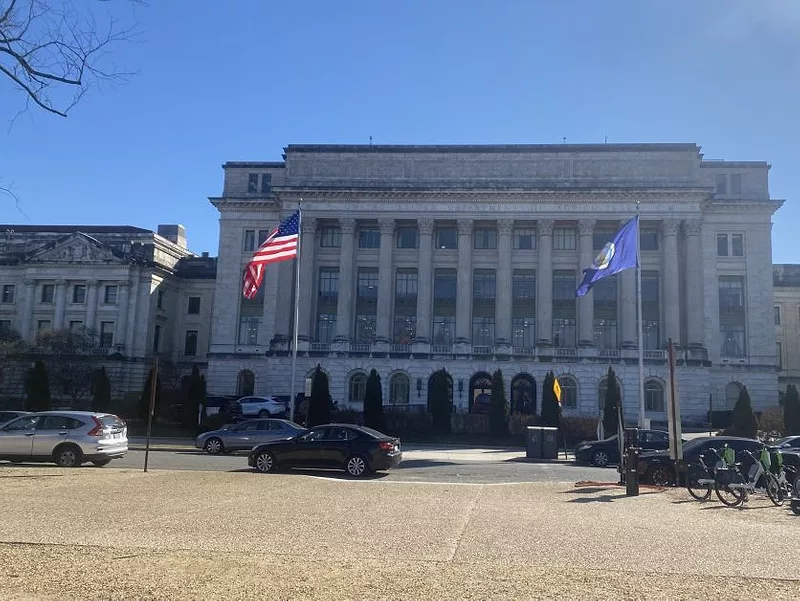
President Donald Trump and his administration cannot mandate mass layoffs at federal agencies, a federal judge ruled late Thursday, ordering the Agriculture Department and more than a dozen other federal agencies to stop planning for reorganization and RIFs.
“Agencies may not conduct large-scale reorganizations and reductions in force [RIFs] in blatant disregard of Congress’s mandates, and a President may not initiate large-scale executive branch reorganization without partnering with Congress,” U.S. District Judge Susan Illston said in an order granting a preliminary injunction sought by federal employee unions, professional societies and local governments.
Agencies affected by the order include the Agriculture, Commerce, Energy, Health and Human Services, Housing and Urban Development, Interior, Labor, State, Treasury, Transportation and Veterans Affairs departments, as well as AmeriCorps, the Environmental Protection Agency, the General Services Administration, the National Labor Relations Board, the National Science Foundation, the Small Business Administration, and the Social Security Administration.
The order stops reorganization efforts at USDA that are expected to include transferring some employees from Washington, D.C., to regional “hubs.”
“The Trump administration’s unlawful attempt to reorganize the federal government has thrown agencies into chaos, disrupting critical services provided across our nation,” the coalition of plaintiffs said in a statement issued Thursday. “Each of us represents communities deeply invested in the efficiency of the federal government – laying off federal employees en masse and reorganizing government functions haphazardly does not achieve that. We are gratified by the court’s decision today to pause these harmful actions while our case proceeds.”
Plaintiffs in the case include the American Federation of Government Employees (AFGE), the American Federation of State, County and Municipal Employees (AFSCME), and the Service Employees International Union (SEIU). Eleven other groups — including the Northeast Organic Farming Association, the American Geophysical Union and the Western Watersheds Project — have joined as co-plaintiffs.
At issue in the litigation, which will continue, are an executive order and a Feb. 26 memo from the Office of Management and Budget and Office of Personnel Management directing agency heads to submit their RIF and reorganization plans to OMB and OPM for review and approval.
It’s easy to be “in the know” about agriculture news from coast to coast! Sign up for a FREE month of Agri-Pulse news. Simply click here.
The federal defendants in the case “cite a host of statutes and regulations that they assert provides OPM with the authority to issue the OMB/OPM Memo,” Illston wrote. “Upon review of the laws cited, the court finds that none support the authority that OPM now claims.”
Referring to the Elon Musk-led Department of Government Efficiency, Illston said “no law gives OPM, OMB, or DOGE the authority to direct other federal agencies to engage in large-scale terminations, restructuring, or elimination of that agency itself. Such action far exceeds the bounds of any authority that Congress vested in OPM or OMB, and, as noted, DOGE has no statutory authority whatsoever.”
“[T]he executive branch … cannot reorganize at this scale without authority from Congress,” the judge’s order said. “What plaintiffs allege — and what defendants have so far failed to refute — is that Executive Order 14210 and the OMB/OPM/DOGE actions to implement it reach so broadly as to exceed what the President can do without Congress.”
Illston’s injunction could be short-lived. The government has submitted an emergency petition to the Supreme Court seeking to overturn a temporary restraining order she issued May 9. That petition is pending.
In her order, Illston said federal agencies would likely be unable to perform the functions assigned to them by laws passed by Congress.
“In some cases, as plaintiffs’ evidence shows, agency changes intentionally or negligently flout the tasks Congress has assigned them,” she said. “After dramatic staff reductions, these agencies will not be able to do what Congress has directed them to do.”
One example concerns the Farm Service Agency, which Illston noted “provides specialized, low-interest loans to small farmers not available from the private sector.”
“After unprecedented flooding in 2024, one Vermont farmer asked [FSA] for disaster assistance to plant a new crop, but the agency first had to inspect the fields,” she wrote. “Due to low staffing levels, the farmer had to wait three to four weeks for an inspection and consequently missed the planting window that season. The department now reportedly intends to further reduce staff at the agency. Other farmers have reported their contacts at the department have been laid off and the remaining staff are not familiar with their farms or their projects.”
“[T]he scale of workforce terminations raise[s] significant questions about some agencies’ or sub-agencies’ capacities to fulfill their statutory missions,” Illston’s order said.
“For example, it appears the Department of Health and Human Services is planning to practically wipe out the National Institute for Occupational Safety and Health, an office established by Congress,” she wrote, citing evidence showing that 93% of NIOSH employees have received RIF notices.
NIOSH works with industry to enhance safety in occupations including mining, forestry and fishing, and agriculture, among others.
For more news, go to Agri-Pulse.com

