
As U.S. negotiators emerged from meetings with their Chinese counterparts in Geneva last month touting a deal that would roll back some of the tit-for-tat tariffs imposed since President Donald Trump took office, Brazil’s President Luiz Ignacio Lula da Silva was headed to Beijing to promote potential deeper agricultural trade ties with China amid heightened U.S trade tensions.
“Our relationship with China will be indestructible,” Lula declared at a business forum in Beijing during the five-day trip.
Brazil and China have signed more than 50 trade and investment pacts since the U.S. election in November, when Trump promised to raise duties on imports from China. The deals cover a range of industries spanning agriculture, mining, infrastructure and energy. But one agreement on sorghum has U.S. grain exporters worried.
“We're seeing farmers in Brazil start to plant sorghum for the first time ever,” an industry source told Agri-Pulse. Brazil’s share of the Chinese sorghum market, they say, “is going to get bigger.”
Xi paved the way for Brazilian sorghum shipments in November when the two sides agreed on a protocol for imports – a move that analysts argued at the time was motivated at least in part by the advent of Trump’s presidency and the prospect of renewed trade tensions.
Brazil’s Luis Rua, who handles trade for its agriculture ministry, also signaled that officials are committed to boosting Brazilian sorghum exports to China in comments to Reuters ahead of Lula’s Beijing visit.
The U.S. accounted for more than half of China’s sorghum imports last year, according to the Observatory of Economic Complexity. Chinese buyers use sorghum for animal feed and for the popular baijiu liquor. But purchases from the U.S. have been drying up in 2025, due in large part to higher tariffs and heightened trade uncertainty.
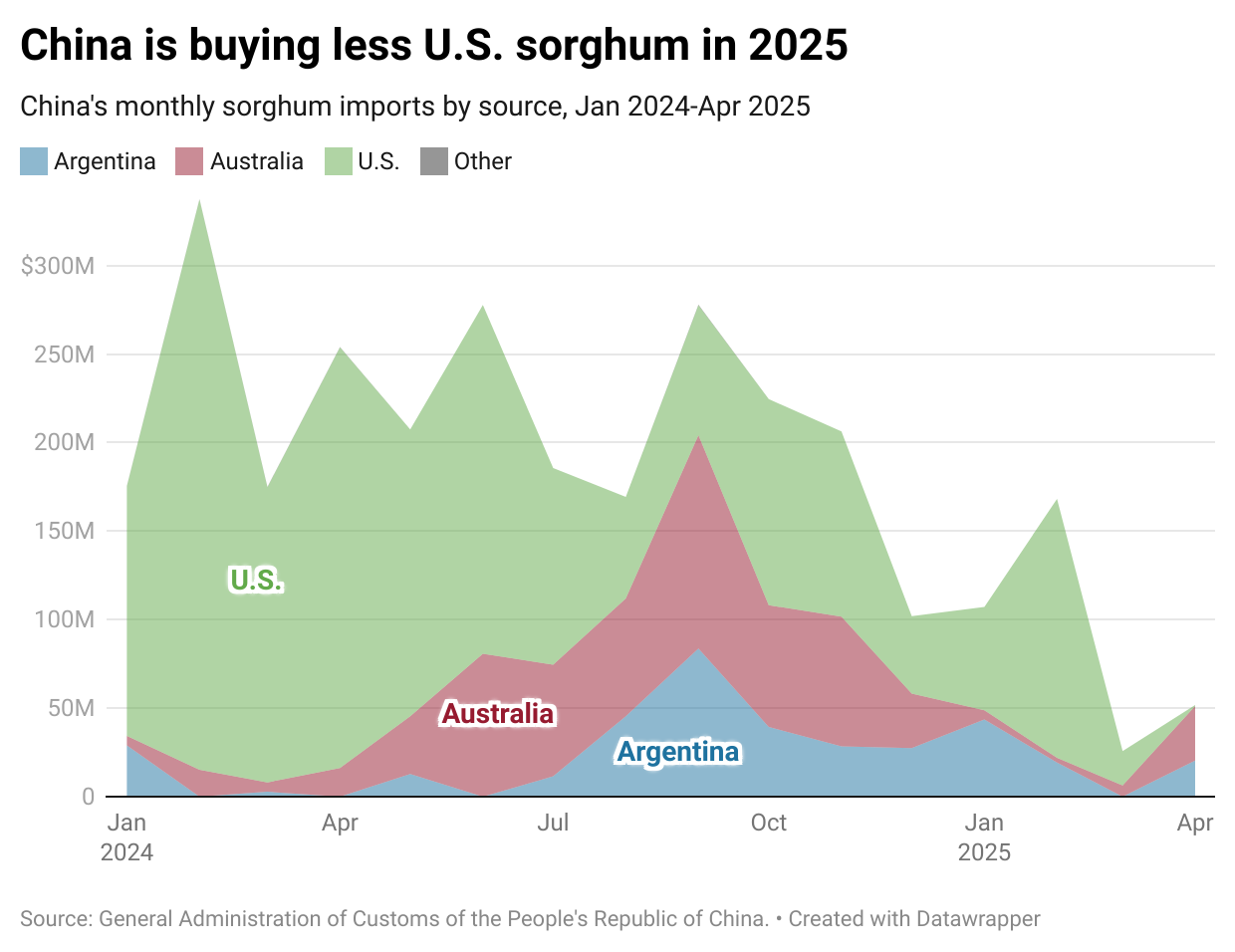
Multiple analysts told Agri-Pulse in interviews that U.S. industry is right to be concerned about preserving its market share. They argued that Brazil is likely to gain a foothold in China once exports begin – at the expense of U.S. exports. The remaining questions, they said, are when will exports start in earnest and how quickly will they scale up?
China has “been working on, of course, trying to diversify away from the U.S.,” Fred Gale, a former USDA economist said. The Brazil agreement, he added, is the latest effort to develop a reliable alternative source of sorghum.
Overlooked no more
Sorghum production in Brazil had been increasing before China signaled it would open its market for imports. In the 2020-2021 crop, Brazilian producers grew around 2 million tons, according to StoneX. This year, the crop is expected to reach around 5.5 million tons – more than half of what the U.S. will produce, according to USDA estimates.
The bulk of Brazilian sorghum has been destined for domestic biofuel and animal feed, with less than 200,000 tons exported.
“Until now, we didn’t have [international] buyers for this production,” Raphael Bulascoschi, a market analyst at StoneX Brazil, told Agri-Pulse.
There are plenty of reasons for Brazilian farmers to increase sorghum planting if Chinese buyers are available. Sorghum requires lower volumes of water to grow than many other crops, Bulascoschi said, making it an attractive second or third crop in Brazil’s central regions.
Carlos Cogo, a Brazilian agribusiness consultant, told Agri-Pulse that Brazil has around 48 million hectares of soybeans planted for 2025-2026, but only 18 million hectares of second-crop corn.
It’s easy to be “in the know” about what’s happening in Washington, D.C. Sign up for a FREE month of Agri-Pulse news! Simply click here
“There are 30 million hectares available for immediate use in second and third crops in Brazil,” Cogo said. “Part of that area could be occupied with sorghum.”
Sorghum is already benefitting from the Brazilian government’s push to increase biofuel production, Cogo added. The uptick in corn’s use as a feedstock has driven prices higher, sparking a search for alternatives.
Demand for sorghum, Cogo said, “should continue to grow – not only as a substitute for corn in animal nutrition but also as a strategic input for the biofuels sector.”
Even with domestic demand rising, both Bulascoschi and Cogo expect Brazil to produce sufficient quantities of sorghum to scale up their exports. The crop’s short lifecycle could mean Brazilian products begin entering the Chinese market as soon as this year, Bulascoschi said.
“The first deals should be made around September, October, maybe November” and export volumes could increase annually thereafter, Bulascoschi predicted.
China’s 2025 sorghum purchases have lagged previous years, and users are likely drawing down stocks, Bulascoschi said. Accordingly, Chinese buyers could come to the market eager to replenish sorghum reserves, creating opportunity for Brazilian suppliers to forge business ties.
Unlike other commodities, sorghum is not subject to a tariff-rate quota in China, Gale pointed out, allowing the private sector access to as much imported sorghum as demand can support.
 Fred Gale (LinkedIn Photo)
If these deals materialize in coming months, the U.S. industry source said, it could be an immediate blow to U.S. exporters.
“That's exactly when we would be exporting to China out of the U.S.,” they said. “That would immediately hit the farmer.”
Trade barriers on both sides remain
Other analysts and industry representatives were skeptical that U.S. farmers would feel the pinch this year or in the near future. Before Brazilian producers can begin exporting to China, they need to secure export licenses and register with Chinese customs. But agents have not yet been dispatched to Brazil to inspect facilities.
“There is still a significant bureaucratic process and exporter approval procedures that must be completed,” Wallas Ferreira, an agronomist at the Brazilian National Association of Grain Exporters (ANEC), told Agri-Pulse via email.
Implementing the phytosanitary protocol that China and Brazil agreed to in November could also prove challenging for Brazilian producers, Cogo said. Beijing will require sorghum imports be free of live insects and 11 named pests. Some pests listed are the same as those prohibited in corn imports. But one – sorghum halepense, or Johnson grass – could pose an issue.
Johnson grass is common in Brazilian fields. Corn exporters remove the pest using sieves, but since sorghum seeds are smaller than corn, existing equipment may need to be adapted or replaced to ensure sorghum is prepared for export, Cogo said.
Ferreira and others also doubted whether Brazilian production growth would outpace rising demand in the domestic biofuel industry and deliver a surplus for export.
“[S]orghum acreage is most certainly going to continue increasing in Brazil, but for the time being most of the sorghum they produce will be sent to ethanol plants and livestock feeders, which will pull bushels away from exports,” said Tanner Ehmke, lead economist for grains and oilseeds at CoBank.
For its part, USDA is projecting Brazilian sorghum exports to shrink in 2025-2026, from 175,000 tons last year to 75,000 tons. But Ferreira pointed out that detailed data on Brazilian sorghum planting, domestic ethanol demand and the size of any future surplus for export is scant.
Tim Lust, CEO at the National Sorghum Producers, told Agri-Pulse he would also be surprised if Brazilian producers could significantly improve their export volumes this year. But Lust added that sorghum producers are taking the Brazil threat seriously after having seen Chinese buyers of other commodities pivot to Brazil during the trade turmoil under Trump’s first presidency.
“Long term, certainly, as we have seen with other commodities, it means we have a potential competitor,” Lust said.
For more news, go to www.Agri-Pulse.com

