
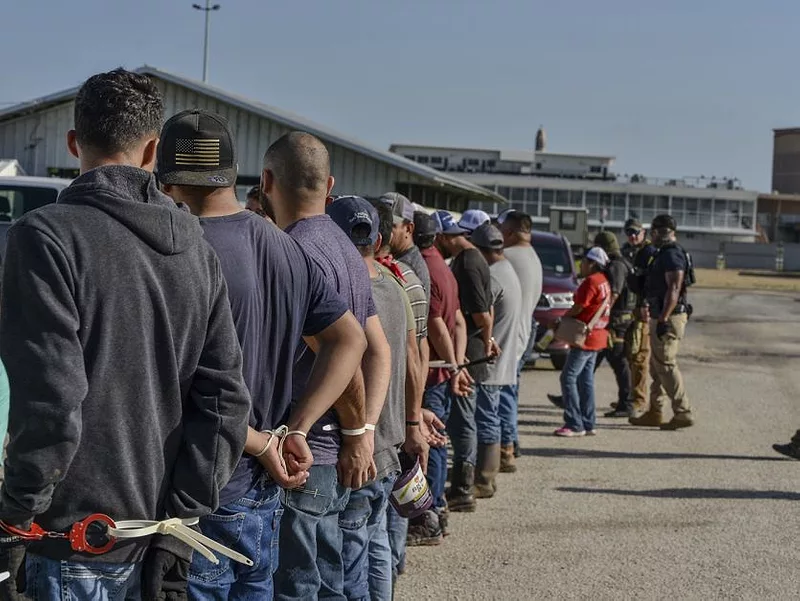
Recent raids and inspections at agricultural operations have producers — and their employees – calling anew for a long-term, legislative solution to the farm workforce problem.
Ag groups also are pushing for lawmakers and the Labor Department to address the ever-increasing adverse effect wage rate that applies to the H-2A program.
The primary legislative vehicle farm organizations like is the Farm Workforce Modernization Act, a bill that was passed by the House in 2019 and 2021 but never got a vote in the Senate. It has been reintroduced by Rep. Zoe Lofgren, D-Calif., with co-sponsors Dan Newhouse, R-Wash., Mike Simpson, R-Idaho, Adam Gray, D-Calif, Jim Costa, D-Calif. and David Valadao, R-Calif.
The bill would freeze AEWR wages for a year, provide a fix to H-2A long sought by the dairy industry by making 60,000 H-2A visas available year-round, and provide a path to legal status for ag workers. The bill is backed by many groups, including United Farm Workers and Western Growers.
Referring to the apparent pullback by the Trump administration on raids of ag operations, Idaho Dairymen’s Association CEO Rick Naerebout said that ag groups need to use the “temporary reprieve” to urge Congress “to do something to provide us a permanent fix. They're the only ones that have that authority.”
 Rick Naerebout (Idaho Dairymen's Association)
Congress is currently occupied almost exclusively with the One Big Beautiful Bill Act, which faces multiple challenges in the Senate after narrowly passing the House. Republicans, Naerebout said, need to be able to go back to their constituents “and say that they've addressed border security.”
Passage would give Congress time to have “robust discussions around immigration reforms,” he said.
The Meat Institute is another group eager for year-round help. In a news release, the institute noted that a House Agriculture Committee task force last year found a need “for dairy producers, meat processors, sugar processors, forestry, ranchers, and others to have access to a steady and legal workforce.”
Ron Estrada, CEO of Farmworker Justice, also sees the FWMA as a potential solution. “I think all parties involved, including the Farm Bureau and the growers and even farmworker groups, are definitely open to working together to have some type of bill which would be a permanent solution,” he told Agri-Pulse.
Groups across the political spectrum “have aligned on labor reform,” he said, providing an opportunity to find common ground, even if the end product is not what every group finds perfect.
It’s easy to be “in the know” about what’s happening in Washington, D.C. Sign up for a FREE month of Agri-Pulse news! Simply click here
But just because a bill has passed one chamber or the other in the past, that’s no guarantee of success next time. In this Congress, the partisan divide is perhaps as wide as it’s ever been.
“Really what we need is Congress to legislate,” said Michael Marsh, president and CEO of the National Council of Agricultural Employers, while noting that NCAE has not signed on to the latest version of FWMA, which is largely the same as what passed the House in 2021.
Marsh’s group has been actively challenging administrative changes to H-2A made by the Biden administration’s Labor Department. The department, reacting to injunctions that had halted implementation of its Farmworker Protection Rule, suspended that rule last week. NCAE also has asked the department to consider settling litigation over other rule changes.
Labor reform legislation could address the issue underlying recent inspections and raids by Immigration and Customs Enforcement: the fact that agriculture relies so heavily on undocumented workers.
 Ron Estrada (Farmworker Justice)
The Economic Research Service reported last year that from 2020-2022, about 42% of farmworkers “held no work authorization.”
Some of those workers have been caught up in recent ICE enforcement actions, which have included a raid of a New Mexico dairy that forced it to find temporary help quickly when more than half its workforce was detained. Other actions have taken place at a meat processing plant in Nebraska, a dairy farm in New York and multiple farms in Ventura County, California, although in those instances, ICE agents were turned away because they did not have warrants.
Lisa Tate, who grows avocados and citrus in Ventura County, said the failed arrests have nonetheless had real impacts in her area.
“The trust is broken and it’s so hard to rebuild,” she said. “It not only affects the number of people who are here to work, but also the productivity and general safety of our workers, regardless of their immigration status.”
And not having people available to work can be devastating for producers who need workers to conduct harvests in short time windows, Tate says.
“My hope would be that this would help everybody focus on the reality that we need a long-term immigration policy that really works, to help us get the farm labor that we need and keep them here for a long time,” she said.
In some cases, detaining workers can have a negative impact on animal health. That was the case in Louisiana recently when more than 80 were detained at Delta Downs horse track.
Eric Hamelback, CEO of the National Horsemen's Benevolent and Protective Association, said two workers were targeted for criminal activity, but that he has used his time since the ICE action “educating Congress on what just happened from an equine health and welfare situation.”
Hamelback said several racetrack operators have “happily complied with ICE agents. If they come to the backside, they tell us the individuals they need. We take them right to them and get them off the track. We're just as happy for criminals to be removed as anyone else.”
However, “blurring the line between immigration law and criminal law is what happened here, to the point of detaining these individuals and then creating this crisis in equine welfare,” he said.
Horses were put in danger when let loose after their handlers were detained, Hamelback said.
Horses are “not intended to be standing out in Louisiana heat for two hours,” which occurred when “there were no attendants, no grooms to help take care of the horses,” he said.
“The consequences are a little bit more dire when you're dealing with livestock,” Hamelback said, citing the example of a dairy farm where cows need to be milked regularly.
For more news, go to Agri-Pulse.com.

