
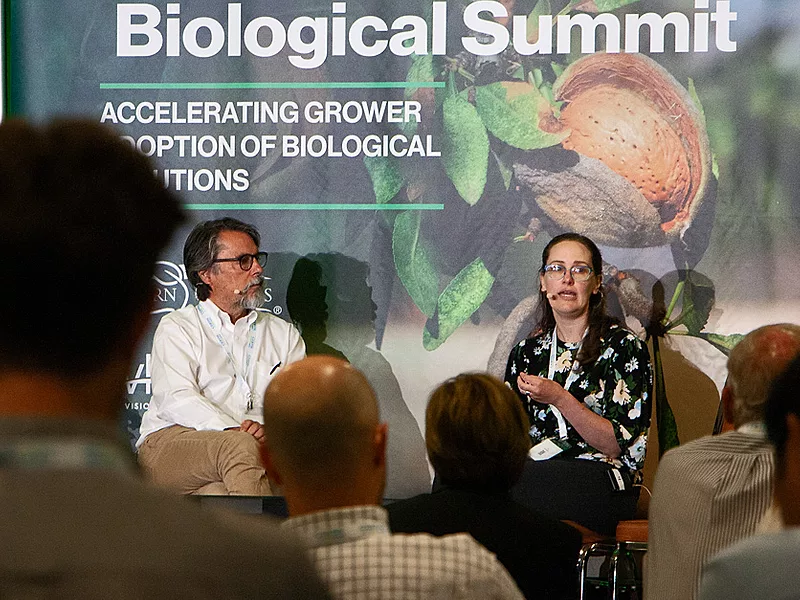
The 2025 Biological Summit in Woodland, Calif., last week took a deep dive into the rapidly evolving world of alternative pest control solutions, with key regulators and industry leaders signaling a transformative moment for sustainable crop protection.
California Department of Food and Agriculture Secretary Karen Ross set the stage for the event by emphasizing the critical importance of collaboration.
“We cannot do this alone,” she stated. “There's not one thing that we can do alone in California. We have a lot of the resources and the natural assets to make it happen. It will only happen with partnerships.”
Ross highlighted the state’s unique agricultural landscape, describing Yolo County — which also hosted the FIRA USA robotics conference last October — as “a microcosm of all that's great about California agriculture.” She praised the region's diversity of crops and innovative spirit, noting its proximity to the University of California, Davis, which she emphasized has the top agriculture college in the country.
 Pam Marrone, Invasive Species Corp. (photo: Brad Hooker/ Agri-Pulse)
The regulatory challenges facing biological products took center stage throughout the summit. In a panel discussion following Ross, Shannon Borges, deputy director of biopesticides and pollution prevention in the U.S. Environmental Protection Agency Office of Pesticide Programs, candidly addressed the agency's most pressing concerns.
“Making sure that we have enough people to do the work is first and foremost,” she explained, outlining her division’s top priorities. “And any other types of initiatives that would help provide clarification or deregulate where it would be necessary, such as biostimulants.”
Borges emphasized the need to support her team and maintain their ability to process new agricultural innovations.
Technology frontiers and market dynamics
Pam Marrone, co-founder and executive chair of the Invasive Species Corp., provided a comprehensive overview of the biological products market.
“In my experience, biologicals really have had to stand on their own, and we’re not dependent so much on external factors,” said Marrone, describing an industry experiencing significant growth and transformation. “There's still double-digit growth of the sector, and it's getting pretty big.”
Marrone was enthusiastic about new discovery methods, observing that “what is old is new again” in biological product development. She shared insights into cutting-edge approaches, including the use of AI and machine learning in microbial discovery.
It’s easy to be “in the know” about what’s happening in Washington, D.C. Sign up for a FREE month of Agri-Pulse news! Simply click here
“We're using [AI machine] learning for genomics-led microbial discovery," she explained, demonstrating how technology is accelerating innovation in the field.
Grower adoption remained a critical consideration at the summit. Marrone stressed that biologicals must consistently demonstrate value.
“We haven't been dependent so much on external factors," she explained. "Instead, we must show the value of the products to growers over time.”
International consumer demand
Global and national perspectives added depth to the discussion, as demonstrated with Roma Gwynn, director and founder of Biorationale Limited, a 25-year-old U.K.-based biopesticide strategy company with products in Africa, Australasia, the European Union (EU) and the U.S. She noted the EU’s biopesticides efforts in the European Parliament through the European Green Deal’s 50% reduction in chemical pesticides. After that was withdrawn, a new parliament has sought to accelerate new biocontrol products.
“But it's not just Europe,” said Gwynn, noting that promoting pesticide reduction has been a priority for the United Nation’s Food and Agriculture Organization and its Environment Programme.
Regulatory complexity emerged as a significant hurdle. Jill LeVake, state government and industry affairs western region director at Corteva Agriscience, called for more streamlined approaches to product registration and approval.
In a separate fireside chat, Karen Morrison, director of the California Department of Pesticide Regulation, outlined the state's ambitious Sustainable Pest Management Roadmap. The roadmap focuses on reducing synthetic pesticide use while promoting innovative biological solutions, among other alternatives.
“I’m thrilled to be here today to reflect on major investments from last year’s budget for sustainable pest management,” said Morrison. “This is the single largest investment we’ve seen within the government ever, with close to a 30% increase in our staffing and resources over the course of three years.”
The environmental effects of biological products were also lauded at the conference. Ross highlighted California's commitment to climate-smart agricultural practices, noting that the sector has reduced its greenhouse gas emissions by nearly 30 million metric tons of carbon dioxide.
Looking to the future, the summit participants expressed cautious optimism. Marrone suggested biopesticides have "moved up the slope of enlightenment and we're past the trough of disillusionment.”
The conversations reflected a growing consensus about the potential of biological solutions. As Ross noted, the goal is not to eliminate traditional agricultural approaches, but to create more sustainable, innovative solutions that work for farmers, consumers and the environment.
For more news, go to Agri-Pulse.com.

