
The European Union has responded to U.S. tariffs by doubling down on free trade. The bloc has launched new free trade agreement negotiations with two countries and accelerated preexisting talks, bringing with it new opportunities to shape global agricultural trade in its image.
In 2025 so far, the European Commission, the bloc’s executive body, has concluded long-running negotiations on a free trade agreement with South America’s Mercosur nations, advanced discussions with India, and begun new talks with the United Arab Emirates and Malaysia. These developments come on top of existing negotiations with Indonesia, Thailand, Australia and the Philippines.
In public responses to President Donald Trump’s new tariffs, European officials have reiterated the bloc’s commitments to free trade and the global trading system and warned of impending economic harm that could spill well beyond U.S. borders.
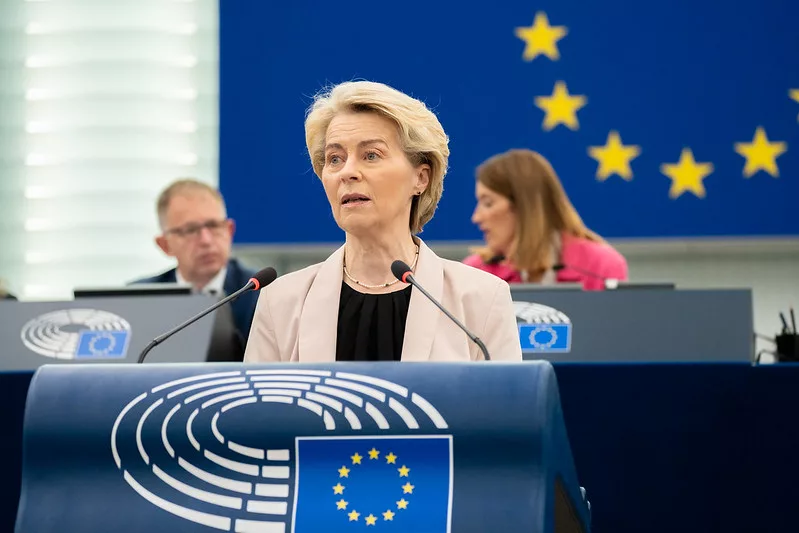
Commission President Ursula von der Leyen said last month that Europe wants to “show to the world that free trade with a large number of countries is possible on a rules-based foundation.”
A senior commission official again took aim at the U.S. tariffs in comments to Agri-Pulse and other reporters in Brussels last week, calling the tariffs “economic madness.”
“We don't believe it helps the U.S. economy. We don't believe it helps the EU economy. We don't believe it helps wider global supply chains or the overall global economy,” the official said.
But behind closed doors at negotiating tables across the world, the tariffs have introduced a new impetus that has reinvigorated trade talks and helped drive discussions, according to former EU chief agricultural negotiator John Clarke.
“The EU has decided to try to speed up its various FTAs,” Clarke told Agri-Pulse. To break deadlocks and accelerate progress, the bloc has dropped some of its pricklier demands in ongoing negotiations to catalyze talks, Clarke added.
For the EU, the benefits of swiftly securing new FTAs are twofold. The EU wants to reduce its reliance on the U.S., Clarke said. The U.S. remains the EU’s largest export market, but the bloc feels Trump has shown the country to be an unreliable trading partner. Bolstering trade ties with third-party countries will help the EU diversify its export markets, Clarke noted.
Advancing a slate of trade talks with third-party countries has also sent an important message to U.S. officials during high-stakes EU-U.S. trade discussions in recent months, Clarke said.
 John Clarke (LinkedIn photo)
It gives “a political signal to the U.S. that ‘we have different fish to fry and we're playing in different places.'”
This message is also being carried outside of traditional FTA negotiations. The EU and China are working towards a joint summit later this month, although hopes that the two countries will make meaningful progress on a litany of bilateral trade issues are slim.
It isn’t just the EU that is responding to the Trump administration’s trade policies by seeking to deepen trade relations with larger, more predictable economies. In some cases, EU negotiators are dealing with eager partners with similar appetites for swift dealmaking.
“Other countries probably have the same logic… ‘We can't rely on the U.S. market in the same way as we thought we could. The EU is a much more reliable, stable market, and so, we should make an extra effort,’” Clarke said. Australia and India in particular, he said, could fall into this line of thinking.
A whole EU world
The EU remains an important export market for U.S. agricultural producers. European buyers shelled out a record-high $12.8 billion on U.S. ag exports in 2024, according to USDA data, cementing the bloc’s position as the fourth-largest U.S. export market.
Interested in more news on farm programs, trade and rural issues? Sign up for a four-week free trial to Agri-Pulse. You’ll receive our content - absolutely free - during the trial period.
Accordingly, any effort from the European Commission to reduce the bloc’s reliance on the U.S. and diversify import sources could have ramifications for U.S. ag – particularly tree nut, soybean and distilled spirits producers, which top the list of U.S. ag exports. But the EU’s drive to ink new trade deals could also have impacts for U.S. exports to the third-party countries involved in EU dealmaking.
The EU uses FTAs to secure protections for iconic food products. Its previous deals have often included language restricting the use of specific food terms to products from a certain European geographical area – known as geographical indications. In many markets with an EU FTA, terms like feta, Gorgonzola, Champagne and port are limited to products from those specific European regions. These geographically protected products can cover as much as 15% of EU food exports.
Importantly, these protections also apply to imported products. U.S. exporters selling into third countries with EU FTAs cannot use those terms to describe products originating from outside the specific European regions mentioned.
And the EU’s agriculture industry has every reason to believe that the protections will expand with each new negotiation.
“In every deal that will be closed, this will be a part,” Laurens van Delft, deputy secretary general of the European Dairy Association, told Agri-Pulse. Van Delft said that EU officials consider the issue to be such a priority that they are willing to accept concessions in other trade areas to ensure the protections end up in a final deal.
Alice O'Donovan, secretary general at the European Liaison Committee for the Agricultural and Agri-food Trade, said geographical indications are “one of the ways of driving added value for European agrifood. There's every likelihood that geographical indications will be built into these trade deals.”
U.S. countertalks?
The U.S. has previously put significant political pressure on countries negotiating with the EU to prevent them from adopting the EU’s GI protections. Some in the U.S. dairy sector would like to see the Trump administration use the latest flurry of trade talks with U.S. partners to push generic terms for products and protect U.S. exports.
Tony Rice, trade policy director at the National Milk Producers Federation, told Agri-Pulse that NMPF has been stressing to U.S. officials to make this issue a priority in discussions.
 Tony Rice (LinkedIn photo)
“We need a much more aggressive and proactive approach,” Rice said. He pointed to an effort to secure protections for some generic cheese names, like cheddar, brie and gouda, in the Chilean market, as well as a side letter in the U.S.-Mexico-Canada Agreement that protects 33 generic cheese names, as two examples of the type of proactive counteroffensive the U.S. needs to mount.
“If we don't have a strong response from the U.S. government,” Rice said, some U.S. producers could be “shut out” from developing markets.
Rice added, however, that administration officials are “very well aware” of the issue and that it is “very much included” in ongoing U.S. talks with trading partners.
Clarke said that he understood that the U.S. has pressed the EU to accept a carveout in its GI regime for U.S. exports but added that the proposal would be a “complete nonstarter” in Brussels.
Matt Herrick, executive vice president and chief impact officer for the International Dairy Foods Association, told Agri-Pulse via text that commonly named cheeses “is always” part of discussions between the U.S. and EU, and was also a feature of recent discussions. But he added that he has not heard of any “noteworthy advancements” in this arena.
The Office of the U.S. Trade Representative did not respond to a request for comment on this story. The European Commission did not respond to a query from Agri-Pulse on whether the U.S. had raised geographical indications as part of its ongoing trade discussions with the bloc.
But even if the U.S. were to make some headway, Clarke argued that it has already lost the war on GIs. The EU, he pointed out, now has GI deals with most of the world and its inclusion as part of the Mercosur deal, which is still awaiting submission to member states, is a further gain for EU producers of specialty products.
“The U.S. are too late,” Clarke said. “They missed the boat on this completely.”
Editor’s note: The European Commission covered the cost of flights and accommodations for a group of U.S. journalists to attend multiple briefings on the EU’s trade positions, including our Trade Editor Oliver Ward.
For more news, go to Agri-Pulse.com

