
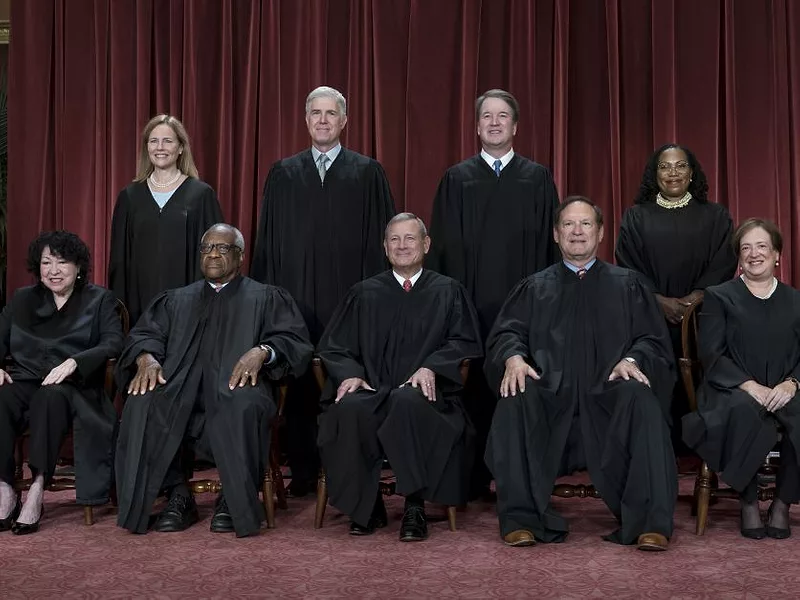
The Supreme Court gave the Trump administration the green light Tuesday to proceed with reorganizations at federal agencies, including the Agriculture Department.
In an unsigned opinion, the court stayed an injunction halting reorganizations and reductions in force issued by a federal judge in California. The injunction had been upheld by the 9th Circuit Court of Appeals.
U.S. District Judge Susan Illston’s injunction was based on the view that an executive order, and a subsequent memo from the Office of Management and Budget and Office of Personnel Management implementing that order, are unlawful, the court said.
“Because the government is likely to succeed on its argument that the executive order and memorandum are lawful — and because the other factors bearing on whether to grant a stay are satisfied — we grant the application,” the court said.
Notably, the court did not express any opinion “on the legality of any agency RIF and reorganization plan produced or approved pursuant to the executive order and memorandum,” the court said.
Justice Sonia Sotomayor wrote separately to concur in the judgment, while Justice Ketanji Brown Jackson issued a lengthy dissent.
Interested in more news on farm programs, trade and rural issues? Sign up for a four-week free trial to Agri-Pulse. You’ll receive our content - absolutely free - during the trial period.
Sotomayor’s concurrence reads, in full: “I agree with Justice Jackson that the president cannot restructure federal agencies in a manner inconsistent with congressional mandates. Here, however, the relevant executive order directs agencies to plan reorganizations and reductions in force ‘consistent with applicable law,’ and the resulting joint memorandum from [OMB] and [OPM] reiterates as much. The plans themselves are not before this court, at this stage, and we thus have no occasion to consider whether they can and will be carried out consistent with the constraints of law. I join the court’s stay because it leaves the district court free to consider those questions in the first instance.”
Jackson, however, said the high court, “from its lofty perch far from the facts or the evidence … lacks the capacity to fully evaluate, much less responsibly override, reasoned lower court fact-finding about what this challenged executive action actually entails.
“I respectfully dissent because, in addition to the government’s failure to show the exigency or irreparable harm that is required for emergency relief, this court could not possibly know in this posture whether the government is likely to succeed on the merits with respect to such a fact-dependent dispute. So it should have left well enough alone.”
For more news, go to Agri-Pulse.com

