
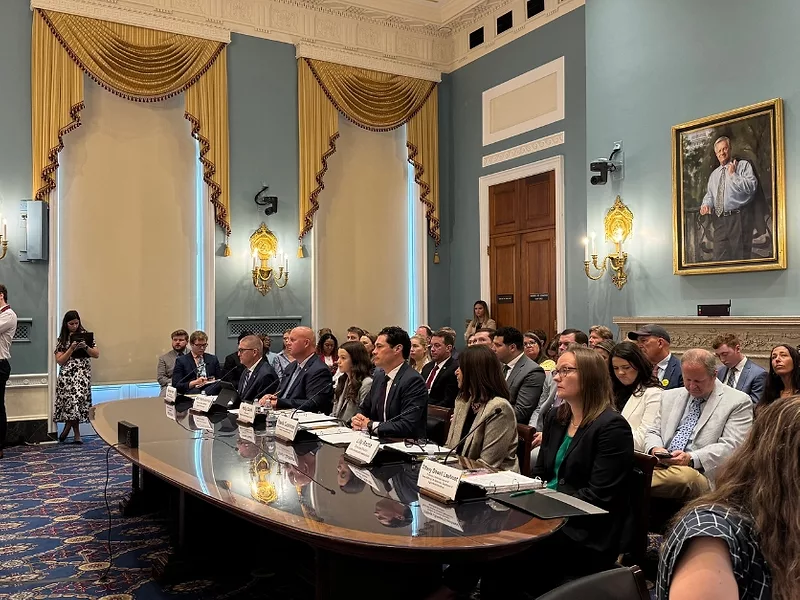
Opponents of California’s Proposition 12 used a House Agriculture Committee hearing Wednesday to voice their concerns about the impacts on the nation’s pork producers of the animal welfare law, which was narrowly upheld by the Supreme Court last year.
Witnesses and Republican lawmakers – joined by one Democrat – said legislation is necessary to allow pork producers to raise their animals without the constraints of Prop 12. The voter-approved law requires that pork sold in California come from the offspring of sows not raised in gestation crates.
The hearing coincided with the introduction of a bill from Rep. Ashley Hinson, R-Iowa. The bill would prohibit state and local governments “from interfering with the production of livestock in other states,” according to a Hinson press release.
House Agriculture Committee Chair Glenn “GT” Thompson, R-Pa., said a legislative solution to Prop 12 would be addressed in the skinny farm bill he wants to move this fall.
A similar measure, the Food Security and Farm Protection Act, was introduced by Republican Sens. Chuck Grassley and Joni Ernst of Iowa, and Roger Marshall of Kansas in April.
The hearing trod familiar ground in the years-long debate over the law, which was passed in 2018 and went into full effect in 2024. Pork producers and trade association representatives said it would drive small and medium-size producers out of business, leading to further consolidation in the industry, and raise pork prices for consumers.
“Retail prices in California are still over 20% higher than before Prop 12 took effect, while the total sales volume is down by double digits,” said National Pork Producers Council economist Holly Cook. “This means Californians are now spending more but consuming less.”
Two pork producers, Patrick Hord of Ohio and Matt Schuiteman from the nation’s top hog-producing state of Iowa, vocalized their concern about future threats to production.
“Despite producing Prop 12-compliant pork, I'm here to say that Prop 12 and an unmitigated regulatory patchwork threatens our farm,” Hord said.
“It creates uncertainty around what design we need to use for our new barns and even how I decide what to do when an existing barn needs remodeling. Whatever I do today could need to be changed when a new state decides they want a different housing standard,” Hord continued. “These are expensive changes and some farmers may exit the business amid this uncertainty, which increases consolidation.”
Cook and the producers agreed that the costs to make facilities compliant plus the increase in fixed and higher operating costs could put the Prop 12 compliance bill at $3,500 to $4,500, or more, per hog.
However, Rep. Jim McGovern, D-Mass., said the criticisms are “an intentional misrepresentation of reality.”
“The reality is that Prop 12 took effect at the beginning of last year, and the fear-mongering has fallen flat,” he said. “Farmers in Iowa have not been forced to go crate-free if they don't want to. Grocery shelves are not empty. The egg industry actively supports Prop 12 cage-free requirements.”
McGovern criticized Republican committee leadership for assembling what he views as a “not balanced panel.”
It’s easy to be “in the know” about what’s happening in Washington, D.C. Sign up for a FREE month of Agri-Pulse news! Simply click here
“There are thousands of farmers who vocally support Proposition 12, but Republicans have not given them an opportunity to speak today” McGovern said. He submitted 150 letters for the record from producers, including one from Brent Hershey of Pennsylvania who voluntarily transitioned his 3,000-head sow operation to fully Prop-12 compliant systems first for the added space for sows, and benefited from premiums provided by processors.
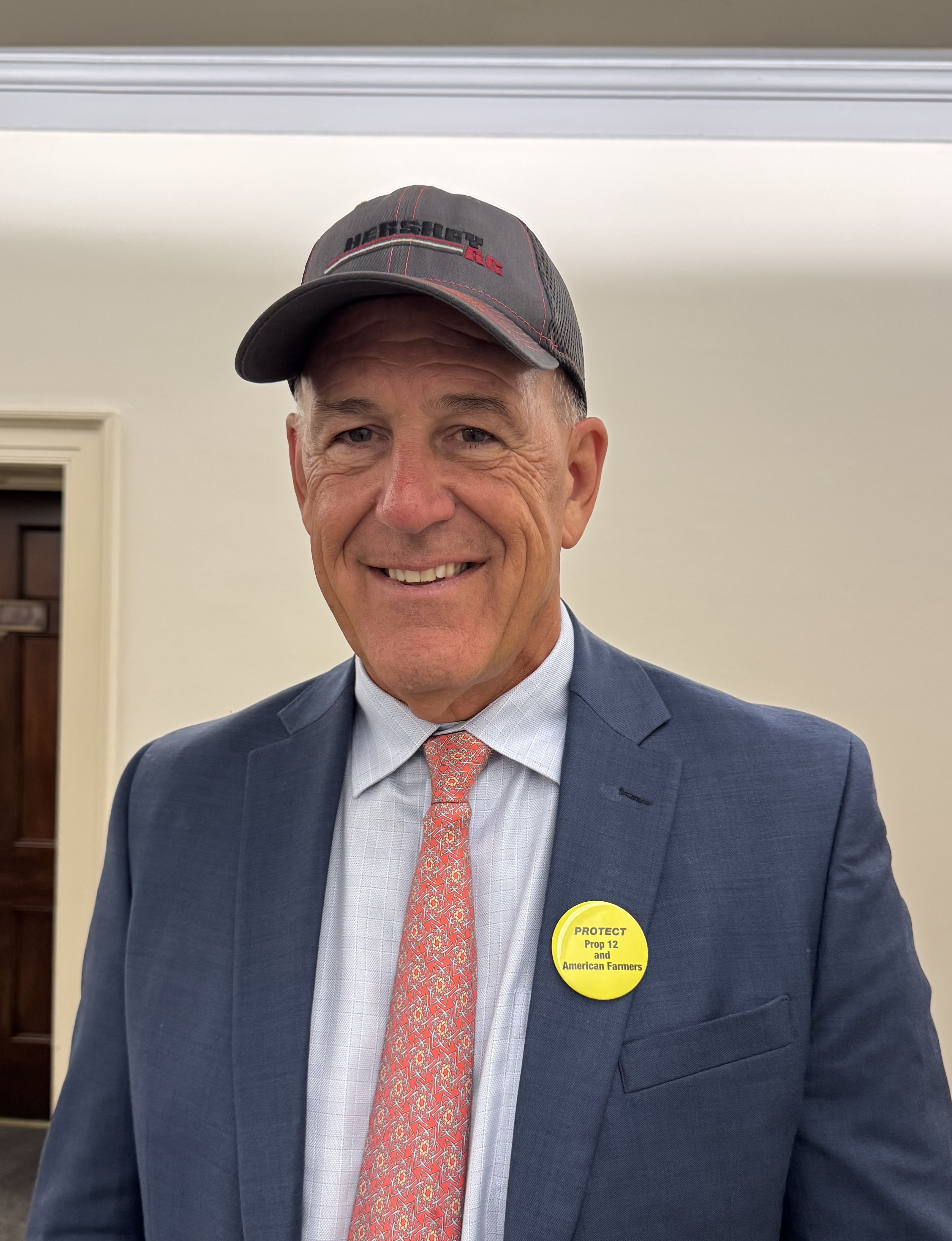 Brent Hershey, Hershey Farms
Lawmakers were generally divided along party lines on the issue, with one Democrat, Rep. Don Davis of North Carolina, firmly opposed to California’s law. He represents an eastern North Carolina district with 1.3 million pigs – “more than people,” he noted.
“We need a fix; that’s the bottom line,” he said.
“No one state should hold the other 49 hostage, which is exactly why I teamed up with my very good friend, a great representative from Iowa, on the Save Our Bacon Act,” Rep. Zach Nunn, R-Iowa, said, referring to Hinson’s legislation.
Thompson said Congress needs to take producers’ concerns seriously “in order to protect the right of American farmers and ranchers to raise their animals how they see fit.”
The committee's ranking member, Angie Craig, D-Minn., said the “contentious” issue “merits thoughtful, bipartisan discussion.”
“I agree that we can’t have 50 states with 50 different regulatory frameworks because of the significant challenges it would present to producers, but I also believe that there are ways to avoid that situation,” she said in her opening statement.
“I also recognize that many pork producers have made significant financial investments to make their operations Prop 12-compliant to satisfy the desires of California's consumers for premium pork products. It would be unfair to the family farmers who updated their facilities to comply with new rules to keep or gain market access, to change the rules on them after they've already made those investments.”
Observing that California voters had approved the law, she also said, “We should think carefully before allowing legislators in Washington to override [their] will.”
“I'm hopeful that this Prop 12 hearing will give us some new ideas to work with, and possibly yield a viable path forward for all of our nation's farmers,” she said.
For more news, go to Agri-Pulse.com.


