
.webp?height=700&t=1775581252&width=800)
USDA is out with its new farm income forecast. The department estimates average earnings for farm businesses will rise by 12% this year to $127,000 per operation. But that average income, which includes government payments as well as commodity sales, masks a lot of variation between types of farms.
Corn farms are expected to have average earnings of $158,100 this year, down 13% from last year. Net cash income is expected to average $123,700 for wheat farms (no change from 2024), $99,100 for soybean farms (down 12%), $59,300 for cotton farms (a 660% increase) and $303,500 for specialty crops (a 2% increase).
Dairy operations are expected to average $585,800 — a 14% increase from 2024. Hog farms are projected to earn $428,200 (up 21%); poultry operations, $227,900 (up 30%); and cattle operations, $71,300 (up 71%).
Keep in mind: Net cash farm income includes receipts from farming as well as cash farm-related income, including government payments, minus cash expenses. The farm debt-to-asset and debt-to-equity ratios are expected to remain relatively stable but still above their 2015-2024 average
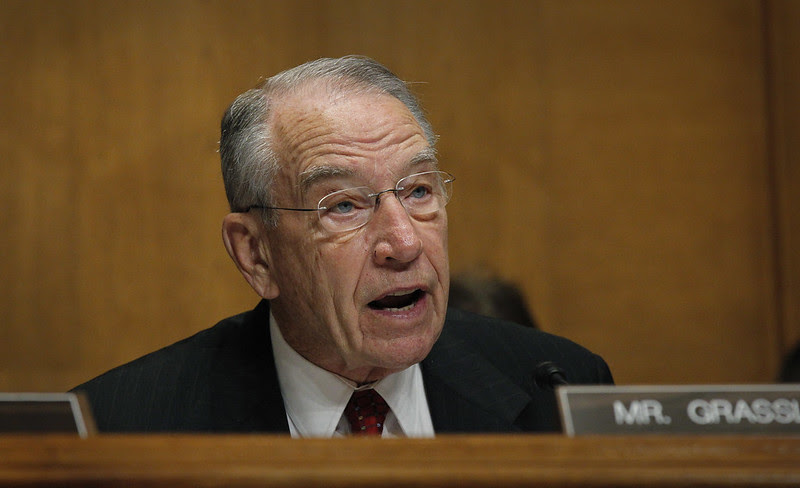 Sen. Chuck Grassley, R-Iowa (File photo)
Grassley: Farm aid possible in year-end spending bill
Sen. Chuck Grassley, R-Iowa, says it’s looking more likely that farmers will need a new round of emergency assistance at the end of the year.
“I would have to say within the last month … the word that I'm getting from bankers and from farmers is that there's going to be tremendous stress as a result of the low prices now, and I think it's going to hit a crescendo where there will end up being some help,” Grassley told reporters Wednesday.
Keep in mind: House Ag Chair Glenn “GT” Thompson, R-Pa., told us this week that he’s looking at funding the aid from tariff revenue. Payments that result from changes made by the One Big Beautiful Bill won’t reach farmers until the fall of 2026.
A big reason that farm income overall is higher this year is because USDA estimates
that direct government payments to producers will hit $40.5 billion, a $30.4 billion increase from last year. That would be the largest amount since the pandemic year of 2020. The forecast doesn't include changes to commodity programs made by the One Big Beautiful Bill enacted in July. Farmers won’t see those until 2026.
European farm sector worried about EU-Mercosur deal
European farm groups continue to oppose a trade deal between the European Union and the South American Mercosur trading bloc.
Don’t miss a beat! It’s easy to sign up for a FREE month of Agri-Pulse news! For the latest on what’s happening in Washington, D.C. and around the country in agriculture, just click here.
The EU is presenting the agreement to member states for approval. Late in the process, the two sides agreed to a “bilateral safeguard mechanism” that would allow either side to impose temporary measures to protect domestic industries in the event they are threatened by a flood of imports.
But the EU farmer coalition COPA-COGECA says it’s not clear how the safeguard mechanism would work.
“The [European] Commission may insist it has ‘listened to farmers,’ but facts indicate clearly that EU agriculture continues to be treated as a bargaining chip in trade negotiations,” a press release from the group said.
The commission said in a press release that the deal “provides full and comprehensive protection” for EU agriculture, in part by limiting agri-food imports “to a fraction of EU production.”
Broadband providers ask lawmakers for faster permitting
Quicker permitting is needed to speed up rural broadband deployment, telecommunications industry members told House lawmakers on Wednesday.
Testifying at a House Small Business Committee hearing, Kristi Westbrock, the CEO of Consolidated Telephone Co. in Brainerd, Minnesota, said “roadblocks, delays and increased costs associated with permitting and approval processes are particularly problematic for providers of service in rural areas.”
The process can “take substantial amounts of time,” she said. Jimmy Todd, the CEO of Lenora, Kansas-based Nex-Tech, agreed, saying “while there are plenty of success stories, small businesses and cooperatives still face burdensome permitting processes that delay builds and discourage investment."
“Congress can help by streamlining these processes so providers can deploy fiber faster and more efficiently,” Todd said.
Hemp roundtable starts farmer advisory council
U.S. Hemp Roundtable has launched a National Farmer Advisory Council, which the group says will be “a resource for decision-makers, federal and state, who are considering regulatory and legislative changes that impact the hemp industry.”
The nearly three dozen members from 18 states are led by hemp farmers Brian Furnish of Kentucky and Ken Meyer of South Dakota.
Since hemp was legalized in the 2018 farm bill, it has grown into a $28-billion-plus industry, the roundtable said. Farmers make up about a quarter of that.
The roundtable includes hemp-related companies and groups.
Final word
“Brazil has acquiesced to their domestic industry’s demands to functionally keep U.S. ethanol from effectively, fairly, and widely participating in their [RenovaBio] program. Conversely, Brazil can participate unabated within U.S. programs. This conflicts with Brazil’s commitments under the WTO, and USTR should take further action to address it.” — Chris Bliley, Growth Energy senior vice president, in testimony at the Office of the U.S. Trade Representative Wednesday. RenovaBio is a Brazilian program to reduce the carbon intensity of transportation fuels. USTR is conducting a Section 301 investigation.
Philip Brasher, Lydia Johnson and Noah Wicks contributed to today’s Daybreak.


