

The Legislature has approved Senate Bill 72, an ambitious measure from Senator Anna Caballero, D-Merced, to set legally binding water supply targets for California and overhaul the state’s water planning process.
SB 72 would enshrine into law a goal of securing an additional 9 million acre-feet of water by 2040, while setting a 50-year planning horizon to guide long-term resilience. The measure builds on Governor Gavin Newsom’s 2022 Water Supply Strategy, which called for an additional 7 million acre-feet by 2040, and responds to projections from University of California researchers that the state could face annual shortfalls of 4.6 to 9 million acre-feet by mid-century. That adds up to as much as 90% of urban water use or as many as 3 million acres of irrigated farmland.
The same scientists warn in a new report that such gaps could slash agricultural production, reduce drinking water reliability and cost the economy up to $14.5 billion each year, along with 67,000 jobs.
Caballero argued the bill shifts the state away from crisis-driven water policy.
“Without clearly defined water supply targets and strategic planning to achieve those targets, the state will continue to experience devastating water shortages with devastating consequences,” she said at a press conference Monday. “SB 72 will strengthen the alignment between state and federal strategy with local and regional investments to bring us closer to sustainability.”
Expanding on that argument, Graham Knaus, CEO of the California State Association of Counties, stressed that without sufficient water, the state’s housing needs cannot be met, along with other critical functions.
 Sen. Anna Caballero, D-Merced. (Agri-Pulse photo/Fred Greaves)
“We also cannot take for granted California's position as the world leader in agriculture,” said Knaus. “Sustaining our rich history as the food basket to the world requires clear goals and action around water.”
He criticized the current policy paradigm, saying the strategy is “to cross our fingers, to close our eyes and to simply hope for the best.”
Caballero agreed, defending the farmers in her district by arguing that “whenever there's a drought, it becomes agriculture's fault that we don't have enough water, and it's just simply not true.”
She equates her bill to the state’s 2030 goal for reducing greenhouse gas emissions, noting that while it is unlikely to reach that target, California still sets ambitious goals to strive for in its policymaking.
Building on last year’s attempt
SB 72 expands on a two-year effort that culminated in a veto last year from Newsom, who worried about substantial ongoing costs to the California Department of Water Resources and the State Water Resources Control Board. The California Department of Finance had pegged the cost to implement Caballero’s SB 366 at more than $6 million annually.
In his veto message, Newsom said the 2023 update to the Water Plan “includes clear goals, watershed-based climate resilience planning, and regional and interregional infrastructure modernization strategies.” He said a revision to the plan “of this magnitude” must go through the budget process and warned that it is “important to remain disciplined when considering bills with significant fiscal implications” when the state has been enacting budget cuts.
Don’t miss a beat! It’s easy to sign up for a FREE month of Agri-Pulse news! For the latest on what’s happening in Washington, D.C. and around the country in agriculture, just click here.
During debates on SB 366, Caballero had seized on new research that the State Water Project could lose 23% of its supply in the next 20 years due to climate change, and she stressed that as many as a million acres of farmland could go fallow in that timespan under the Sustainable Groundwater Management Act.
The bill initially set a target of 10 million acre-feet by 2040 and 15 by 2050, but during a committee hearing on SB 72 this year, Caballero said 2050 was “too far out to make an analysis” and pointed out that the UC researchers landed on 4.6 to 9 million acre-feet after assessing “all the water needs in the state.”
With Caballero as the powerful Senate Appropriations chair, both of her bills have passed through the fiscal gatekeeper, where legislation deemed too costly to implement often stalls.
Modernizing the water plan
In seeking to broaden the support beyond water users, SB 72 directs DWR to expand the advisory committee for updates to the California Water Plan — the state’s framework for water infrastructure investment — to include tribes, labor, environmental justice advocates and climate research experts. It also requires the plan to assess costs, benefits and impacts of proposed actions across sectors, from agriculture to recreation. The bill further mandates public workshops and reporting back to the Legislature before each update, with the next revision due in 2033 and then every five years.
Supporters say the updated process will produce a more inclusive framework for managing water scarcity and ensure that investments reflect the needs of agriculture, rural communities and disadvantaged groups. The backing is broad: dozens of water agencies, farm groups, business leaders and environmental advocates all support SB 72.
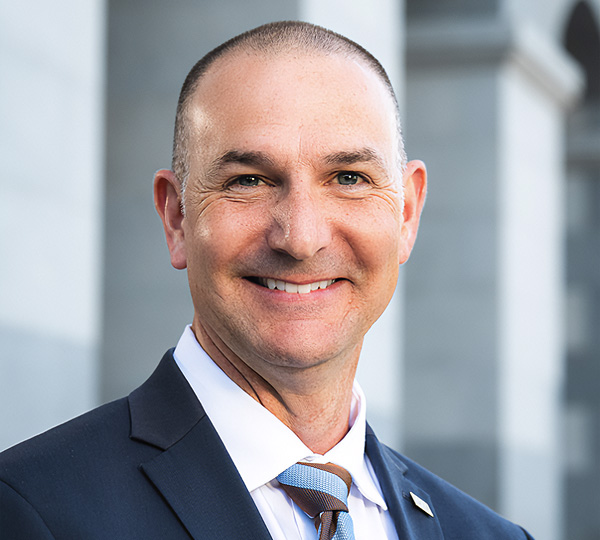 CSAC CEO Graham Knaus (CSAC photo)
Caballero argues the state has not made meaningful revisions to the plan in 20 years and during that time “extreme weather patterns resulting from climate change have profoundly impacted water supply.”
Water providers for major cities, which are under strict state mandates to conserve more water, are driving the legislation.
“It's not about taking water from one use and giving it to someone else,” said Craig Miller, who serves as the general manager of Riverside-based Western Municipal Water District and as president of the California Municipal Utilities Association, testifying in support of SB 72. “It's [about] developing enough water for all uses.”
Reviving the legislation this year, Caballero made technical changes to “make it more attractive to the governor.”
Despite the changes, environmental and sportfishing groups have maintained their opposition out of concern for the endangered salmon and other species that rely on freshwater flows. In response, Caballero asserts the bill “doesn't pick winners or losers” and includes environmental needs as one of the top priorities for expanding the supply. She has also inserted provisions to ease concerns from counties along the Sacramento-San Joaquin Delta that are concerned over exporting more water to the south.
Critics have also pointed out that the middle ground in the recommendation from the UC researchers, around 6.8 million acre-feet, is “remarkably close” to the Newsom administration’s assessment of a need for 7 million acre-feet of additional supply.
Despite the pushback and the previous veto, the measure advanced rapidly through the Senate and Assembly with strong bipartisan support and advanced out of the Legislature last week. Newsom has about a month to determine the fate of the bill.
For more news, go to Agri-Pulse.com.

