
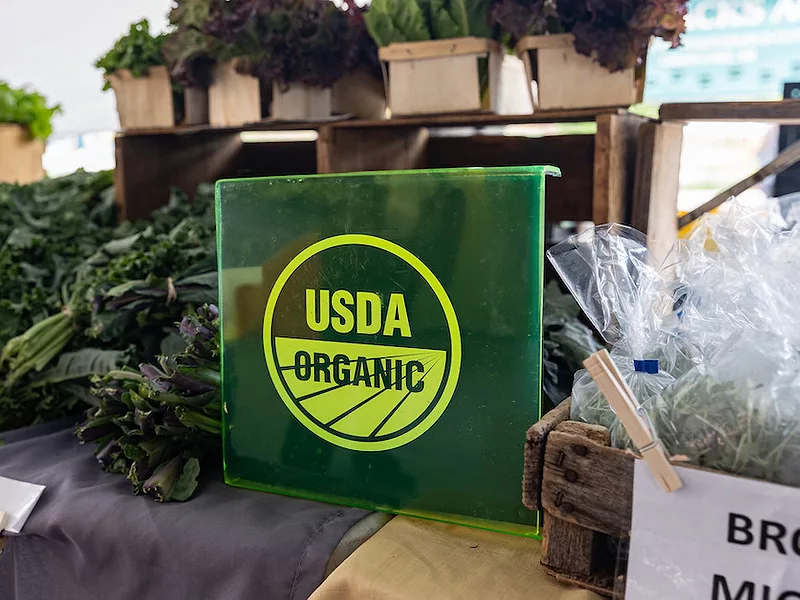
The organic industry is grappling with fast sales growth, driven by consumers across the political spectrum, that has outpaced U.S. production and is looking for help from Congress in boosting domestic supplies of feed, meat and other products that have to be imported.
Organic imports surged from less than $1 billion in 2011 to over $5.7 billion in 2024. Sales of organic food grew by more than 5% in 2024 according to the Organic Trade Association (OTA), and domestic production is struggling to keep pace.
More than 300 OTA members have been in Washington this week for the organization's annual Organic Week, focusing on opportunities to onshore organic production.
Sens. Pete Ricketts, R-Neb., and Tina Smith, D-Minn., are introducing the Organic Import Verification Act to require testing of imported organic products to ensure they meet the same standards as U.S.-produced organic products.
USDA’s National Organic Program, the federal regulatory program that develops and enforces consistent national standards for organically produced agricultural products, has long focused on increasing enforcement of organic products being imported to the U.S. Federal investigations show that organic grain and oilseed fraud can lead to tens of millions of dollars in fraudulent sales within just a few months.
“We have strong evidence that they are just based on acreage not matching yield from some of these countries and we hope to better address it through fraud prevention,” OTA co-CEO Matthew Dillon told Agri-Pulse Open Mic.
The U.S. currently imports over $500 million in beef each year and much of the organic corn and soybeans used to feed livestock that will be harvested as USDA Certified Organic meat products.
 Matthew Dillion (OTA photo)
OTA will also be pushing for an expansion in infrastructure through on-farm grants to better accommodate the scale of production needed for organic storage and processing in the Domestic Organic Market Expansion Act (DOME).
“We're looking for some on-farm grants as well as some matched funding in processing to expand that domestic opportunity and capture that high-value market that right now is overseas,” Dillon said. “That is priority number one even before even thinking about exports.”
Dillion says it’s important to safeguard the integrity of the USDA Certified Organic label because it’s seen as a status symbol around the globe.
Nicole Atchison, CEO of food ingredient manufacturer PURIS, and Wisconsin organic dairy farmer Joshua Tranel say in an Agri-Pulse op-ed that the legislation is supported by many farmers and businesses who have both organic and conventional production.
“The accessibility of value-added manufacturing, the storage and distribution options for organic, and the required segregation and other regulatory complexities are unique to organic and are often a lesser problem for our conventional counterparts," the pair write. “DOME will help more conventional producers and manufacturers who want to pick up the slack on domestic organic production.”
Cut through the clutter! We deliver the news you need to stay informed about farm, food and rural issues. Sign up for a FREE month of Agri-Pulse here.
Organic industry sees broad consumer base
Virtually all consumers have purchased an organic product at some point in the last six years, according to Jessica Wright, the vice president of product intelligence at the wellness-focused product database SPINS.
“Some are motivated by sustainability and then focused on aligning their purchases with more of their ego-values. Some are looking to purchase products that they know are organic and healthy for their children,” Wright said. “Some are motivated by more fair-trade practices and animal welfare.”
While Gen Z skews the total number of buyers, she says millennials are accounting for the majority of U.S. organic product dollar sales.
The emphasis on consumers purchasing quality products likely isn’t a short-term trend. Craig Stevenson, CEO for Lundberg Family Farms, said the company is experiencing "phenomenal growth” in the organic and regenerative organic business that has tremendous opportunity to build with the momentum of the Make America Healthy Again movement.
 Craig Stevenson (LinkedIn photo)
“It’s really interesting as you think about the future for organic or regenerative organic is this convergence … between the left and the right around healthier solutions to your overall physical well-being,” Stevenson said. “Whether that's the MAHA movement on the right or sort of long-standing traditions on the left, that to me is one of the best convergences that's happening in the marketplace right now.”
Perdue Farms Chief Commercial Officer Todd Tillemans said organic chicken represents about 25% of Perdue’s business and is growing four times faster than any other segment.
“We're on this mission to make organic more affordable, to bring it to more families,” Tillmans said. “It does come with additional costs.”
But Perdue pays about two and a half times more for organic grain than it does for conventional. The company has a unique advantage of being diversified with about a 50-50 split between agribusiness operations and livestock production. Tillmans estimates about 20% of the company’s agribusiness production can be traced from the seed through the delivery of animal protein to families.
“It's traceable, and consumers are gravitating,” Tillmans said.
OTA launches simplified consumer messaging
A new generation of consumers requires a fresh look at marketing, advertising and promotion.
The Organic Trade Association unveiled a simplified, refreshed marketing campaign during the Organic Week conference. The campaign's message – “The Seal Makes it Simple” – is intended to get consumers to look for USDA’s organic certified seal to know the product was produced with the high standards.
Stevenson of Lundberg Family Farms said retail companies also have a role in promoting the organic brand.
“Younger consumers have so many different platforms where they can actually find information about where their food is sourced, how it's grown, how it cares for the environment. We have to be communicating to them in ways that break through,” Stevenson said.
U.S. consumers spend an average of less than 10% of their income on food. For many, increasing the percentage is a valid investment for the health of their families. Jack Sinclair, CEO of Sprouts Farmers Market, noted that customers with specific dietary preferences often remain consistent in their purchasing habits regardless of the state of the economy.
“Our customers — the vegetarian, the vegan, the people who are very interested in organic — they tend to stick with this,” Sinclair said. “The price of gas going up doesn't affect whether they're going to stay vegan or not.”

