
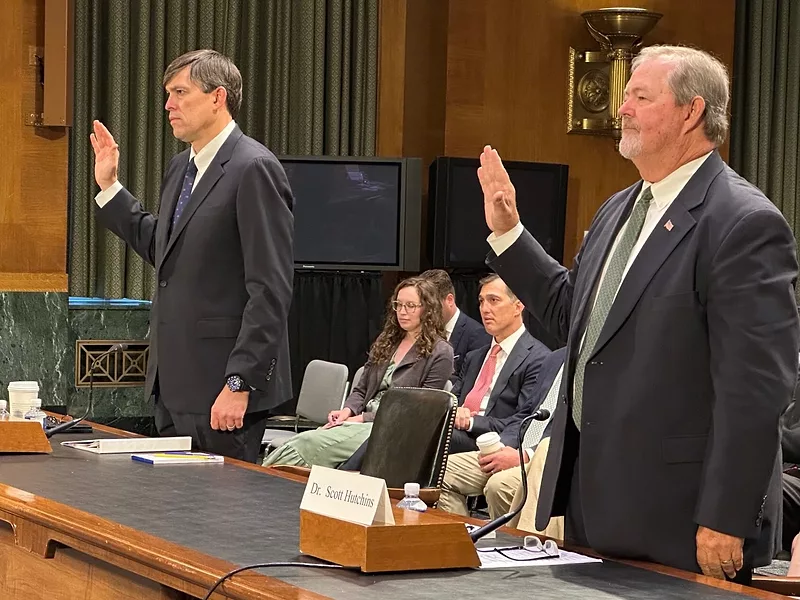
USDA is on the verge of getting three new undersecretaries. The Senate could vote as soon as today on a group of 48 sub-Cabinet nominees.
The three nominees are Richard Fordyce, President Donald Trump’s pick to be undersecretary for farm production and conservation; Dudley Hoskins for marketing and regulatory programs; and Scott Hutchins for research, education and economics.
The Senate voted 52-47 Wednesday to limit debate on the package after Republicans pushed through rule changes for considering nominations.
Trump and Starmer to meet, discuss recent trade pact
Trump was scheduled to sit down with British Prime Minister Keir Starmer today amid a push to hammer out more details of a recent trade framework.
Britain was the first country to strike a deal with the U.S. Starmer’s government accepted a 10% reciprocal tariff rate in exchange for additional market access for U.S. ethanol and beef producers, among other measures.
The initial pact was short on details, however, and both sides left the door open to broadening the framework in subsequent negotiations.
Ag Secretary Brooke Rollins has accompanied the president on the trip. Britain’s leading ag group, however, is pushing Downing Street not to grant any more market access concessions in the food and drink sector — particularly for U.S. dairy.
World agri-food groups pledge support for WTO, global trading system
A coalition of international agri-food groups reiterated their support for the global trading system Wednesday as the World Trade Organization’s annual public forum got underway.
In a letter to WTO Director-General Ngozi Okonjo-Iweala, 11 groups, including CropLife International, the Global Farmer Network and the International Seed Federation, highlighted the organization’s role in promoting food security.
“We are entering a new era — one that will test industries, governments, and global cooperation like never before,” the groups write. “But trade is not going to stop.”
They added that global trade rules have supported “millions of smallholder farmers, and safeguarding against fragmentation and protectionism.”
USTR solicits input on USMCA review
The Office of the U.S. Trade Representative is kickstarting preparations for next year’s review of a North American trade pact by gathering public comments over the next few weeks.
Interested parties have until Nov. 3 to submit their comments on the U.S.-Mexico-Canada Agreement. The agency is seeking, among other things, recommendations for potential U.S. proposals to improve the deal.
The joint review is slated for July next year. If parties don’t agree to extend the deal, they will meet every year for a review until it expires in 2036.
As part of the information-gathering process, USTR will also hold a hearing on Nov. 17.
Senators mount push to force more tariff votes
A group of senators led by Virginia Democrat Tim Kaine and Sen. Rand Paul, R-Ky., have introduced a measure to force another vote on Trump’s Canada tariffs. A staffer tells Agri-Pulse that Kaine will file another bill today to force a vote on the new Brazil tariffs.
Senate rules dictate that both bills can be fast-tracked to the Senate floor.
The Canada vote would mark the second in the Senate, where lawmakers passed a similar measure in April. That legislation was not taken up by the House, however.
But, but, but: Although the efforts will put many GOP lawmakers on record defending the tariffs, they won’t lead to a repeal any time soon.
Don’t miss a beat! It’s easy to sign up for a FREE month of Agri-Pulse news! For the latest on what’s happening in Washington, D.C. and around the country in agriculture, just click here.
The House on Monday voted to nix a Democratic effort to scrap the Brazil tariffs. GOP lawmakers also this week extended a block on votes to end the national emergencies underpinning tariffs. The block was initially extended to March, before being shortened to Jan. 31 as part of a rule vote Wednesday on unrelated legislation.
By the numbers: Industry study details grain facility impact
$402 billion. That’s the annual economic impact of U.S. grain and feed facilities, according to a report commissioned by the National Grain and Feed Association.
Nearly 176,000 people are employed directly by the 9,683 facilities across the country.
Iowa has the largest number of people directly employed in that industry with 18,386. Minnesota has 16,635 and Illinois has 16,436.
Nationally, industry employees make on average about $85,000 a year.
NAS report: GHG damage to human health ‘beyond scientific dispute’
A new National Academy of Sciences report has concluded that synthetic greenhouse gases endanger human health. The academy prepared the report to submit to EPA after the agency proposed to withdraw its 2009 endangerment finding, which has formed the basis of regulations to reduce GHG emissions.
“The evidence for current and future harm to human health and welfare created by human-caused greenhouse gases is beyond scientific dispute,” the academy’s press release said.
In a section of food and agriculture, the report says, “Extreme heat, drought, and moisture excess are increasingly co-occurring within a single growing season since 2000, resulting in up to 30% yield losses globally, with the United States noted as a region of greatest losses.”
Extreme heat events and warm nights also have decreased yields, the report says. In addition, “episodic temperature increases that exceed plant physiologic thresholds reduce yield and cause plant stress throughout the life of the crop, especially during flowering.”
Colorado River feud continues as states look beyond 2026
Upper Colorado River Basin negotiators appear to be making little progress in talks with Lower Basin states over a post-2026 framework for water cuts.
Notably, Wyoming’s negotiator, Brandon Gebhart, says Lower Basin negotiators are demanding that his state give up nearly all the Colorado River water uses it has developed under the 1922 compact. Currently, Wyoming uses only around 30% of the water supply it was originally promised, Gebhart said.
“I simply can’t promise to give up everything Wyoming got under the compact, which was our future,” Gebhart said at an Upper Colorado River Commission meeting on Wednesday.
Colorado’s negotiator, Becky Mitchell, took issue with Lower Basin demands for Upper Basin cuts, arguing that changes "must be made in the Lower Basin in the immediate future to avoid a system failure."
“Sitting here today, it is often difficult to feel optimistic,” Mitchell said. "I think we should be clear about what is making things difficult. Water users in the Lower Basin have developed a reliance on water that exceeds their apportionments and is simply not there anymore."
Final word
“It is disappointing to see Secretary Kennedy and Commissioner Makary celebrating marketing announcements as public health ‘wins.’ Every authoritative scientific body to study the issue has concluded that high-fructose corn syrup is nutritionally equivalent to sugar and other caloric sweeteners. Threatening a $5 billion loss on the American corn industry with no nutritional benefit is a loss that undermines President Trump’s ‘America First’ efforts.” — Corn Refiners Association CEO John Bode, responding to Health and Human Services Secretary Robert F. Kennedy Jr., FDA Commissioner Martin Makary and others celebrating this week's news of a company pulling HFCS from its products as a "win.”
Philip Brasher, Oliver Ward and Noah Wicks contributed to today’s Daybreak.


