
President Donald Trump wants to use tariff revenue to bail out farmers harmed by trade wars, but experts say he’ll need help from Congress to do that, and GOP lawmakers are working on lifting key restrictions.
The Trump administration wants to use its authority under a Depression-era law known as “Section 32” that’s funded through tariffs. Section 32 is traditionally used to buy commodities for nutrition assistance programs, but the law also authorizes using the authority to pay farmers to restore their “purchasing power.”
One of the challenges for Trump is that since fiscal 2018, appropriations bills have capped Section 32 direct payments to farmers at $350 million, according to the Congressional Research Service (CRS). That cap is far under what the president will need for a farm bailout. The administration hasn’t released an estimate, but some lawmakers say at least $20 billion could be needed.
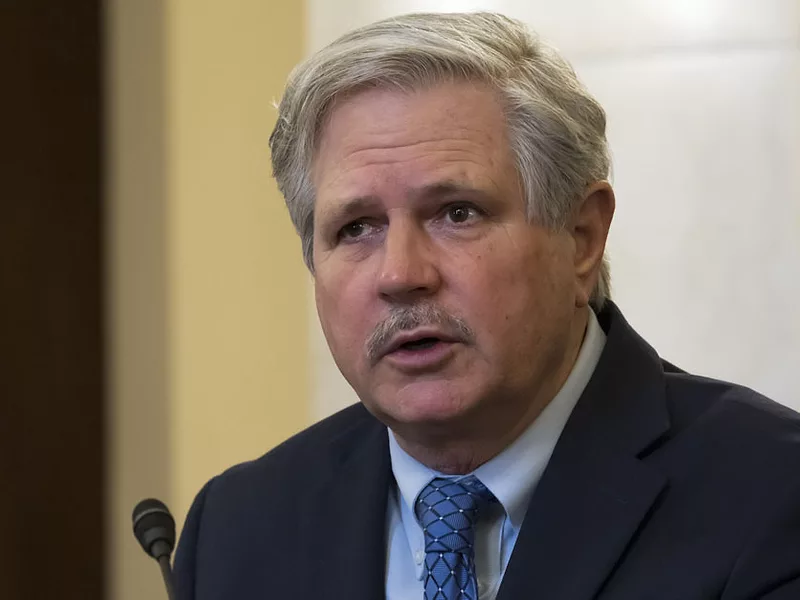
The chairman of the Senate Agriculture Appropriations Subcommittee, John Hoeven, R-N.D., told Agri-Pulse he’s working on changes to USDA’s spending authority, but he didn’t provide specifics. He noted that in 2018 the GOP-controlled Congress eased restrictions on USDA’s Commodity Credit Corporation, the legal authority that Trump used in 2018 to compensate farmers for the trade war with China.
“If you'll recall, back when we used CCC, we actually had to implement some changes to do that. … and in the same fashion we're working on” changes to Section 32, Hoeven said. The goal is “to make sure that we're ready to go when the president and secretary decide it's time to move forward,” Hoeven said.
He declined to disclose the size of the potential aid package but said Congress needed to act on it by the end of the year.
Hoeven said that crafting the aid package is needed to counter China's moves to punish U.S. agriculture by declining to buy U.S. commodities and restricting fertilizer exports.
"It sends a message to China that they're not going to put pressure on us by using our farmers. So it's important in the trade negotiation," he said.
In an interview Wednesday, Senate Ag Committee John Boozman, R-Ark., said Congress needs to act as quickly as possible.
“We ... need to make sure that whatever we do is done in the next few weeks because it's vital that farmers have the certainty as they start talking to their bankers now,” Boozman said. “The bankers are very concerned, that farmers have the ability to show that they're going to have this income coming in.”
The $350 million cap isn’t the only challenge for the administration when it comes to using Section 32. Most of the tariff revenue that flows into the account is earmarked for USDA’s Food and Nutrition Service. Support for farmers is funded through the account's “reserved spending authority,” according to a Congressional Research Service report issued in August.
CRS estimates that the reserved spending authority account will have $1.76 billion for fiscal 2026, which starts Wednesday, while the FNS will get $23 billion.
“USDA only has the authority to use their reserved spending account, which is a much smaller amount that's tied to inflation,” said a senior Democratic aide familiar with legal issues around Section 32. USDA can’t legally move money out of the FNS account, the aide said.
Cut through the clutter! We deliver the news you need to stay informed about farm, food and rural issues. Sign up for a FREE month of Agri-Pulse here.
The administration’s other option for payments to farmers is through the CCC’s Section 5 authority, which the department used to make the $23 billion in Market Facilitation Program payments provided to farmers for 2018 and 2019.
The CCC is essentially a revolving fund that is also used to make payments to farmers through some farm bill programs. But there are challenges with also using the CCC for a farm bailout. USDA hasn’t disclosed how much money is currently in the account, but it’s believed to be only a few billion dollars.
Congress is due to refresh the account at some point, but USDA still can’t legally borrow more than $30 billion from the account. But Hoeven acknowledged the borrowing limit could be a problem for the administration in coming months because USDA will have to leave money in the account for a large increase in commodity program payments that are expected to be made in 2026.
According to the Farm Bart Fischer (Agri-Pulse photo) CPA Report, USDA may have to make $14 billion in payments through the Agriculture Risk Coverage and Price Loss Coverage programs in the fall of 2026. If market prices fall further, the payments could be larger than that. Some conservation payments also flow through the CCC.
In 2018, when Trump launched his first trade war with China, officials said the CCC had about $15 billion in borrowing authority.
Congress likely will have a lot to say about the size and scope of an aid package, according to Texas A&M University economist Bart Fischer, a former top GOP aide to the House Agriculture Committee who has also advised USDA under the new administration.
“I don't underestimate USDA attorneys and their ability to find authority for a president to be able to do what he wants when he wants. And so I wouldn't rule that out. But honestly, Congress has a lot to say, too,” Fischer said at the annual Ag Outlook forum hosted by Agri-Pulse and the Agricultural Business Council of Kansas City.
“Whether it's restoring and plussing up CCC, whether it's taking the shackles off Section 32, there is a tremendous amount that could be done” by Congress to address the farm economy, Fischer said.
Kim Chipman contributed to this report.


