

Soybean producers and the rural communities they belong to have watched the return of U.S.-China trade tensions with rising concern. China has frozen its purchases, and farmers are warning of storage challenges and dire economic consequences if the two countries do not reach a political settlement soon.
“The damage we're doing is going to have a long, long shadow,” Minnesota State Auditor Julie Blaha said on a recent call with reporters.
Former Ag Secretary Tom Vilsack, who led USDA for 12 years through the Obama and Biden administrations, has also warned that China won’t quickly return to purchasing U.S. soybeans once trade tensions thaw.
The long-term impacts of the latest trade frictions are difficult to parse through, however, and multiple analysts told Agri-Pulse Brazil will continue to grow its soybean acreage and remain a competitive force in global markets. However, Brazilian farmers are grappling with economic headwinds similar to those faced by their U.S. counterparts, and infrastructure challenges continue to hamper supply chain reliability and limit the pace of export expansion, some argue.
Meanwhile, Argentina, another soybean export behemoth, is unlikely to repeat its elevated exports next year.
Some irreversible lost export market share is likely
Brazilian soybean acreage is growing faster than its domestic consumption. In the 2025-2026 marketing year, Brazilian production will increase by around 6 million metric tons, to 177.6 million metric tons. Exports are set to grow from 3.9 billion bushels last year to 4.1 billion, with exports to China accounting for the bulk of that increase.
Those exports are also costing China more. Spurred by surging Chinese demand for Brazilian soybeans, producers in that country are receiving $2 to $3 more per bushel than they did before the latest round of U.S.-China tensions, said Tanner Ehmke, lead economist for grains and oilseeds in CoBank's Knowledge Exchange research division.
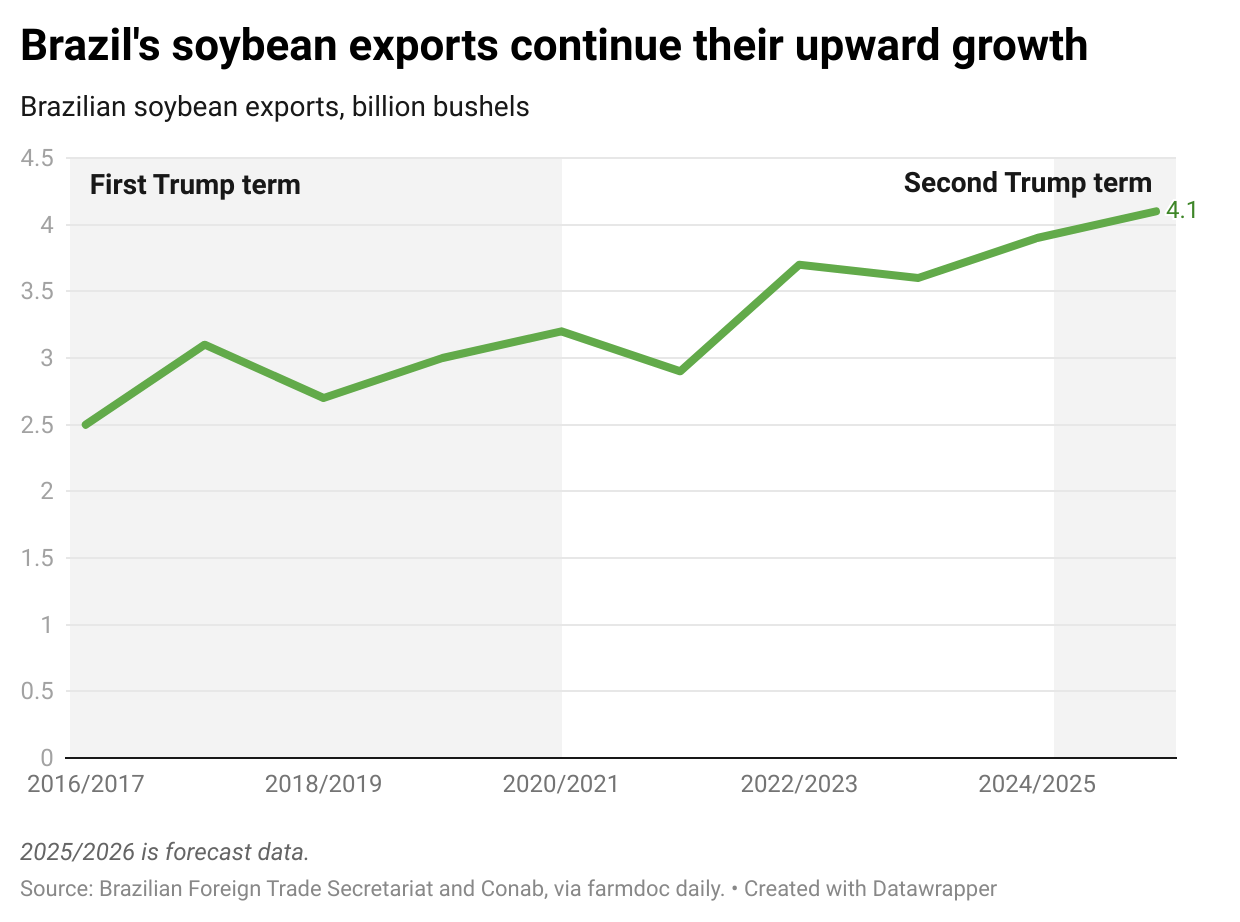
“That is going to give even more tailwind for Brazilian farmers to expand acreage” and increase their Chinese market share, Ehmke said.
Brazil's National Supply Company, the country's food supply and statistics agency known as Conab, projects an increase in soybean planted area for the 2025/26 growing season to reach 121 million acres, a 3.5% increase from the year before. Much of that ground grows two or even three crops annually.
Deputy Ag Secretary Stephen Vaden sounded the alarm over Brazil’s land expansion at a North Carolina Chamber event in September.
Cut through the clutter! We deliver the news you need to stay informed about farm, food and rural issues. Sign up for a FREE month of Agri-Pulse here.
“Even if we took care of China tomorrow, that doesn't remove Brazil's production from the market. It doesn't solve their expanding footprint … and that is a problem which we separately have to face,” Vaden said.
He also accused Brazil of expanding its production by destroying Amazon forests. However, most of Brazil’s cropland acreage expansion occurs in the tropical savanna region of Cerrado, which is not part of the Amazon but sits just south of it, according to Joana Colussi, an assistant professor in the Department of Agricultural Economics at Purdue University.
Colussi, a Brazil native, suggests that most of the conversion to cropland in Cerrado occurs because livestock producers struggle in the area due to dry conditions and issues securing fertilizer.
Brazilian headwinds
But Brazilian farmers are facing their own challenges, which some economists argue could hamstring the country’s ability to accelerate its efforts to capture a greater share of the Chinese market.
Rising input costs are narrowing profit margins – as they are in the U.S. – and Brazil’s central bank has been raising interest rates since last summer, increasing the cost of borrowing.
Expensive and unreliable crop insurance policies also leave over 85% of farmland uninsured and farmers exceptionally risk-averse.
“It's not all sunshine and rainbows,” said Angie Setzer, a partner at Consus Ag Consulting.
Setzer said she expects Brazilian soybeans to ultimately increase their share of the Chinese market, but gradually.
Brazilian soybean exports rose in the three years after Trump launched his first trade war in 2018, but not as fast as they did between 2021 and 2024, while President Joe Biden was in office, according to analysis from the University of Illinois. The first trade war undoubtedly helped Brazil, but it was not the singular catalyst it is sometimes made out to be, Setzer said.
Economists are also divided over whether Brazil’s infrastructure could handle a rapid uptick in the country’s exports to China.
“Production is increasing at a much larger pace than the logistical capability,” said Raphael Bulascoschi, a São Paulo-based market analyst for StoneX.
Limited storage for beans puts pressure on growers to move product fast, which leads to high freight costs during peak export periods. These high freight costs, Bulascoschi said, have long eaten into growers’ profits.
Soybean shipments compete with corn, sugar cane and cotton for logistics resources, said Stephen Nicholson, a global strategist for grains and oil seeds at Rabobank.
“There just isn't enough logistical capacity internally to do all that at one time,” Nicholson said.
 Stephen Nicholson (Rabobank photo)
“What we've seen the last couple of years is that vessel count get really high at peak periods,” he added, “and the wait times just continue to go up.”
The soybean shuffle
China has historically been the world’s largest soybean buyer and demand driver. The country is set to account for 60% of global soybean imports in 2025, according to USDA data. But China's own production has been increasing at the same time its population has started to decline, and the pork industry – which buys significant volumes of soybeans for animal feed – has begun to shrink.
Accordingly, analysts say that it will be biodiesel, not animal feed, that could soon become the major driver of soybean demand. And that means countries outside of China will be the areas of fastest demand growth.
The International Energy Agency projects biofuel feedstock demand to grow 25% from 2024 to 2030, with seed oil demand expanding most in Brazil, Indonesia and Malaysia following higher blending mandates.
Even in the short term, if China completely replaced U.S. soybeans with South American exports, there is enough demand outside China to support 1.6 billion bushels of U.S. soybean exports – just a touch below USDA’s 2025/2026 export estimates of 1.7 billion, University of Illinois economist Scott Irwin said in a recent blog post.
Ongoing policy uncertainty in Argentina around its export tax could also see Argentinian exports drop off after this year, Setzer said. A recent export tax holiday contributed to a surge in Argentina’s soybean exports, which could top 12 million metric tons this year.
“That's almost going to be a one-and-done sort of deal here,” Setzer said. With high export taxes on soybeans, Argentinian producers may pivot from soybeans to corn, bringing soybean production down to levels that match domestic crush demand, she noted, effectively removing Argentina as a raw soybean exporter.
Changing U.S. policies still seen as risk
All of this is to say that if soybean producers can weather the current trade turmoil, the export markets of tomorrow could be less bleak than today, with one caveat: The U.S. must protect its reputation as a reliable supplier, said Nicholson.
Reliable suppliers, he said, set tariff rates, then stick to them.
As a buyer, “you don't want to be in a position to think, ‘Well, if I buy this today from the United States, when I need it delivered in six months … will the price still be the same? Will I still be able to get it? What will the policy be?’” Nicholson said.
“One of our competitive advantages across the globe is that we have stable policy, that we know what it is today, and we know what it's going to be tomorrow. And right now, if you're a buyer, you're going, ‘I don't know if I want to do that,’” he added.


