
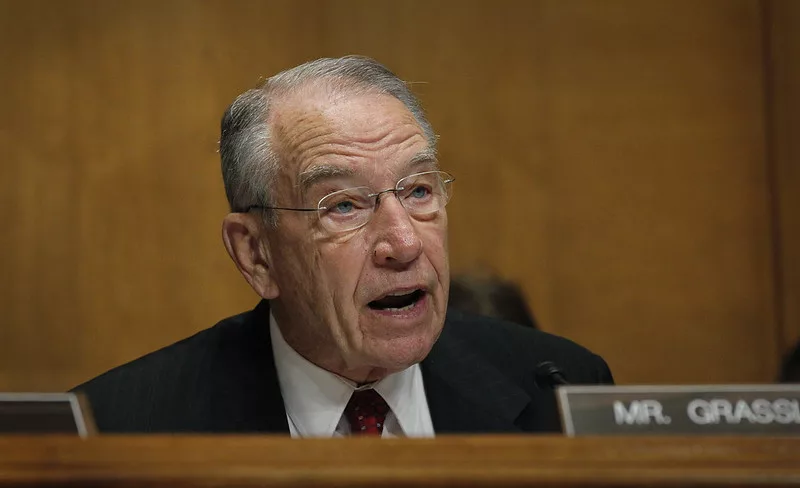
Farmers and ag industry leaders warned the Senate Judiciary Committee Tuesday about the rising cost of seed and fertilizer to producers but didn't agree on what should be done about it.
Farmers, seed and fertilizer industry group leaders, an independent seed company operator and an antitrust advocate all weighed in on causes and effects of rising input costs. Committee Chair Chuck Grassley, R-Iowa., noted that the seed and chemical sectors have seen increasing consolidation in recent years.
Iowa Farm Bureau member Noah Coppess said he's been planting the same variety of soybeans for five years due to a lack of competitive options, which he said, "this limits the resiliency" of his farm.
"We have no doubt that consolidation will continue, and the challenge for lawmakers and the ag industry will be to balance the efficiency with fairness and resiliency," Coppess said.
Caleb Ragland, president of the American Soybean Association, said farmers' seed prices have increased 18%, fertilizer prices by 37%, pesticide prices by 25% and machinery prices by 23%. He added that tariffs are another factor contributing to the rise in prices for certain inputs.
"If high input costs continue on this path, farm profitability for row crops like soybeans remain dire," Ragland said.
Cut through the clutter! We deliver the news you need to stay informed about farm, food and rural issues. Sign up for a FREE month of Agri-Pulse here.
Diana Moss, the director of competition policy at the Progressive Policy Institute, said two firms currently control 72% of the corn seed market and 66% of the soybean seed market, while three firms control 83% of the cotton seed market. When it comes to fertilizer, she said four firms represent 100% potash and phosphate markets, and around 77% of the nitrogen market.
Andy LaVigne, the president and CEO of the American Seed Trade Association, suggested lawmakers could reduce seed costs by reforming regulatory requirements, citing a 2022 study that found regulatory compliance constitutes nearly 40% of the $115 million it takes to bring a biotech product to market.
"Reform is needed to ensure that the rapid pace of scientific innovation is not hampered by unjustified regulatory barriers," LaVigne said.
However, John Latham, the president of the independent seed company Latham Quality Inc., said "when you've got a couple different companies that are controlling the whole market, it makes it very difficult" for independent companies to invest in new technology. He asked lawmakers to crack down on rebate programs and "discretionary" funds he says his vendors seek to use to maintain loyalty from companies like his.
"The rebates are very punitive for independent companies," Latham said. "If you had broad licensing, I think you could see a flood of new breeding companies into the market, which is vastly needed."
Corey Rosenbusch, president and CEO of the Fertilizer Institute, attributed high fertilizer prices to global supply shortages and crop acreage growth. He noted that "many of the largest globally traded agricultural commodities" driving high fertilizer demand are "not even grown in the United States," pointing to coffee and palm oil as examples.
"We recognize how challenging and frustrating this must be for our customer partners at a time when they're experiencing very low prices for the crops that they grow," he said.
In his written testimony, Rosenbusch called for the appointment of a full-time USDA fertilizer economist to study market dynamics, the creation of a national policy to expand domestic fertilizer production and streamlining of permitting and regulatory reviews of fertilizer plants and mines.
Moss, with the Progressive Policy Institute, said the government should be more aggressive in enforcing antitrust regulations when it comes to the crop genetics and fertilizer industries, as well as improving price data collection. She said she'd also be interested in seeing USDA be given the authority to intervene "if consolidation raises supply chain safety, stability and resiliency issues with farmers in the middle of this vortex."
"Both farmers and consumers...should be able to count on having choice in what they buy and who they buy it from," she said. "A more coherent policy approach is to strengthen antitrust enforcement."
Mark Mueller, president of the Iowa Corn Growers Association, who did not testify, but submitted written comments, said the federal government should "keep up vigorous antitrust enforcement," noting that "competition issues can't be solved with cash.
In an interview with Agri-Pulse following the hearing, Mueller said farmers "need more suppliers, not less." He believes producers may soon face "another farm crisis" amid the confluence of high input costs and low commodity prices.
"The bottom line is that farmers input costs are higher than they've ever been and prices we're receiving for our commodities are as low as they've been," Mueller said. "We can't sustain this."
For more news, go to Agri-Pulse.com.
Editor's note: This story has been updated to include comments from American Soybean Association President Caleb Ragland.

