
California’s ambitions to lead the next agricultural technology revolution were on full display at the FIRA USA robotics conference in Woodland last week. But beneath the optimism over drones, autonomous tractors and harvest-assist robots ran a sobering message: The investment dollars are running thin, and the momentum could stall unless new financing and workforce strategies take root.
Over three days, farmers, startup founders and public officials wrestled with a paradox. The need for automation has never been greater, yet the flow of venture capital, once the lifeblood of Silicon Valley innovation, has slowed to a trickle for ag-tech.
Western Growers Vice President of Innovation Walt Duflock, who has become one of the state’s most prominent voices on ag-tech, laid out the math that drives this urgency.
“We have $16.3 billion — out of the $60 billion-plus California ag GDP number — spent on labor,” Duflock told reporters.
That money “buys 850 million hours of labor,” with a third spent on nonharvest activities. The industry has been able to automate about 3% of those activities, with the hope of extending that to 20% in the next five years.
“Until we get that number up, we continue to have to increase international farmworker usage. That comes at $30 an hour,” he said.
Duflock said automation has become essential to survival in California’s high-cost farm economy.
“Without automation, it gets really, really hard for growers to continue to farm in California, and it gets really, really tempting to move other places,” he said.
Despite the scale of the opportunity, “we have no fresh harvest robots out there with venture capital money at the moment.”
 David Still, CSU Agricultural Research Institute (Brad Hooker/Agri-Pulse photo)
Duflock argued that venture investors expect short-term returns that do not align with agriculture’s long growing cycles. Instead, Western Growers is experimenting with a model where farmers share early risk, a cooperative approach that can move automation faster from pilot to production, while giving growers ownership of the outcomes.
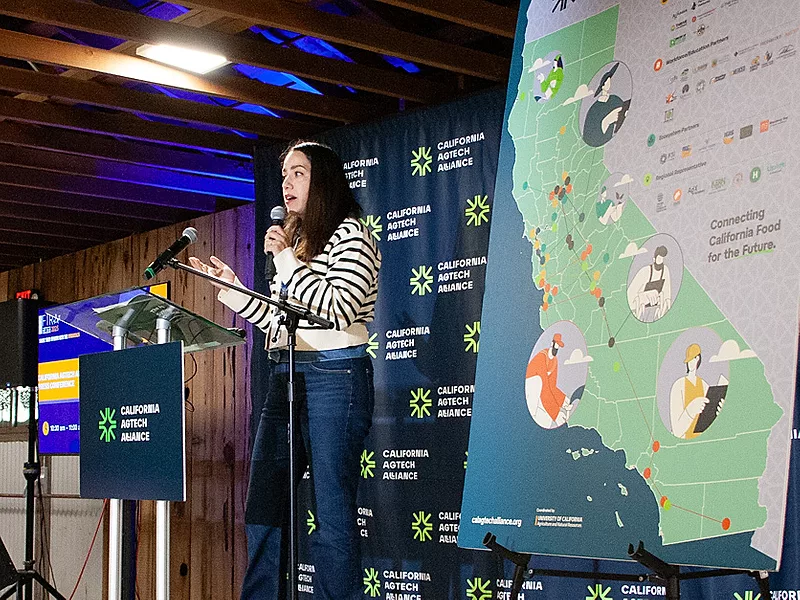
At a separate press conference, Duflock and University of California Agriculture and Natural Resources Chief Innovation Officer Gabe Youtsey announced the launch of the California AgTech Alliance, a new statewide network connecting universities, economic development groups and industry partners. Youtsey said ag-tech is finally being treated as a major economic sector on par with life sciences, AI and advanced manufacturing.
The state has directed $28 million in recent months to build that ecosystem. Supported by the Governor’s Office of Business and Economic Development, the alliance aims to accelerate commercialization and strengthen local clusters around robotics, automation and data tools. It will take more than venture investors alone, requiring government, industry and science coming together in new ways, he explained.
Cut through the clutter! We deliver the news you need to stay informed about farm, food and rural issues. Sign up for a FREE month of Agri-Pulse here.
Building a workforce for automation
While funding was the dominant concern, speakers also focused on the people needed to install and operate emerging technologies. California Department of Food and Agriculture Secretary Karen Ross, taking the stage after Duflock and Youtsey, said the state’s innovation push must “leave no one behind” as California transitions to a carbon neutral economy.
Ross said the real challenge is ensuring that automation improves working conditions instead of displacing jobs.
“We are not only about making sure this is a bright place to work — these are jobs that support families — but that young people get as excited about California agriculture as Karen Ross does,” she mused.
That idea is guiding new programs in higher education, as highlighted by Ross at FIRA and at the monthly hearing of the Cal/OSHA Health and Safety Standards Board leading up to the conference. Cody Jacobsen, dean of agriculture and industrial technology at Merced College, described to the board the school’s partnership in an ag-tech certificate program and how it trains students to handle robotic and precision equipment while meeting safety requirements. He said the college aims to bridge the gap between traditional farm labor and the digital economy.
“As we continue to grow with technology in the agriculture industry, things are constantly evolving and changing,” said Jacobsen. “We're finding equipment that's requiring a little bit more advancement of technological skill, and that's where we come into play.”
Karen Aceves, founder and CEO of the consulting firm ARKEN Strategies, shared that message with the board, as well as with the FIRA audience and with the State Board of Food and Agriculture, which held its monthly meeting at FIRA. Aceves helped bring the program, known as AgSTEP, to life at Merced College and at six other community colleges in the Central Valley through a collaboration known as the Future of Food Innovation Initiative, or F3.
“We said that if we are going to transform this economy, we have to make sure those workers who are at risk for automation are first in line for the opportunities,” said Aceves.
Beyond workforce development, Ross previewed the California Agricultural Research and Innovation Roadmap alongside UC ANR Vice President Glenda Humiston and David Still, executive director of the California State University Agricultural Research Institute.
Based on months of listening sessions with growers, the forthcoming plan identifies priorities for public and private investment, along with pain points and bottlenecks. The intent, said Ross, is “not replacing the long-term research, but supplementing that for all the young people that we hope are just starting out their careers.” The funding will support automation, pest control, water efficiency, food safety and other areas.
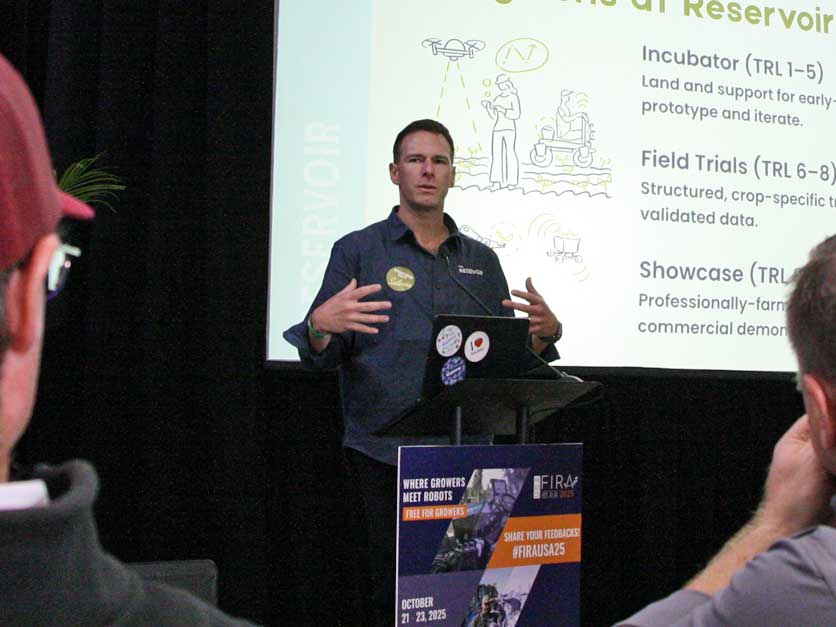 Danny Bernstein, Reservoir Farms (Brad Hooker/Agri-Pulse photo)
“We hope to be able to funnel it down to what we think are the most likely funding sources — we have to be realistic about that — the most feasible ones for which we could get early successes, and hopefully the ones that are actually going to more readily address the pain points in agriculture,” said Ross.
The plan will focus on “priority buckets” for climate resilience, water challenges, pest and disease management, food safety and consumer health, technology, and economics.
From demonstration to deployment
The ag-tech industry is also creating its own infrastructure to keep innovation grounded in commercial realities. In Salinas, Reservoir Farms has opened a farm-based incubator that provides testing space for robotics startups. CEO Danny Bernstein said at FIRA that he saw a need for a facility that could merge field operations with research and fabrication.
Despite more than 7,000 startup incubators in the world, “we couldn't find one that combined two things: a working specialty crop farm and a space for ag-tech, robotics, precision, fab, machines, etc.”
Bernstein said too many startups lose time and funding because they lack access to commercial fields, describing it as “capital inefficiency. The company has raised venture capital, but they're not testing on a farm for nine months,” and testing in a way that does not interrupt the grower.
Reservoir now offers small acreage and facilities where developers can conduct side-by-side comparisons under real-world conditions, explained Bernstein. The plan is to run multiple trials on the farm for a single commodity across multiple small plots. If a startup gets through those trials and hits its milestones, Reservoir taps into its network to engage more farms. Western Growers will publish case studies on the products to quantify cost savings and speed adoption in the commercial market. Bernstein plans to expand the concept to sites in the Central Valley and wine country.
Throughout the FIRA discussions, leaders across industry and government agreed that automation is no longer a distant vision but a survival tool for the state’s farms.
“California — and specialty crop agriculture in the western U.S. — is really critical to the U.S. food supply, and we want to see it here for many generations,” said Youtsey. “Innovation is driving [the industry] towards the future, with automation and smart machinery applications, new biological tools and a variety of other innovations that are going to be critical to keeping California agriculture and the U.S. food supply strong and resilient.”

