
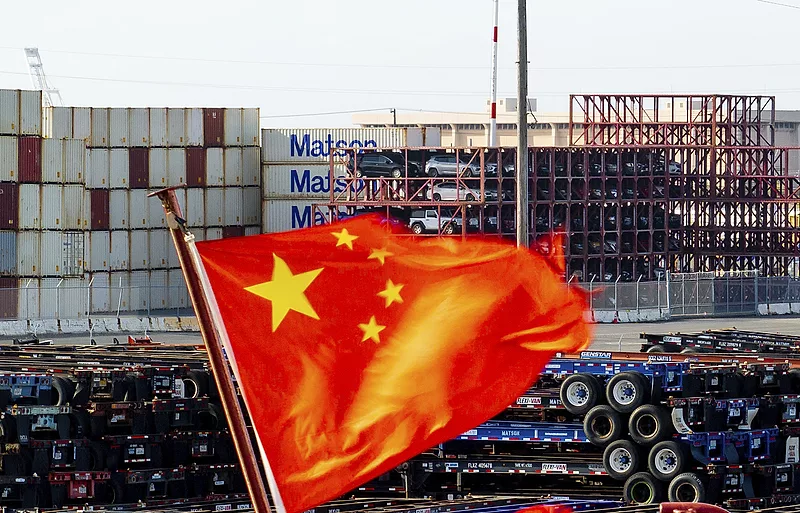
Ag officials aren’t involved in China talks … yet
No ag officials in U.S.-China trade talks so far, according to three people familiar with the discussions. Industry figures and former officials say that suggests any announcement this week will reflect preliminary goals, without highly specific details.
During the Phase One Agreement negotiations in President Donald Trump’s first term, USDA officials sat in on all 33 negotiating sessions. These included representatives from the Foreign Agricultural Service’s China office and others.
But sources say ag officials have not yet been in the discussions with the Chinese.
USDA did not respond to questions about who has been in meetings and whether working-level meetings have begun.
“It's a much tighter circle,” a person familiar with the talks told Agri-Pulse.
Accordingly, two former officials said that they expect that any announcement from a Trump-Xi meeting on Thursday will focus on purchase commitments to secure immediate relief for U.S. growers. Non-tariff barriers, they said, would likely be addressed later.
The absence of ag officials in the talks serves to highlight Trump’s approach to trade negotiations in his second term. Deals have followed a similar pattern with the release of a headline announcement before officials begin work on specifics and final details.
A similar announcement on Thursday would be entirely fitting with the “cadence” of other negotiations, an industry source said. They said that they wouldn’t expect ag-specific officials to be involved before negotiations on actual text kick off.
“There are still preliminary discussions taking place to try to outline what a framework could look like,” a former official told Agri-Pulse.
They hope down the line that, “the appropriate experts, trade negotiators and subject matter experts can get in the room with their Chinese counterparts and hammer out details that would benefit U.S. agriculture.”
Take note: The Wall Street Journal on Tuesday reported that the Trump administration is reportedly looking at halving the 20% duties applied to China over its role in the fentanyl crisis as part of negotiations.
Lawsuit over SNAP benefits cites USDA shutdown plan, law
The fight over November SNAP benefits is now in federal court.
The law that created the Supplemental Nutrition Assistance Program says recipients must be provided benefits, even during a government shutdown, according to 25 states and the District of Columbia that filed a lawsuit in Massachusetts Tuesday.
They also argued that USDA’s shutdown plan recognizes that USDA can use a contingency fund to pay SNAP enrollees. That fund has between $5 billion and $6 billion, the complaint said – enough to cover most of November.
That plan was recently taken off USDA’s website. On Oct. 24, USDA said it was suspending benefits for November.
“The contingency fund is not available to support FY 2026 regular benefits, because the appropriation for regular benefits no longer exists,” USDA said in its Oct. 24 explanation that went to states.
Cut through the clutter! We deliver the news you need to stay informed about farm, food and rural issues. Sign up for a FREE month of Agri-Pulse here.
“The USDA memorandum supplied no legal citation for this legal claim,” the states’ lawsuit says.
Vance weighs in: Vice President JD Vance says the Democrats are to blame for the government shutdown. Democrats have insisted Republicans agree to retore Medicaid cuts made in the One Big Beautiful Bill Act and extend a premium tax subsidy for healthcare premiums.
“We are trying as much as possible to ensure that critical food benefits get paid, that our military gets paid,” Vance told reporters. “But you know what makes it really easy? If the Democrats just opened up the government.”
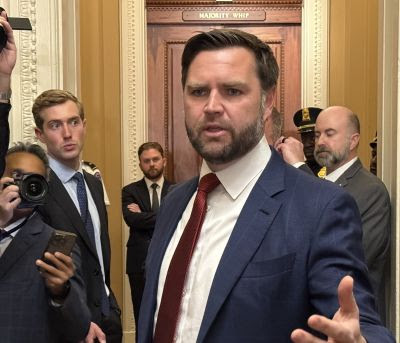 Vice President JD Vance (Agri-Pulse photo)
Callahan on the Hill
Trump’s pick for chief ag negotiator in the Office of the U.S. Trade Representative, Julie Callahan, will appear before the Senate Finance Committee this morning.
Expect senators to highlight specific trade barriers for their states commodities, while Democrats decry the Trump administration’s trade policy and alleged lack of transparency in negotiations.
GOP reps pan Argentina assistance, call for swift tariff help
Four farm-state Republican lawmakers concerned about the administration’s decision to extend financial support to Argentina are calling on officials to swiftly ink a China deal and stand up tariff support for farmers.
A $20 billion currency swap line “risks using American financial strength to indirectly subsidize foreign competitors,” the lawmakers argue in a letter to Treasury Secretary Scott Bessent and Agriculture Secretary Brooke Rollins. “We strongly urge you to ensure that any extension of credit or financial support to Argentina includes conditions that protect U.S. agricultural interests.”
Missouri Rep. Mark Alford led the letter, first reported by Agri-Pulse. It was also signed by Reps. Don Bacon, Neb., Mike Ezell, Miss., and Ann Wagner, Mo.
“Our producers cannot afford to wait while foreign competitors receive favorable terms,” they argue.
Ranchers advised to hit the internet in Trump era
The National Cattlemen’s Beef Association has a tip for businesses trying to keep up with the Trump administration: ramp up the social media.
“If you can find a way up front to get ahold of the social media aspect of your industry, I would strongly recommend you do that early,” said Ethan Lane, NCBA’s senior VP of government affairs. “This is an administration that places an incredibly high value on social media, on influencers. They don't seem to have a huge amount of concern about whether those are real or a creation of the internet.”
The advice comes as U.S. beef producers oppose Trump’s proposal to import meat from Argentina.
“There has been a pretty loud outcry,” Lane said at a Semafor discussion in Washington on Tuesday. On whether the move could lower meat prices for consumers, Lane cited a study showing the decrease might be around 6 cents a pound, “probably not the rock anybody’s church is built on.”
Lane says Trump’s timing was particularly bad for an industry finally emerging from rough market conditions and making seasonal decisions on whether to replenish their cattle or sell heifers at historically high prices.
“What they heard from the administration, an administration that … most of them voted for, was, ‘I think you should take less for your cattle,’” he said. “So while the White House and USDA has made it very clear they want to work with us to rebuild the herd, which we would love, the message that was sent last week was the exact opposite.”
Ohio officially submits SNAP food restriction waiver request
Ohio on Tuesday officially joined other states that want approval from the Agriculture Department to bar purchases of soft drinks through the Supplemental Nutrition Assistance Program.
According to a copy of the request obtained by Agri-Pulse, Ohio is seeking to bar SNAP purchases of beverages that contain sugar, corn syrup, high fructose corn syrup “as the first ingredient, or as the second ingredient if the first ingredient is carbonated water.”
Take note: Ohio's request will require USDA approval before being implemented.
For a state-by-state breakdown of waiver requests that have been submitted so far, click here.
Final word
“Enough is enough. President Trump and Agriculture Secretary Brooke Rollins must disburse the congressionally appropriated funds and use all available legal authority to ensure the most vulnerable members of our communities can keep food on their tables come November.” – Rep. Angie Craig, D-Minn, ranking member of the House Agriculture Committee, on the lawsuit filed against the administration over SNAP benefits.
Kim Chipman, Oliver Ward and Noah Wicks contributed to today’s Daybreak.
.webp?t=1762183428)


