
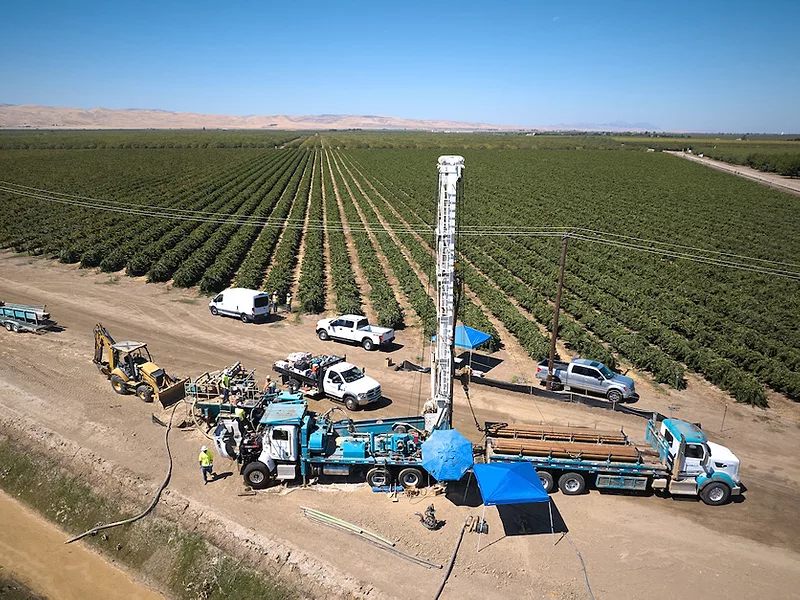
A new study by the California Department of Water Resources finds that stabilizing groundwater levels — rather than expanding canals — is the top priority for protecting long-term water supplies in the San Joaquin Valley.
The San Joaquin Valley Conveyance Study concludes that widespread land subsidence caused by decades of groundwater overpumping has significantly damaged the region’s major water delivery system and threatens future reliability if not addressed.
The study shows that ground sinking has already reduced the capacity of key State Water Project and Central Valley Project canals that move water across the valley, including the California Aqueduct, San Luis Canal, Delta-Mendota Canal and Friant-Kern Canal. Some sections of the San Luis Canal have sunk more than 8 feet since the 1960s. DWR reports that subsidence has cut the California Aqueduct’s conveyance capacity by 44% and the San Luis Canal’s capacity by 46% compared with design levels.
The report warns that if subsidence continues at recent rates, California’s ability to move water during wet years and store it for dry periods could be dramatically reduced. DWR modeling found that, without repairs or operational changes, State Water Project deliveries could drop by as much as 87% over the next two decades due to the combined impacts of land subsidence and climate change.
Don’t miss a beat! It’s easy to sign up for a FREE month of Agri-Pulse news! For the latest on what’s happening in Washington, D.C. and around the country in agriculture, just click here.
Rather than recommending major new conveyance construction, the study finds that limited surface water availability, not infrastructure size, is the primary bottleneck in most parts of the valley. An analysis of 38 water service areas found that 29 were water supply-limited, meaning existing canals could move more water if additional supplies were available. Only a small number of areas showed potential benefit from expanded conveyance capacity.
The report concludes that repairing subsidence-damaged canals and raising groundwater levels above critical thresholds are the most cost-effective steps for protecting water reliability. Achieving that goal will depend heavily on implementation of the Sustainable Groundwater Management Act, which requires local agencies to bring basins into balance by 2040 or 2042, depending on basin conditions.
DWR officials said addressing groundwater decline is essential to safeguard both communities and agriculture.
“This study makes the picture unmistakably clear: The most effective path forward is stabilizing groundwater levels and repairing the major canals that bring surface water to the San Joaquin Valley,” said Joel Metzger, deputy director of statewide water resources planning and enterprise project management. “Taking action to support these goals is essential if we want to protect the valley’s communities, support its agricultural economy and maintain a functioning water system in a hotter, more extreme future.”
The study was completed as part of Gov. Gavin Newsom’s Water Resilience Portfolio and will be followed by additional watershed-level analyses focused on flood-managed aquifer recharge and climate impacts, expected to be released in December.

