
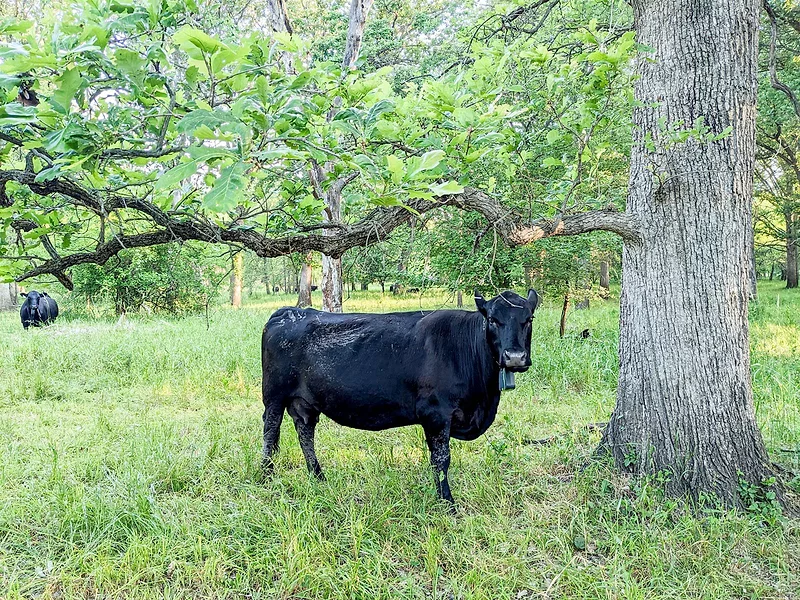
When heavy rains flooded pastures in East Hardwick, Maine, in July 2023, rancher Ben Nottermann couldn’t reach his livestock for days.
Yet his cattle remained safe with access to higher ground and food, guided by collars from a virtual fencing system.
“Had they been on poly wire and step-in posts, they would have either run out of feed, broken the poly wire to get more, or made a giant mess,” said Nottermann. “I was able to move them forward and keep them in grass from my home without actually having to go there.”
As extreme weather, rising labor costs, and growing interest in regenerative agriculture drive demand, public and private funding are helping producers like Nottermann adopt the technology.
Virtual fencing uses GPS collars, audio cues, and mild electric pulses to guide livestock within set boundaries, and farmers are testing the technology for rotational grazing and protecting sensitive areas, reducing the need for high-maintenance physical fences. Farmers can set fencing perimeters and track animals all through an app.
Nofence U.S. managing director Alex Bell said the collars are simple to set up. “You basically unbox the collar, you put the battery in, and you’re off to the races,” he said.
 Alex Bell (Nofence photo)
Bell added that virtual fencing is more than a containment tool. “It’s not just a fence, it’s a management system that helps the farmer or rancher get more out of their land and livestock,” he said.
Research on virtual fencing began in the 1980s but only became commercially available in the U.S. in 2024. Several companies, including Gallagher’s eShepard, Halter, Nofence and Vence, now offer systems.
Federal conservation funding now available
Virtual fencing isn’t cheap. Costs differ by herd and pasture size, battery life and signal technology. Some systems rely on cellular signals, while others use multiple base stations to send signals to collars.
The cost of the collars ranges from $18 to $66 each and some require an annual subscription and additional installation fee for base stations, according to a comparison chart developed through The Rangelands Partnership. Some collars have solar charged batteries that can last up to 10 years, while others use replaceable batteries.
Some producers rely on grants and partnerships to help cover upfront expenses.
The U.S. Department of Agriculture’s Natural Resources Conservation Service (NRCS) updated its national fence practice standard in 2024 to include virtual fencing. On Oct. 1, the beginning of the federal fiscal year, the technology became eligible for financial assistance through the Environmental Quality Incentives Program, operated by NRCS.
Interested in more news on farm programs, trade and rural issues? Sign up for a four-week free trial to Agri-Pulse. You’ll receive our content - absolutely free - during the trial period.
The funding is available for cross-fencing and prescribed grazing through paired practice standards, so virtual fencing must be part of a larger grazing management plan. Cross-fencing creates smaller paddocks by installing fencing within a larger pasture.
NRCS views virtual fencing as an alternative to interior or cross-fencing, not a replacement for perimeter fencing. Many producers and conservation groups hope that changes as reliability improves.
Bell said federal support is accelerating adoption. “We want this to become mainstream because it drives profitability at the farm level. Funding helps producers get there,” he said.
Private and nonprofit groups also are helping producers cover equipment costs.
The Property and Environment Research Center (PERC), for example, funds pilot programs nationwide on wildfire mitigation, wolf conflict management and other challenges.
Kari Esbensen, a Wisconsin farmer using virtual fencing for a goat herd and to preserve pollinator habitat, received a $45,000 PERC grant. “I was blown away by the opportunity,” she said. More than 90 other producers applied, she added. PERC grants range from $10,000 to $75,000 for projects demonstrating conservation benefits.
Potential cost savings, conservation benefits
Virtual fencing advocates say it can help reduce labor and feed costs. By increasing grazing days through precise rotations, producers can cut back on winter feeding.
“More grazing days pretty directly leads to less winter feed input and less winter feed costs,” said Tony Capizzo, director of The Nature Conservancy’s Flint Hills Initiative in Kansas.
In California, wildfires have destroyed miles of traditional fence, prompting interest in virtual fencing as a cost-effective alternative.
“Some ranchers lost 20 or 30 miles of fence,” said Ethan Inlander, TNC’s California project director. “Contracting a mile of new barbed-wire fence can cost $35,000, so virtual fencing is worth exploring.”
Labor savings are another benefit. Capizzo said his team has seen cattle move themselves to new paddocks overnight, reducing daily fencing work.
Nottermann said virtual fencing saves him about 45 minutes a day, turning tasks that once took an hour into 10 minutes.
 William Burnidge (TNC photo)
 During calving season, the technology allows ranchers to confine cattle to smaller areas and respond quickly when help is needed, said William Burnidge, director of TNC’s Sustainable Grazing Lands Program.
The Nature Conservancy has partnered with universities and ranchers on multi-year projects testing whether the technology can support soil health, biodiversity and cattle production simultaneously.
In Kansas, virtual fencing has improved habitat for greater prairie chickens, an “umbrella species” whose needs benefit other tallgrass prairie wildlife.
Capizzo said collars allow managers to rotate grazing and create small exclusions, often about 10 acres, in prime nesting areas.
“We’re seeing really high use by both henslow sparrows and greater prairie chickens,” Capizzo said. “In this case, the virtual fence system has really made the difference in creating high-quality habitat.”
The technology also supports prescribed-fire intervals while increasing productive grazing and wildlife habitat across the prairie.
As adoption grows, conservationists say virtual fencing is poised to become a core tool in modern grazing.
Burnidge said the technology can support profitability, quality of life and healthier land.
“It’s going to improve that triple bottom line,” he said. Virtual fencing will connect with other ranch innovations and give producers more flexibility to plan grazing and respond to drought.
“It’s part of a package of innovations that will shape what ranching looks like in the next 25 to 50 years.”

