
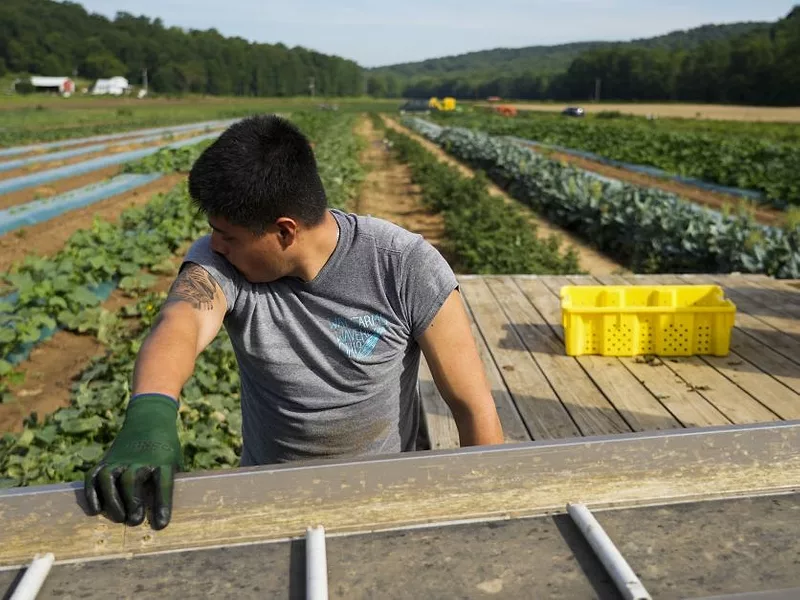
Farmworker and grower groups are battling over the future of the H-2A program, as the Trump administration seeks to lower wages and provide relief to farmers who have complained for years about rising labor costs.
The fight is now in court, where farmworker advocates have filed a lawsuit challenging an interim final rule issued in October that took immediate effect. That rule includes new requirements designed to decrease the salaries paid to farmworkers using the adverse effect wage rate (AEWR), so named because by law, the H-2A program is supposed to ensure that its operation does not have an “adverse effect” on U.S. workers.
Comments submitted to the Labor Department on the rule offer a preview of how the lawsuit might play out in court. United Farm Workers, the UFW Foundation and 18 farmworkers filed it in federal court in the Eastern District of California Nov. 21. The court set a scheduling conference for March 19.
The rule will result in an annual benefit to producers of $2.46 billion, money that would no longer have to go to farmworkers, the department estimated in its rule.
The major issues revolve around the Labor Department’s scrapping of USDA’s Farm Labor Survey (FLS) in favor of the Bureau of Labor Statistics’ Occupational Employment and Wage Statistics (OEWS) survey; reclassification of employees based on the work they do; and a credit for employers who, as the law requires, must provide housing to H-2A workers.
USDA's National Agricultural Statistics Service said in September it was discontinuing use of the USDA survey, calling it "duplicative and/or no longer necessary."
Ag employers have alleged for years that the survey inflates farm wages. National Council of Agricultural Employers CEO Michael Marsh, for example, said in comments that the survey's data was suspect in part because it picks up wages paid to H-2A workers, “generating an echo effect in the data.”
 Michael Marsh (Agri-Pulse photo)
Marsh said the OEWS is better than the FLS because it excludes overtime and bonuses, allowing wages “to be more reflective of the market for agricultural labor.”
The Georgia Fruit and Vegetable Growers Association said the OEWS, while better than the FLS, isn’t perfect because it also includes AEWR wages. However, the rule’s use of a three-year rolling average to determine wages “will help dampen some of the annual shocks from double-digit percentage wage changes under the FLS-based wages," said Executive Director Chris Butts.
Debate over Farm Labor Survey continues
UFW and the UFW Foundation, however, said the FLS was the better survey because it actually surveyed farmworkers. “The [interim final rule] argues that it should replace the FLS data with OEWS because it is a more precise and robust data source,” the groups said in their comments.
“But if DOL was seeking to achieve its objective and statutory mandate of preventing an adverse effect on U.S. workers employed in farm labor, it would not be using the OEWS, which surveys non-farm establishments like [farm labor contractors]. The FLS surveyed farm establishments, like farm operators, landscape architects, and other agricultural businesses, while none of these entities are surveyed by the OEWS.”
Farmworker Justice also criticized the change, noting that the FLS was conducted four times a year and thus “came closer to capturing seasonal peaks in farmworker wages by measuring wages at four points during the year: January, April, July, and October.” The OEWS, however, is only done in May and November and “as a result, it is unlikely to capture wages from peak harvest season, when there is more competition for farm labor and wages are typically higher.”
Even farm groups said the Labor Department needs to move cautiously in using the OEWS.
“The OEWS was not designed to measure on-farm wages, and its output should be interpreted carefully until agricultural data are integrated,” the International Fresh Produce Association (IFPA) said in its comments.
Interested in more news on farm programs, trade and rural issues? Sign up for a four-week free trial to Agri-Pulse. You’ll receive our content - absolutely free - during the trial period.
Labor Services International (LSI), a farm labor consulting company, also said the OEWS needs further refinement.
“One major concern is that OEWS may still carry the influence of wage levels inflated under the Biden administration’s AEWR methodology,” LSI's Catherine Watts said. LSI works for about 100 agriculture employers in North Carolina, Virginia, Mississippi, Louisiana, Wisconsin, Kentucky, Tennessee and Texas.
“In our experience, many employers were required to pay wages well above true market rates simply because the prior AEWR system demanded it,” Watts said. “Those inflated wages, in turn, were captured in state wage surveys. If OEWS continues to incorporate historical data without filtering, it risks creating artificially elevated wages.”
The Georgia fruit and vegetable group embraced the department’s proposal to add farms to the OEWS survey: “They will provide a key data source, and we trust the ability of [the Bureau of Labor Statistics] to gather accurate data more than we ever did the flawed FLS surveys.”
Another disagreement centers on worker classification. Under a Biden administration rule that was struck down by a federal judge in Louisiana, workers were paid based on what was called the “single duty test,” which required that workers “who performed higher-paying tasks were paid accordingly, even if they did not perform those tasks for the majority of their contract,” UFW said.
Under the new “primary duties” test, workers would be paid based on their skill level (Skill Level I or Skill Level II), as opposed to the five farmworker classifications in the FLS.
The use of the two skill levels “effectively codifies a permanent pay downgrade and establishes a two-tier wage system that rewards employers for misclassifying and underpaying workers,” UFW and the UFW Foundation said. “The majority of farmworkers will likely be classified as Skill Level I, which will have wages that are equal to the lowest 17th percentile of wages in the relevant farming sectors.”
New classification system may still cause confusion, farm groups say
The National Council of Farmer Cooperatives (NCFC) said it supports the two-tier system but added that basing the classification on the “majority of duties on the majority of days” could lead to problems for employers.
“Agricultural employment is inherently dynamic; workers often rotate between related tasks depending on weather, crop cycles, and production schedules,” NCFC CEO Duane Simpson said. “No single duty may dominate across an entire contract, making a rigid majority-of-days test impractical.”
The Labor Departm Duane Simpson (Bayer photo)ent “should clarify that primary duties – the principal or most significant work performed over the contract – govern [Standard Occupational Classification] assignment. Ancillary or incidental duties should not change classification if secondary to the position’s core function.”
LSI also said the classification system “needs refinement.”
“A workday-based threshold is too rigid,” the company said. “It captures minor duties performed briefly every day, even when those duties represent only a very small portion of actual time worked.”
The rule also provides a credit to employers for providing housing to H-2A workers. The credit varies by state, with the California AEWR, for example, dropping by $3/hour. For Skill Level I, that amounts to a drop from $16.45 an hour to $13.45 an hour. Most states’ credits are below $2.
UFW and the UFW Foundation said the housing “adjustment,” as it’s called in the rule, “makes the AEWR go below the state or territory-wide minimum wage in large parts of the country, including 21 states and additional territories.” The groups also said that even a $2 to $3/hour wage cut would be difficult for farmworkers to absorb.
And the Economic Policy Institute (EPI) said the housing deduction will “harm U.S. farmworkers, not help them.”
Previous H-2A rules “required employers to offer no-cost housing to U.S. farmworkers if they were in corresponding employment with H-2A workers; thus, they were entitled to the same benefit if they needed housing,” EPI said.
“But the massive reduction in wages that H-2A workers will see from the housing deduction will greatly reduce labor costs for employers who hire H-2A workers as compared to U.S. farmworkers – undercutting U.S. wages and incentivizing employers to hire H-2A workers and bypass U.S. farmworkers—which will unquestionably ‘adversely affect’ the wages and working conditions of U.S. farmworkers.”
Farm groups, however, welcomed the housing credit. IFPA said the rule strikes a “balance between statutory obligation and practical implementation” by “align[ing] compensation with tangible non-cash benefits employers are legally required to provide.”
The American Farm Bureau Federation’s John Newton, vice president of public policy and economic analysis, noted that employers have numerous obligations under H-2A besides wages. They have to pay for transportation to and from the U.S. and visa costs.
“An employer must pay over $1,300 in application fees alone for one H-2A worker to enter the United States, before any work is completed,” Newton said. “When combining this with USDA estimates on housing and foreign transportation costs, nonwage costs are over $11,000 per worker, not including daily travel to worksites.”

