
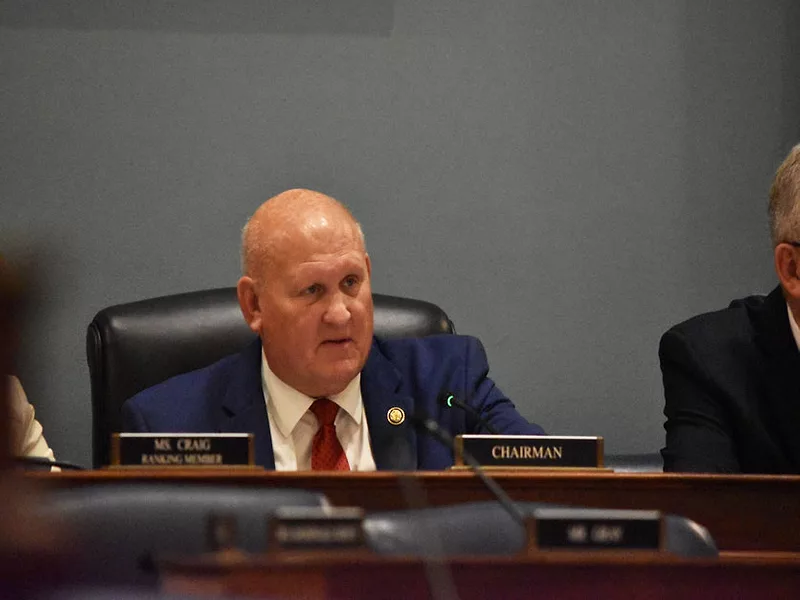
House Agriculture Committee Chair Glenn “GT” Thompson, R-Pa., is taking issue with suggestions that the days of full, five-year farm bills may be over.
"I think that's people who are naive and don't have a great historical grasp on farm bill processes," he told Agri-Pulse. Thompon also said on Tuesday that federal lawmakers need to give farmers at least $10 billion more on top of $12 billion in aid from the Trump administration.
Meanwhile, Richard Fordyce, undersecretary for the U.S. Department of Agriculture’s Farm Production and Conservation Mission Area, told Agri-Pulse the agency has no plan to look at providing additional payments.
"USDA is where we are at and probably will be as far as the level of support," he said, adding that he didn't have insight on what Congress might do.
Biofuels market stalled till RVOs come out, analysis says
The biofuels market will remain in regulatory limbo until EPA issues its final Renewable Volume Obligations, Bloomberg Intelligence analyst Brett Gibbs writes in a new report.
Sweeping changes in the proposed RVOs could test the EPA's authority around the 20-year-old Renewable Fuel Standard. Still, it's clear federal support is intact for existing biomass-based diesel capacity and that U.S. agriculture inputs are being prioritized, which together "instill confidence in a recovery in margin and volume in 2026," Gibbs wrote.
The report also looks at the complex world of renewable identification numbers, or RINs. Those are credits used to track RFS compliance and are "the currency of U.S. biofuels," the report said. With a collective value of $28 billion in 2023, RINs are a main driver in biofuels production, Gibbs noted.
Biomass-based diesel used 47% of U.S. soybean oil last year, while ethanol typically uses more than a third of America's annual corn harvest.
Meanwhile: Sen. Chuck Grassley warned the Trump administration that the 2025 window to complete crucial regulations for farmers and renewable fuel producers is closing fast.
The Iowa Republican said Tuesday that Treasury Department guidance on the 45Z Clean Fuels Production Tax Credit and EPA final rules on 2026-27 biofuel-blending requirements are urgently needed so farmers can plan for next season.
‘MAHA win’ slammed by row crop groups
U.S. soybean, canola and corn groups on Tuesday decried what they called "troubling" social media content from the Department of Health and Human Services.
"Vegetable oils play an essential role in a healthy food supply," the groups said in a web post. "Portraying corporate marketing moves as public health 'wins' is misleading and counterproductive, doing little to address obesity or chronic disease. Worse, it fuels consumer confusion, erodes trust in science-based guidance, and unfairly vilifies American-grown, American-made ingredients that are essential to our food system."
The statement didn't identify the post, but on Dec. 12, HHS touted "another MAHA win!" on X, highlighting a news headline about a restaurant group no longer using seed oils.
HHS didn't immediately respond to requests for comment.
Take note: Agri-Pulse is hosting a free webinar at 1 pm CT on Dec. 18 on this topic: “Analyzing the Health and Economics of Seed Oils”. Click here to register and learn more.
US ag will struggle to comply with EU’s deforestation rule even with delay
The European Parliament will vote today to delay incoming European Union deforestation rules as the bloc is set to postpone implementation again. But the U.S. ag sector warns that even with another delay supply chains will struggle to adjust by the new deadline unless the rule is amended.
Cut through the clutter! We deliver the news you need to stay informed about farm, food and rural issues. Sign up for a FREE month of Agri-Pulse here.
Under the new timeline, large companies will have until the end of 2026 to comply, while smaller companies get until mid-2027.
Covered U.S. industries, including soy and timber, will still struggle to comply with the rules even with the extra runway, the American Farm Bureau Federation says in its latest analysis.
The rules require geographic coordinates from the plots of land each product was grown on – a logistical nightmare for bulk commodities like woodchips which are mixed in storage facilities, AFBF says.
As “long as the rule stands as currently drafted, agricultural supply chains will be strained from the looming enforcement deadline,” the analysis reads.
California officials suggest Colorado River plan
The Colorado River Board of California released a proposed framework Tuesday for post-2026 operations that includes a 440,000 annual acre-foot reduction of annual water use.
The proposal suggests that Mexico and the three lower basin states of California, Nevada, and Arizona conserve up to 1.5 million acre-feet per year, according to a press release. The framework calls for “hydrology-based, flexible water releases" from both Lakes Powell and Mead, and a long-term agreement with adaptive phases.
The press release says on top of the 440,000 acre-feet in the proposal, California is "also committed to making additional reductions to address future shortages as part of a comprehensive basin-state plan” if circumstances warrant.
The press release also says California leaders are “willing to set aside many of their legal positions to reach a deal.” Those include releases from Lake Powell under the Colorado River Compact, distribution of Lower Basin shortages, and other provisions of the Law of the River, “provided that there are equitable and sufficient water contributions from every state in the Basin and the country of Mexico.”
Take note: Negotiators from across the Colorado River basin are meeting this week at the annual Colorado River Water Users Association conference in Las Vegas, where California officials are offering this proposal. All seven states are currently involved in tense negotiations over the future of water-sharing on the river.
Haitian workers file lawsuit against JBS
Three Haitian workers on Tuesday sued JBS Foods, accusing the meatpacker of misleading Haitian employees in its recruitment efforts.
The class-action lawsuit filed in federal court in Colorado asserts that JBS charged Haitians to “live in squalid conditions and subjected them to dangerous work conditions without proper training” after recruiting them to its Greeley, Colorado, plant.
The Haitians said they were promised “high-paying jobs that required no English language skills and employer provided housing in nearby apartments.” The lawsuit charges the company violated the Civil Rights Act and the Colorado Wage Claim Act.
JBS did not respond to a request for comment by press time.
Final Word:
“The last trade war caused a 76% drop in the value of U.S. soybean exports to China and cost U.S. agriculture more than $27 billion. Soybean farmers don’t need another trade fight; we need certainty. That means enforcing past commitments and working toward agreements that keep markets open and predictable for the long term.” – American Soybean Association Chairman Josh Gackle at a hearing to review China’s follow-through of its Phase One commitments.
Kim Chipman, Lydia Johnson, Oliver Ward and Noah Wicks contributed to today’s Daybreak
.webp?t=1762183428)


