

|
California’s ongoing effort to rein in anticoagulant rodenticides has erupted into a regulatory battle pitting agricultural interests and pest control professionals against environmental advocates.
At issue are draft regulations that would classify both first- and second-generation anticoagulant rodenticides as restricted materials and sharply limit their use near structures, along with new training and sustainable pest management requirements. State Department of Pesticide Regulation officials say the rules are intended to reduce repeated wildlife exposure to blood-thinning poisons that have been linked to widespread contamination of raptors, mountain lions and other nontarget species.
The draft has unleashed a flood of public comments that have laid bare sharp divisions over how to regulate widely used rodent poisons. Opponents from the agricultural sector warn that the restrictions could cripple rodent control at food facilities and farming operations, while environmental groups argue the proposal does not go far enough to protect wildlife and to fulfill the department’s statutory obligations.
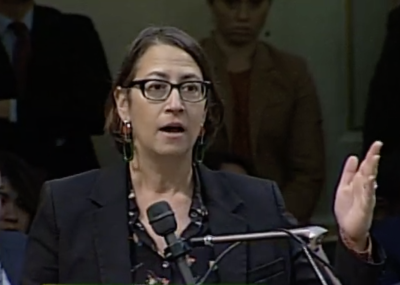 Rep. Laura Friedman, D-Calif. (Friedman office photo)
What it means for food facilities
The proposed regulatory text would cap rodenticide applications at 35 consecutive days and require all unconsumed bait to be collected at the end of that period, with total anticoagulant use at a site limited to 105 days in a calendar year. It would also prohibit placing above-ground bait more than 50 feet from a human-made structure.
The draft spells out where use in and around human-made structures would still be allowed, listing locations like health facilities and clinics, pharmacies, FDA-registered drug manufacturing sites, grocery stores, permanent food facilities, food processing facilities, and locations primarily used for producing, storing, holding or packing agricultural commodities, livestock, poultry or fish.
DPR proposes a new sustainable rodent management training course requirement, with annual completion by anyone applying or supervising anticoagulant rodenticide applications beginning one year after the rules take effect. The draft outlines integrated pest management and sustainable pest management principles, sanitation and exclusion, nonchemical options, resistance prevention, and carcass handling and disposal, along with recordkeeping requirements.
A parallel requirement would mandate a written management plan at each business location or property before anticoagulants are used, to be reviewed yearly and updated as needed.
DPR plans to complete its scientific reevaluation of anticoagulant rodenticides by the end of the fourth quarter of 2026. If that review determines rulemaking or other mitigation measures are necessary, the agency expects to complete formal rulemaking by the third quarter of 2028, according to agency materials.
Don’t miss a beat! It’s easy to sign up for a FREE month of Agri-Pulse news! For the latest on what’s happening in Washington, D.C. and around the country in agriculture, just click here.
The timeline reflects legislative changes in recent years that require DPR to reassess anticoagulant rodenticides and address unintended wildlife exposure before loosening statutory restrictions. While a moratorium on most uses of second-generation anticoagulants has been in place for years, legislation passed in 2024 expanded the restrictions on first-generation products.
Then-Asm. Laura Friedman, D-Glendale, now representing the district in the House, led the push for more regulations through Assembly Bill 2552. Friedman charged that rodenticides pose a public health threat and cited statistics from the American Association of Poison Control Centers that rodenticides led to more than 3,000 human poisonings in 2021, with most victims being children under six years old.
Friedman worked closely with conservation advocates on several pesticide proposals during her tenure in the Legislature.
“As our state pivots to more sustainable and less inherently flawed products, more humane and strategic pest control can work in concert with our wildlife predators, not against them,” Lisa Owens Viani, director and cofounder of the advocacy group Raptors Are the Solution, or RATS, told state lawmakers during testimony on AB 2552.
Owens Viani claimed that alternatives like fertility control products can work just as well as rodenticides.
Friedman assured lawmakers that “the vast majority of agriculture” remains exempt from the bill. But that did not alleviate concerns from farm interests. Taylor Triffo, a lobbyist for the firm Kahn, Soares & Conway representing a coalition of agricultural associations, blasted the measure for usurping the current process for governing pesticides. She argued the bill would allow DPR to overturn the bans through its scientific review process — but only if it meets “near impossible” standards.
“The science should dictate the decision making in that process,” argued Triffo.
She pointed out that Friedman and the environmental groups backing the bill can already submit information at any time on the impacts to species and that DPR would be leg Taylor Triffo, Kahn, Soares & Conway (office photo)ally bound to impose new mitigation standards or ban the products altogether, as needed.
The industry coalition successfully negotiated with Friedman to eliminate a provision in the first incarnation of AB 2552 that would have enabled residents to sue pesticide retailers on behalf of animals.
Food safety, rodent surges and compliance burdens
Agriculture has been among the most vocal critics of the draft. The Western Tree Nut Association is leading an agricultural alliance that represents apple, blueberry, cotton, milk, olive, olive oil and wild rice producers, along with the Nisei Farmers League, African American Farmers of California, and the Fresno and Madera county farm bureaus.
The coalition called out the 35-day and 105-day use limits and the requirement for a sustainable rodent management plan as “destroying the current integrated pest management systems” and conflicting with federal and third-party food safety programs that require documented, continuous rodent control at processing facilities.
In their filings, industry advocates also warned that the proposal’s structural definitions and timing could complicate compliance. They noted that definitions of “site” and “structure” in the draft are ambiguous and could sweep in facilities like packinghouses, cold storage and processing centers that depend on targeted rodenticide applications to meet sanitation standards.
Growers and pest control professionals have underscored that California is experiencing what they describe as an unprecedented rodent population explosion, driven by weather variability and habitat disruptions. They argue that limiting rodenticide use at precisely the moment when rodent pressures are surging could increase disease risks, property damage and plant food contamination if adequate alternatives are not available.
As Gov. Gavin Newsom signed AB 2552 into law, severe rat infestations were surging across more than 100,000 acres of Central Valley orchards and adjacent farm facilities. University of California agricultural economists estimated the overall damages surpassed $100 million and may have been as high as $310 million.
While direct damage to trees led to yield losses, the invasive roof rats also gnawed through electrical wires in trucks and harvesters and in irrigation lines, depriving trees of water and adding a further hit to yields. The rats left a trail of droppings on equipment to clean up, at a cost of up to $4 million.
Farmers spent as much as $168 million just to replace the drip lines. Yield losses the following season, due to the lack of postharvest water, were anticipated to be as high as $130 million.
Also concerned about DPR’s proposal are trade groups representing pest management professionals. The Golf Course Superintendents Association of America raised alarms in its comments that temporary prohibitions are in place until DPR concludes its reevaluation and rulemaking processes. The association urged clear guidance and a workable transition framework for professionals who rely on anticoagulant rodenticides as part of an integrated pest management toolbox.
The push to block all rodenticides
Despite the passage of AB 2552 and the proposed regulations, environmental and wildlife advocates, led by the Center for Biological Diversity, remain frustrated DPR is not doing more to protect wildlife. They continue to point to alternatives like fertility control, exclusion and habitat modification as sustainable long-term solutions and argue that improved sanitation and structural exclusion are often more effective and safer for communities, pets and nontarget wildlife.
“The truth is that no poison is a good poison,” said Kian Schulman, who directs Poison Free Malibu, during a DPR workshop on the proposal last fall. “No poison available on the market in the United States poses no risk to wildlife.”
Industry advocates countered that many of the alternatives are not scalable for large facilities and can be cost-prohibitive. They also cautioned that some nonchemical methods may require substantial infrastructure investments or ongoing labor that smaller operations cannot afford.
Agricultural representatives are taking that message back to the Legislature as it kicks off a new session and lawmakers file hundreds of new measures ahead of a February deadline — with the prospect of yet more pesticide rules in the works.

