
|
The Environmental Protection Agency is refining habitat maps and mitigation options for growers to ensure crop protection chemicals don’t harm federally endangered species.
“If it doesn't work for you all on the farm, then we have some significant rethinking to do, but increasingly, I'm cautiously optimistic,” Kyle Kunkler, deputy assistant administrator in EPA's Office of Chemical Safety and Pollution Prevention, told members of he American Farm Bureau Federation at their recent annual meeting. “I think we're moving in the right direction.”
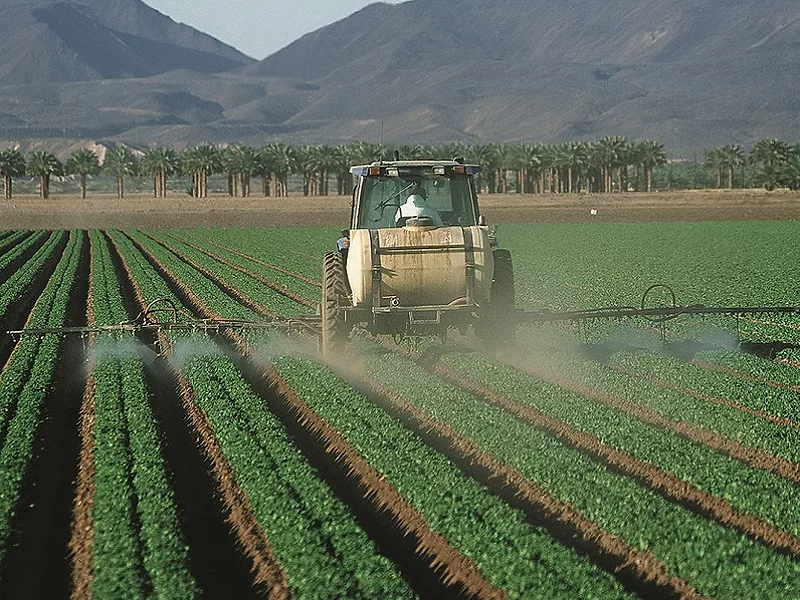
Kunkler outlined how growers can mitigate for the impact of pesticide applications, which as he noted are intended to kill crop pests but can have “unintended consequences to other types of nearby species,” including endangered plants, insects or mammals.
The agency has released final herbicide, insecticide and rodenticide strategies that will use the maps and software to aid growers as they survey their fields to see how they can minimize application impacts.
Interested in more coverage and insights? Receive a free month of Agri-Pulse West.
The strategies apply to new registrations and chemicals that have gone through registration review. At this point that only encompasses a handful of species, such as the nematicide-fungicide active ingredient cyclobutrifluram, which was registered in November for use on turf, ornamentals, and romaine lettuce, as well as cotton and soybean seed. Herbicides glufosinate and Enlist also have mitigation options.
“Slowly but surely as we get through these products that we're reviewing, once we issue new labels, you will see more and more of them begin to have these mitigations on them,” Kunkler said. “And then, as we're issuing registrations for new active ingredients, you would expect to see those new active ingredients have those mitigations on them, as well.”
“They aren't taking effect overnight,” he reassured the crowd at the convention in Anaheim, California.
Lawsuits spurred agency to action
The years-long effort grew out of lawsuits filed against the agency for failing to consult with federal wildlife agencies such as the Fish and Wildlife Service over the impacts of the chemicals on species and their designated critical habitats. But the interagency consultation required under the Endangered Species Act can take years to complete, which spurred EPA to come up with a framework to comprehensively address the issue.
The resulting strategies provide menus of mitigation options containing specific practices that can be used to reduce pesticide impacts. The “two major buckets of potential risks” are runoff and erosion, and spray drift, Kunkler said.
 Kyle Kunkler (ASA photo)
Growers are slowly coming around to the idea that they’ll have to use mitigation, says University of Georgia Extension Weed Scientist Stanley Culpepper.
Growers understand the concept, he says – “put your product on target and keep it there.” Documenting compliance, “is the hard part, and that's what we're trying to work through now and actually help them do that.”
Under the strategies, growers earn points for adopting different mitigation options. The pesticides that pose the least risk will require fewer points than more toxic products.
Culpepper explains that the label provides the baseline for application procedures regarding runoff and spray drift. But growers also should check Bulletins Live! Two, which provides location-specific details on the presence of endangered species.
Culpepper says when he speaks with growers, he narrows the list of mitigation options for runoff from the 38 choices that are available to 11, to simplify the process. His goal is to help them earn enough points so they can use whatever they need to.
“For most growers, if we can help them do it, it will cost them time, right? But I am doing everything I can not to cost them money,” he says.
“They're getting better and better in developing the core maps” to create the Pesticide Use Limitation Areas (PULA) for different species, Culpepper says. “And we're getting better information out in regards to how and when we need to protect those species.”
'Relief points' help growers
Critical to accumulating the points are what are called mitigation “relief points,” which reward growers if they are in a dryland county or their fields are relatively flat. “Field slope is big for me, because I have a lot of flat fields,” Culpepper says. In addition, soil texture, cover crops, and use of conservation tillage methods such as strip-till can be used to accumulate points.
Kunkler and Culpepper both pointed to the introduction of the Pesticide App for Label Mitigations, or PALM.
The app “will walk you through the whole mitigations list and say, what is the slope on your field, what is the soil type on that field?” Kunkler said. Growers can also get credit for having “managed areas” around their fields that they can subtract from the buffer needed to address spray drift.
Growers also can get credit for documenting their mitigation. “If you just document what you're doing, you get a point for that,” Culpepper says.
Culpepper says farmers practicing conservation tillage will “knock it out of the park” as far as mitigation, but with specialty crop growers it will be more difficult to accumulate points.
“If the product stays on target, we’ve got better pest management, we’ve got better resistance management,” he says. “We’ve got, hopefully, more yield, more quality. So, we're trying to turn this into a positive, but the main message is we need time to work through all this, because it is complex.
However, Nathan Donley, environmental health science director at the Center for Biological Diversity, says he has “serious concerns that ESA work on pesticides is going to change directions a bit under this administration.”
Donley points to guidance issued by EPA on the effects of antimicrobial pesticides on endangered species that removed language saying EPA would not consider risk assessments performed by registrants.
“EPA would likely not consider such submissions while conducting its own analyses,” said the draft, issued near the end of the Biden administration. “EPA is responsible for conducting risk assessments and making effects determinations.”
 Stanley Culpepper (UGA photo)
“That was specifically taken out in the final [guidance] and that was a huge red flag to us,” Donley says. “That was incredibly disheartening to hear, and I think broadly signals the direction that this administration is going to go in, which is let the registrants do more on ESA and give some of that control from the agency over to registrants.”
His group has been in the forefront of suing EPA over the impact of pesticides on endangered species and entered into a settlement with the agency and CropLife America requiring development of the strategies. Pesticide Action Network North America also was a party to the settlement.
Donley also says the emergence of the “relief points” for being located in a dry county, having a flat field or documenting mitigation, for example, has had the effect of diluting the mitigation “with a lot of things that are basically going to exempt most people from having to do the good things,” such as vegetated filter strips.
“For most pesticide applications, I would say 90-plus percent of growers are not going to have to implement anything. They just get the relief based off of where they live,” he said. “Most pesticide applications are only going to need two or three [points].”
He adds he does see promise in EPA’s desire to get farmers nine points through use of a conservation plan. The agency is taking comments until March 6 on that option.
“If they can qualify conservation plans that actually do mitigate runoff, to the extent that pesticide users adopt those programs, I think that could have a great impact on ESA work. The question in our mind right now is, is this going to be a legitimate certification, or is this just going to be everyone and their grandfather gets to propose some worthless plan and get certified?” Donley says.
James Todd, a crop consultant in West Texas, says growers in his area should be fine because they’re starting with two points due to low runoff potential.
But, he adds, other areas along the East Coast, including North Carolina and Florida where there are more listed species, it may take more than nine points when PULAs are factored into the equation.
Kunkler and Culpepper urged growers to make their voices heard. “It’s really time for all of our pesticide applicators in agriculture to be aware of this. We want everybody's input, because we want to make this better, because again, we’ve got to protect that endangered farmer as well,” Culpepper said.

