
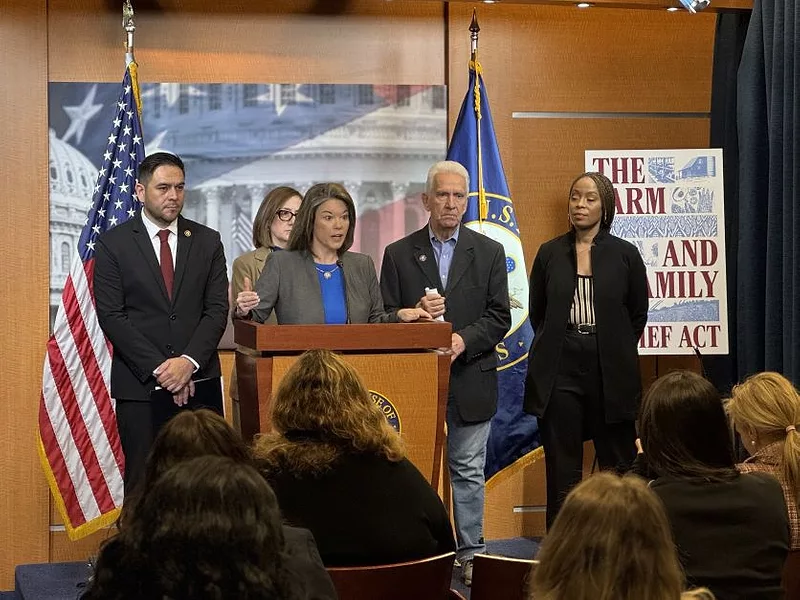
U.S. farmers would get $17 billion in additional aid and President Donald Trump's tariffs would be rolled back under a farm and nutrition bill introduced Thursday by the House Agriculture Committee's senior Democrat, Angie Craig.
The Farm and Family Relief Act also would provide a four-year delay in the cost shift of SNAP benefits to states, currently set to begin in October 2027, a provision Craig said would help protect vulnerable Americans from potentially losing federal nutrition benefits.
The bill would terminate Trump’s orders imposing tariffs under the International Emergency Economic Powers Act (IEEPA). The Supreme Court is currently considering a challenge to Trump's use of the IEEPA.
“President Trump took office one year ago and after launching his worldwide trade war, the cost of living has increased for just about everybody,” Craig said in a statement. “Family farmers have been hit hard by tariffs and lost market opportunities. Hardworking people pay more for groceries each time they go to the store."
House Ag Chairman Glenn "GT" Thompson, R-Pa., has said he wants to move a farm bill through the committee as soon as February. Craig's bill sets up the Democratic position. The measure's co-sponsors include Democrats such as Shontel Brown of Ohio and Jim Costa of California.
Craig, who is running for Senate this year in her home state of Minnesota, urged Republicans to also back the bill.
Cut through the clutter! We deliver the news you need to stay informed about farm, food and rural issues. Sign up for a FREE month of Agri-Pulse here.
The legislation was previewed earlier this month by Craig and other Democrats on the Republican-led House Ag Committee.
Senate Republicans recently released the framework of a proposal to also provide additional financial assistance to struggling farmers, likely about $15 billion, to augment the Trump administration's $12 billion Farmer Bridge Assistance program announced in December.
The bill from Craig would provide one-time payments to row crop commodity producers to cover economic losses from 2025 harvests, with payments determined using projected 2025-26 market year average prices and yields set by USDA. It would give payment on 100% of farm acres, including so-called prevented planting sowings, unlike the Trump aid program, according to a summary from Craig's office.
It also would provide one-time payments to specialty crop producers that are modeled after the Marketing Assistance for Specialty Crop (MASC) program set up during the former Biden administration to deal with farmer losses, with $5 billion allocated and payment limits matching MASC at $900,000.
The measure would cover 65% of estimated sugar beet losses and would provide $520 million in aid to forest producers and $250 million for direct cash assistance to forest landowners and timber processors affected by tariffs who can demonstrate losses stemming from last year.
For more news, go to Agri-Pulse.com.
.webp?t=1762183428)
