

|
The safety of glyphosate, the active ingredient of Roundup, will test the political power of the Make America Healthy Again movement this month as the House Agriculture Committee takes up a farm bill.
Over the opposition of most Democrats, House Ag Committee Chair Glenn “GT” Thompson plans to include in the legislation a provision that would preempt certain pesticide labeling lawsuits in state courts.
But last week, Florida Gov. Ron DeSantis and the state’s surgeon general, Joseph Ladapo, created a new challenge for Thompson and advocates of the provision by releasing test results that showed six of eight loaves of bread purchased in the state contained traces of glyphosate.
The findings were well below the EPA limit, but Ladapo asserted that the testing found "high levels of glyphosate in some popular bread brands" and that Floridians “should be able to consume [bread] without worrying about toxins.”
The state’s announcement met an immediate response from the North American Millers’ Association, American Bakers Association and National Association of Wheat Growers.
The announcement “needlessly scares consumers about trace levels of glyphosate that don’t present genuine risks,” the groups said.
Separately, NAMA said in a news release, “While claims of glyphosate in the food supply are meant to scare consumers, it is important to recognize that the trace levels reported in Florida’s test results are more than 100 times lower than levels that could pose a risk to human health according to the EPA.
“Millers follow the science, and more than 40 years of rigorous monitoring and scientific evaluation have determined that glyphosate use on food crops is safe. The health and safety of our consumers will continue to be the milling industry’s top priority.”
The highest level of glyphosate found in the bread was 191 parts per billion. The tolerance, or residue limit, established by EPA for cereal grains is 30 parts per million.
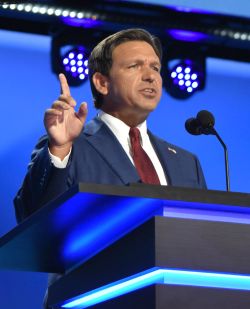 Florida Gov. Ron DeSantis (Agri-Pulse photo)
Bayer spokesperson Brian Leake pointed to the statement from the bakers, millers and wheat growers and called the levels detected in Florida “exceedingly small residues.” In a statement, the company asserted that "dietary exposures of glyphosate do not pose any meaningful risk to gut microbes."
Bayer is the defendant in thousands of lawsuits where plaintiffs allege exposure to Roundup has caused their non-Hodgkin lymphoma.
A House Ag Committee aide said the Florida test results show "what we already know to be true — residues of glyphosate are far below values deemed unsafe. For context, the average adult would have to eat approximately 600 loaves of bread at the highest reported level of residue from the brands tested by Florida on a daily basis to reach the conservative limits set by U.S. regulators.”
FIFRA is a 'floor, not a ceiling,' preemption critic says
On the other side of the issue, Scott Faber, senior vice president of government affairs at the Environmental Working Group, told Agri-Pulse that “more than 40 states, including Florida, have long enjoyed the ability to add supplementary pesticide protections. FIFRA has always been the floor, not the ceiling.”
FIFRA stands for the Federal Insecticide, Fungicide and Rodenticide Act, the national law governing approval of pesticides and how they are used.
However, “extremists like Chairman Thompson and others want to rob states of these consumer protection powers. It’s good news that Governor DeSantis and other leaders in both parties are standing up to him,” Faber claimed.
The House aide said the language in the forthcoming bill would be based on legislation introduced in the last Congress, the Ag Labeling Uniformity Act.
The language “has the same intent of making sure producers maintain access to crucial crop protection tools. The Farm, Food and National Security Act of 2026 has updated language that makes it crystal clear that bad actors can still be held liable for their actions, ensuring that there is no ‘liability shield’ as some people mistakenly characterize this provision.”
On the whole, Democrats are opposed to the language, which is expected to prevent states from adding language to pesticide labels that differs from Environmental Protection Agency conclusions reached by human health assessments or carcinogenicity classifications.
Committee ranking member Rep. Angie Craig, D-Minn., has objected to its inclusion, calling it a “poison pill.”
At a press conference announcing Democrats' version of the farm bill, Craig said including the preemption language in the majority's version would make it "very difficult to get widespread Democratic support" for the farm bill. She also said Republicans would "come under tremendous pressure from the [MAHA] movement" if preemption language is included.
One Republican who already is against such language is Rep. Thomas Massie, R-Ky., who was opposed to a version of the preemption language that was eventually stripped from the Interior-Environment spending bill.
In a letter last month to House Speaker Mike Johnson, R-La., and Minority Leader Hakeem Jeffries, D-N.Y., 135 Democrats said they were opposed to “any and all pesticide policy riders that would endanger public health, diminish local authority, and jeopardize Congress’ ability to deliver bipartisan legislation to strengthen our food system.”
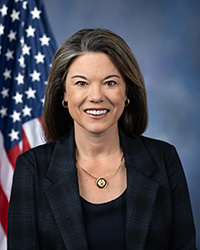 Angie Craig (Official photo)
Craig did not sign the letter, and her office did not respond to a request for comment on her personal position. She cosponsored the Agricultural Labeling Uniformity Act in the last Congress.
The House Ag Committee aide who spoke on behalf of Thompson reiterated his desire to tackle pesticide labeling uniformity in the new farm bill and pointed to support from some Democrats for the FIFRA language, including Craig and committee members Jim Costa of California, Don Davis of North Carolina and Nikki Budzinski of Illinois.
Critics of the language, however, say that glyphosate manufacturer Bayer and other pesticide companies would benefit because plaintiffs would not be able to claim the label failed to warn them of potential harms.
Another factor in the legislative debate could be whether legislation is necessary or prudent, given Bayer’s pending case before the Supreme Court addressing the same issue. The question teed up for the court is whether FIFRA “preempts a label-based failure-to-warn claim where EPA has not required the warning.”
The Modern Ag Alliance, which was founded by Bayer to press for uniform pesticide labeling and includes more than 100 farm groups, doesn’t think the existence of that case should matter.
“The purpose of the judicial branch is to interpret the laws, and we know that judicial interpretation can evolve over time,” MAA Executive Director Elizabeth Burns-Thompson told Agri-Pulse. “At the end of the day, the most concrete, sure-fire way to get a solution to this problem that has the same authority moving forward is a legislative solution.”
Similarly, Elizabeth Rivera of NAWG said the language in the Ag Labeling Uniformity Act "was carefully drafted long before the Supreme Court was even asked to take up the Durnell case. Farmers across the country need Congress to seize this opportunity to make the law crystal clear without further delay."
John Durnell is the Missouri man who won a $1.25 million verdict in Missouri state court that is being challenged in the Supreme Court by Bayer.
The MAHA movement associated with Health and Human Services Secretary Robert F. Kennedy Jr. has made defeating any FIFRA preemption language a top priority. MAHA leaders warn that Republicans who support it risk losing support in the midterm elections this year.
More than 300 “MAHA doctors, farmers, and state and national MAHA leaders” sent a letter in June to members of the House and Senate MAHA caucuses, urging them to “block any attempt to preempt state-level pesticide restrictions or weaken existing accountability.”
Kennedy himself has been highly critical of glyphosate. He was on the legal team that represented Dewayne Johnson, a California landscaper who initially won a $289 million jury verdict in 2018 after alleging exposure to Roundup had caused his non-Hodgkin lymphoma. The award was later reduced to $21 million.

