

The Agriculture Department is anticipating a slightly easier 2026 for U.S. ag producers, with prices for major commodities nudging higher and input and labor costs moderating, according to USDA Chief Economist Justin Benavidez.
Benavidez, who joined the department in January, presented his first annual forecast at USDA’s Agricultural Outlook Forum in Arlington, Virginia, on Thursday, offering an improved economic picture in 2025.
“For the first time in several years, the cost of production is beginning to moderate,” he said. Once adjusted for inflation, the total costs of seed, fertilizer and chemicals is set to fall 0.9%, Benavidez said.
Producers will likely spend a similar amount on labor in the coming year as they did in 2025. Once adjusted for inflation, this represents a slight easing of labor burdens, Benavidez noted.
This is most likely to benefit U.S. specialty crop producers, Benavidez said, for whom labor costs make up almost half of all expenditures.
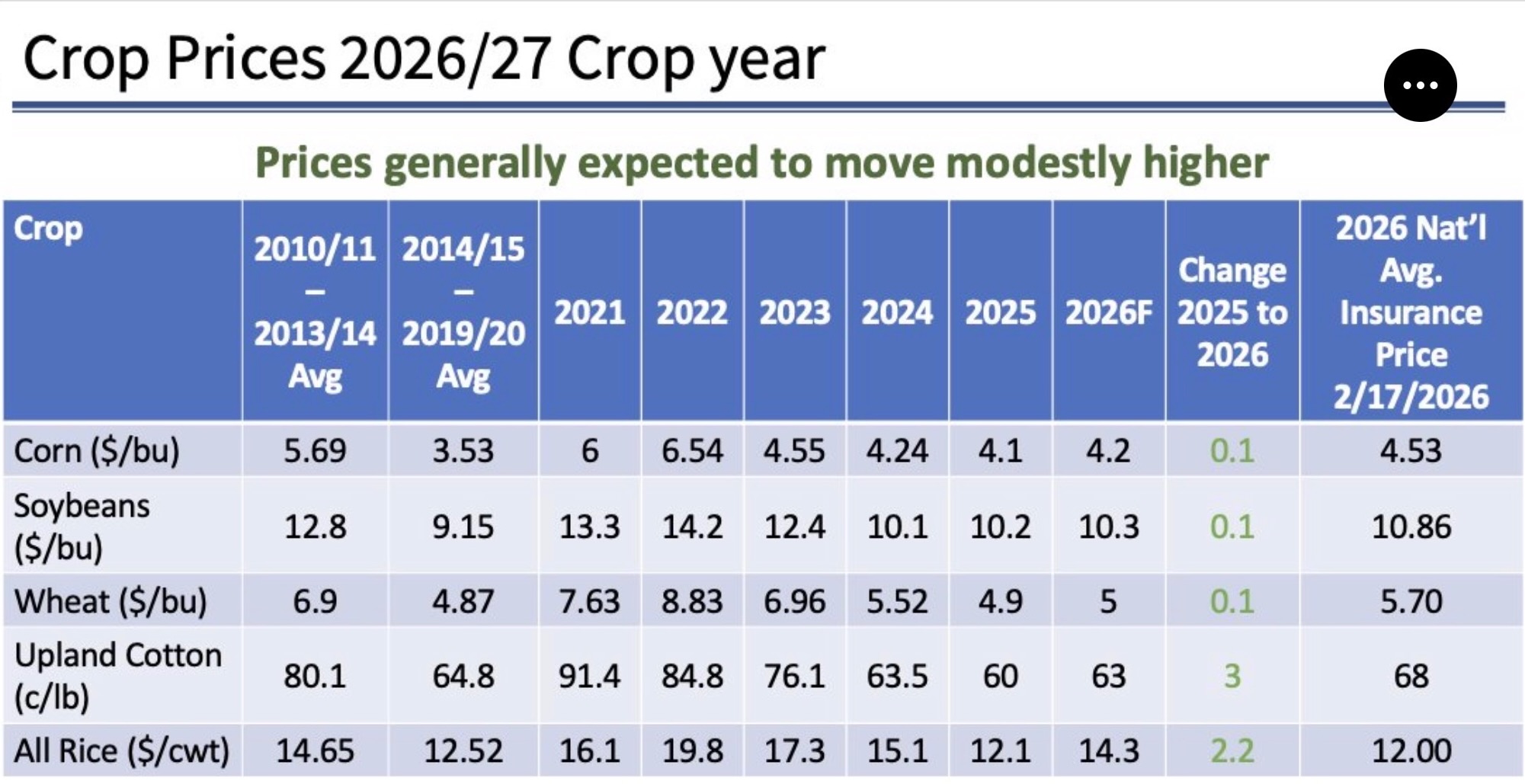
Meanwhile prices are set to rise modestly, with USDA anticipating corn, soybeans and wheat all set to rise 10 cents per bushel, Benavidez noted. Cotton, meanwhile, could increase three cents per pound, he said.
“The story for the year is progress being made on the price,” Benavidez said. “We’re not hitting it out of the park. We’re not solving everyone's problems in terms of pricing overnight, but price is generally expected to move modestly higher.”
Federal support is also set to grow in 2026, reaching $44 billion, with farmers still receiving distributions from $10 billion allocated under the American Relief Act, $12 billion forthcoming via the Farmer Bridge Assistance program, and increased safety net payments under the One Big Beautiful Bill Act passed last summer.
“The question becomes do we continue this ongoing ad hoc support?” Benavidez said. While he didn’t weigh in on the question, he warned that if additional federal support were to end, the U.S. will lose additional farms, with losses particularly acute in specific regions.
 Source: USDA
But he added that ad hoc support “has to be a bridge to something.”
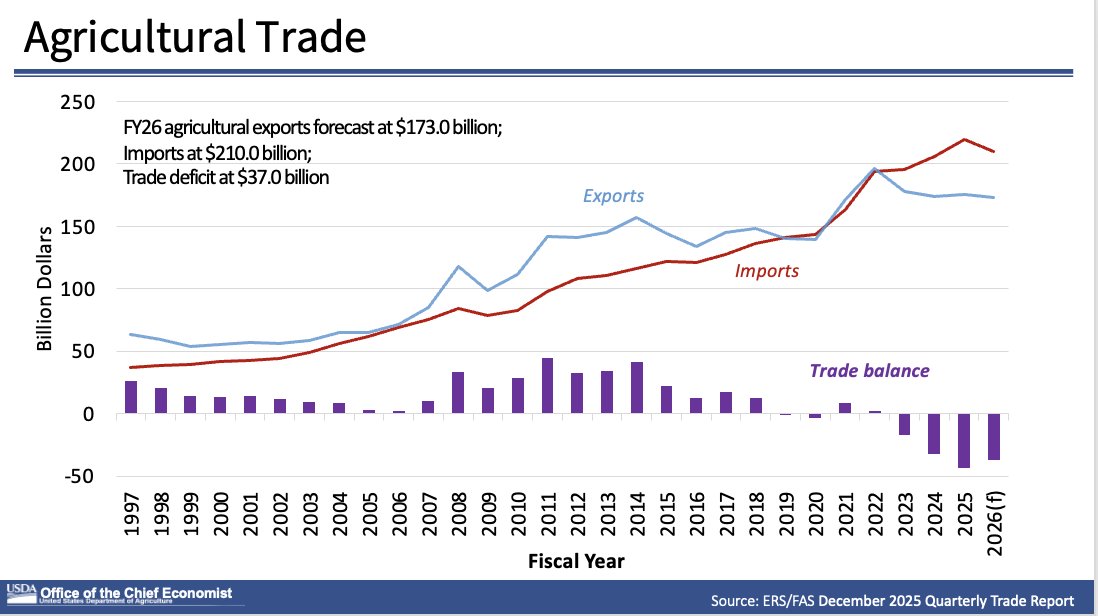
“We want to bridge to better demand conditions for producers across the board,” he said. Further closing the gap between production costs and returns, Benavidez said, will require spurring domestic demand, including through biofuel consumption, expanding trade markets and addressing unfair trade barriers abroad and lifting global protein consumption, that will offer increased opportunities for feed sources as well.
“These are the problems that have to be solved in the long run,” he concluded.
Further, USDA unveiled its outlook for individual commodities on Thursday. Highlights include:
Grains and oilseeds
A lackluster corn outlook is weighing on prices after USDA said it sees the season-average price farmers up just 10 cents to $4.20 per bushel. Output, domestic use, exports and ending stockpiles all are expected to be down in the 2026-27 season.
U.S. acreage is forecast at 94 million acres, down almost 5% from last year after a record crop that’s weighed on prices due to excess supply.
Soybean seedings rise under USDA’s outlook, gaining nearly 5% from last year. The season-average farm price is seen at $10.30 per bushel, slightly higher than the prior marketing year.
The acreage increase reflects better profitability than other crops, USDA said. Soybean futures have climbed in recent months while corn has declined. Helping push up prices are China’s resumption of U.S. purchases under its trade deal with the U.S. and the Trump administration’s proposal for higher blending levels of green diesel into its petroleum counterpart. Soy oil is a widely used feedstock in making the biomass-based fuel.
Wheat production is down 6% this year versus last season, according to USDA. The season-average farm price is expected to be $5 per bushel, slightly higher than a year ago.
Cattle and beef
As cattle producers slowly rebuild their herds, USDA projects slaughter to decline for another year, but at a smaller rate than in 2025.
The number of available feeder cattle outside feedlots was 1% higher than the previous year, but feeder cattle supplies “are projected to remain relatively tight, and feedlot inventories are expected to decline once again in 2026.”
Steer and heifer slaughter will continue to be limited by lower feedlot inventories, but declines aren’t expected to be as bad as 2025. “Cow slaughter in 2026 is also expected to decline, but at a lower rate, particularly as the recent expansion of the dairy herd is not expected to carry into 2026 and less productive animals are culled from the dairy herd.”
Beef exports are expected to drop 15% in 2025, with tighter domestic supplies and higher prices limiting the amount of beef shipped overseas. Imports in 2025 are expected to increase 16% to 5.4 billion pounds.
Dairy
The dairy report says that after strong growth in herd sizes and milk supply along with a steady decline in milk prices, cows in milk production are expected to fall in 2025, ending the year with 35,000 fewer compared to the end of 2024.
This year, milk production per cow is expected to grow by less than 1%. But the herd size is expected to be higher than 2025’s.
“The combined effect of the larger herd and higher milk per cow supports milk production in 2026 growing at a forecast annual rate of 1.3%,” USDA’s dairy report says. In addition, milk component levels “are expected to continue to grow and augment the growth in milk production.”
USDA expects milk prices to be lower on average in 2026 compared to 2025.
Feed
Corn, soybean meal and alfalfa hay prices are expected to continue their “downward trend,” according to the Livestock and Poultry report. The large 2025/26 corn crop and increased domestic soybean crush are expected to keep feedstuffs available for livestock producers. On-farm hay stocks on Dec. 1, 2025, were estimated at 81.7 million tons, up slightly from 2024 significantly higher than 2022’s recent low of 71.7 million tons.
“Alfalfa hay prices fell significantly in 2024 and 2025 as supplies have recovered,” the outlook said. “For 2026, prices are expected to be stable relative to a year ago and remain below highs seen in recent years.”
For more news, go to Agri-Pulse.com.
.webp?t=1762183428)


