
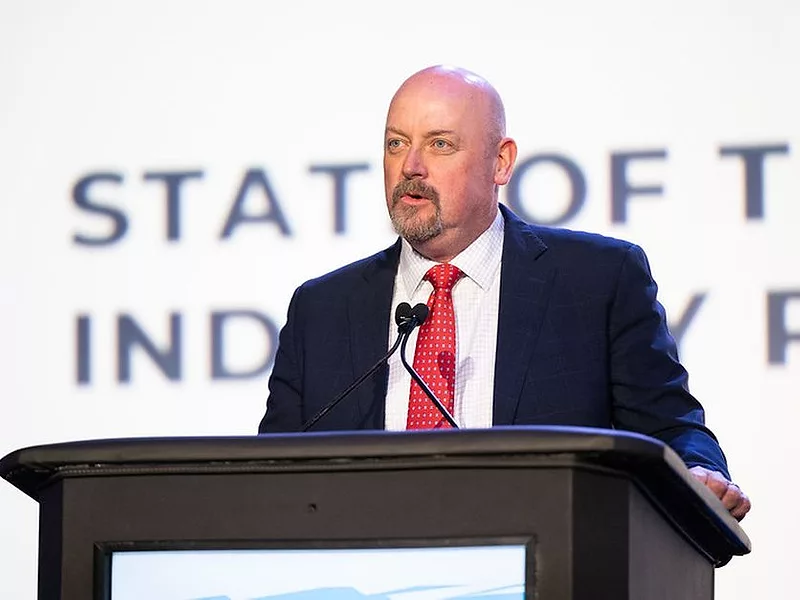
Renewable Fuels Association President and CEO Geoff Cooper said he’s optimistic EPA will stick to its proposal for the highest-ever biofuel-blending targets.
He also called on EPA to fully reallocate volumes exempted for some refineries in prior years when it issues its final regulations for 2026 and 2027.
But when?
“We just need EPA to finalize that rule, and we know the agency is close to doing so,” Cooper said at his group’s National Ethanol Conference in Orlando.
An EPA official speaking at the conference said the proposed final rule would be sent to the White House for review Wednesday, according to Bloomberg Intelligence analyst Brett Gibbs.
Sending the rule for review signals it could be out in the next two to four weeks. EPA has said in court filings it aims to issue the regulations by the end of March. (Update: The rule has been sent to the Office of Management and Budget for review.)
China ready to respond to any US tariff hikes, as Greer pledges continuity
Beijing says that it is ready to retaliate to any increase in U.S. tariff rates that may come from an investigation into its implementation of the Phase One deal.
“If the U.S. insists on pushing forward with relevant investigations or even uses the investigation as a pretext to introduce restrictive measures such as tariffs, China will take all necessary measures to resolutely defend its legitimate rights and interests,” a Chinese Commerce Department spokesperson said Wednesday.
But, but, but: The top U.S. trade official stressed that the administration has no immediate plans to reignite trade tensions.
U.S. Trade Representative Jamieson Greer said on Wednesday he expects China to eventually face a similar tariff rate as it did before the Supreme Court struck down emergency tariffs. “We don’t intend to escalate,” he said in an interview on Fox Business.
The administration is planning to use Section 301 investigations, like the one launched against China, as a mechanism to enforce previously agreed trade pacts, he argued.
“That is the enforcement mechanism to make sure that countries comply with their deals,” he said.
Take note: The Supreme Court struck down a 20% tariff on Chinese exports. With a new global tariff rate currently at 10%, China has, so far, seen a tariff cut from the court’s action. But the administration says the global tariff could rise to 15%.
“It’ll go up to 15 for some,” Greer said. “It may go higher for others.”
AFBF gives farm bill push
The American Farm Bureau Federation is calling on the House Ag Committee to agree on a new farm bill. In a statement being issued today, AFBF President Zippy Duvall says the GOP draft bill “updates important food and farm programs, enhances conservation efforts, bolsters assistance to specialty crops, and makes critical investments in agricultural research.”
The statement goes on to say that the committee should “work together to find common ground during markup and pass a bipartisan farm bill. After three years of delays, farmers desperately need policy that will help give them the tools and certainty to continue growing food and fiber for every family in America.”
The committee is scheduled to take up the bill next week.
Soybean growers: We want win-win on biofuels
The American Soybean Association is going on the record cautioning that authorizing year-round use of E15 shouldn’t result in harm to biomass-based diesel production. There has long been concern about the impact of small refinery exemptions on biodiesel demand.
Those exemptions are currently the subject of negotiations on Capitol Hill with oil refiners.
ASA members adopted a resolution Wednesday on its E15 position. “What we don’t want is a net zero, where it helps E15, but it’s negative to biodiesel. As farmers, we’re looking for something that gives us a plus-up on both sides,” ASA Vice President Dave Walton said at a news conference later.
‘Just in time’ dicamba
Cotton and soybean farmers nervous about getting their hands on dicamba herbicide this year don’t need to worry, Bayer’s Brian Naber tells Agri-Pulse.
In a big relief to growers, EPA this month approved dicamba for over-the-top use on soy and cotton. One of the biggest questions Naber hears now from farmers is if there’s enough time for Bayer to deliver its new Stryax dicamba herbicide for the upcoming growing season.
“Yes, we will,” he said in an interview from Commodity Classic in San Antonio. “But it will be just in time to get it there.”
Bayer expects adoption and market share of the product to be “really high,” said Naber, head of North America and Australia/New Zealand region for crop science.
The crop science giant is in the process of taking orders and ramping up production.
Short stature corn: On Bayer’s short stature corn, Naber said commercially planted acres are expected to more than double to 200,000, up from 85,000 a year ago. The corn’s shorter height means a stronger stalk to endure high winds and also makes it easier for farmers to do field work, according to Bayer.
Oklahoma cattle producers see losses from wildfires
Wildfires that have burned through parts of Oklahoma over the last week have resulted in significant cattle losses for some of the state’s producers, according to Bryce Boyer, director of communications for the Oklahoma Department of Agriculture, Food and Forestry.
Boyer told Agri-Pulse Wednesday that based on the number of producers the agency has talked to about the impact of the fires, cattle losses could be in the hundreds — and may go as high as 1,000 or more.
“Even looking past the immediate impact of the cattle, the ground is burned over pretty well,” Boyer said of the loss of forage. “Part of northwest Oklahoma looks like a big sand pit. There's no grass to be seen because of the blowing sand."
Boyer also said producers have reported losses of farm buildings and houses. He said on one operation, a barn building came down with the cattle still inside.
Final word
“This is [a corn] earworm. This is the kind of thing that destroys our crops. ... If we fail to use proper pesticides, it will drive down yields 20 to 50%, even more for fruits and vegetables, the very thing we want people to eat more of.” — Sen. Jon Husted, R-Ohio, at the confirmation hearing for Casey Means to be surgeon general.
“This is a very complex issue. I have the utmost respect for the American farmer,” Means responded but also said, “We have developed an agriculture system that is dependent on chemicals that are toxic to have an affordable food supply. That’s not good for farmers, it’s not good for consumers.”
Read more at Agri-Pulse.com.

.webp?t=1762183428)


