
|
The thorny topic of tariffs dominated talks at a policy summit of the National Corn Growers Association, with some members saying the corn lobbying group needs to figure out where it stands on President Donald Trump's trade strategy.
Taxes, regenerative farming and the accuracy of USDA crop reports also came up last week during Corn Congress, a semi-annual gathering for NCGA members to debate policy issues.
During a separate session at Commodity Classic in San Antonio, members of the American Soybean Association debated resolutions on trade as well as biofuels, drones and other issues.
Among resolutions adopted by ASA delegates was one stating that authorizing year-round use of E15 shouldn’t be done in a way that harms use of biomass-based diesel. Small refinery exemptions from the Renewable Fuel Standard can reduce demand for renewable diesel or biodiesel if the waived volumes aren’t reallocated to other refiners.
“We as an organization are supportive of year-round E15, as long as it doesn't hurt the biodiesel volumes,” ASA Vice President Dave Walton told a news conference. “And some of the proposals that are out there on the table now are a plus for E15, but there's a potential negative in there for biodiesel.”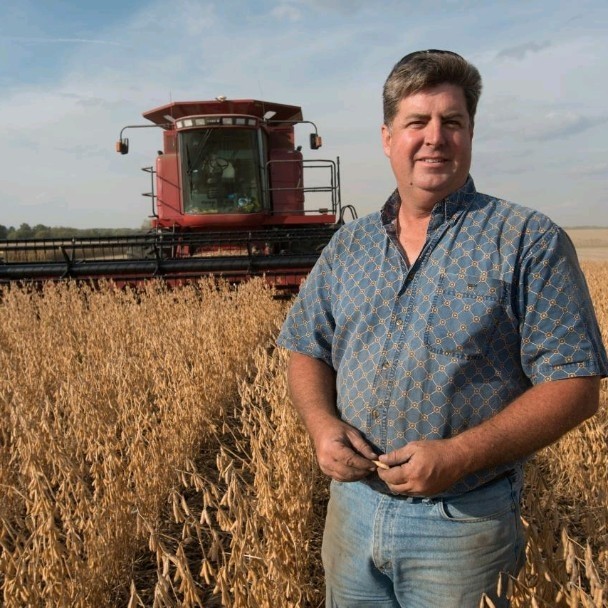 Dave Walton (LinkedIn photo)
During NCGA’s Corn Congress at Commodity Classic, Ohio delegates successively sought to modify a previously adopted resolution to say that NCGA supports the use of all available tools to open markets where trade barriers exist. The original version said the group specifically supported tariffs as a tool. The change spurred lively debate among the 126 voting delegates before it was approved.
An Ohio farmer said referring solely to “tariffs” would limit the group’s options. Others agreed, saying broader language offered more flexibility.
Interested in more news on farm programs, trade and rural issues? Sign up for a four-week free trial to Agri-Pulse. You’ll receive our content - absolutely free - during the trial period.
An Iowa delegate said the group was merely wordsmithing and what’s needed is a discussion on tariffs to determine where NCGA stands as an organization.
Trump’s tariff wars are a tricky issue for ag producers in general. Farmers are among the president’s most loyal supporters, but the levies have caused major financial stress in some cases. Trump last year asked growers to be patient with him, vowing that his policies would ultimately lead to a “golden age” of agriculture.
Another trade issue debated was a call for NCGA to formally support an export tax on critical minerals. The proposal from Iowa members targeted U.S. phosphate production and exports.
 Lance Lillibridge (Agri-Pulse photo)
“It’s being exported and can be bought in other countries cheaper than what we can buy,” said Iowa delegate Lance Lillibridge. “Why are we exporting it and it's costing us all more money?”
Delegates voted to change the proposal’s language to remove the word “tax” and instead say the group backs legislation to “limit exports” of critical minerals. The group then agreed to defer the issue to an NCGA committee for more discussion.
Delegates also adopted a motion calling on USDA statistics services to develop new methodology to increase transparency, predictability and accuracy of crop reports.
Lillibridge, in making the proposal, said USDA is using methodologies “from the 1970s and they are not working.”
Other resolutions approved by NCGA delegates called for:
- Supporting retirement and tax policies that would allow distribution of traditional retirement accounts without penalty for purchase of farmland or livestock facilities for farm buyers who will hold the majority of financial risk of the purchase and be the main decision-maker.
- Engaging with all U.S. states to defeat “radical animal rights groups,” as opposed to only interacting with NCGA member states. The proposal from Illinois delegates is aimed at countering what they say are activists’ efforts to push new laws in states without a lot of agriculture, in hopes they will pass and then other states will follow.
- International standard-setting bodies should include farmer representation to explore on-farm feasibility and flexibility of measurement, monitoring, reporting and verification protocols and procedures.
Among other issues ASA delegates debated were drones; delegates voted to oppose “restrictions on the purchase or use of foreign-manufactured machinery, software, or precision agriculture technologies” unless the restrictions were justified by a national security risk assessment and took into account the availability of other cost-competitive technologies.
A resolution on data centers asserted that they should not limit the availability of “affordable essential resources such as water, energy, land or broadband.”
ASA delegates also adopted policy language:
- Opposing “any action that hinders timely access” to fluorinated pesticides.
- Supporting policies to mitigate light pollution that can negatively affect photosynthesis.
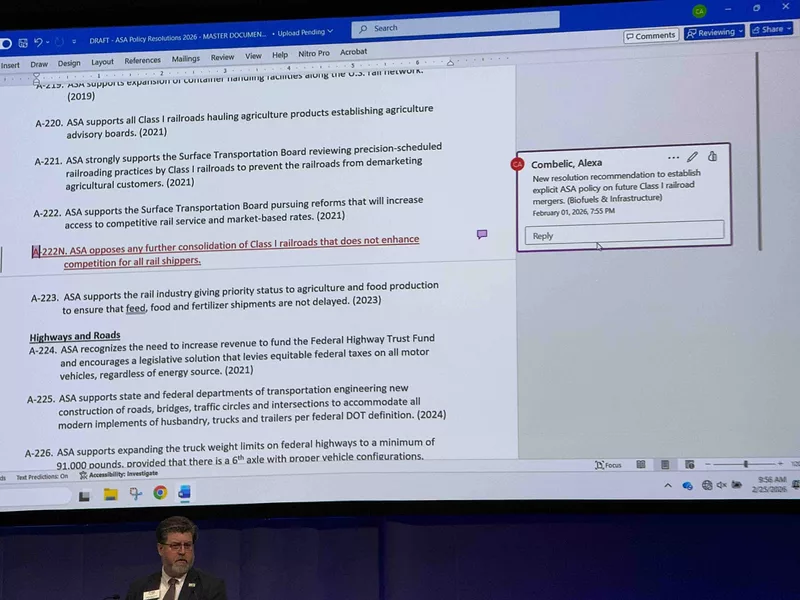
- Opposing additional mergers of major railroads that don't "enhance competition for all rail shippers." That resolution comes as Union Pacific and Norfolk Southern are proposing to create the first coast-to-coast rail line.

.webp?t=1762183428)
