
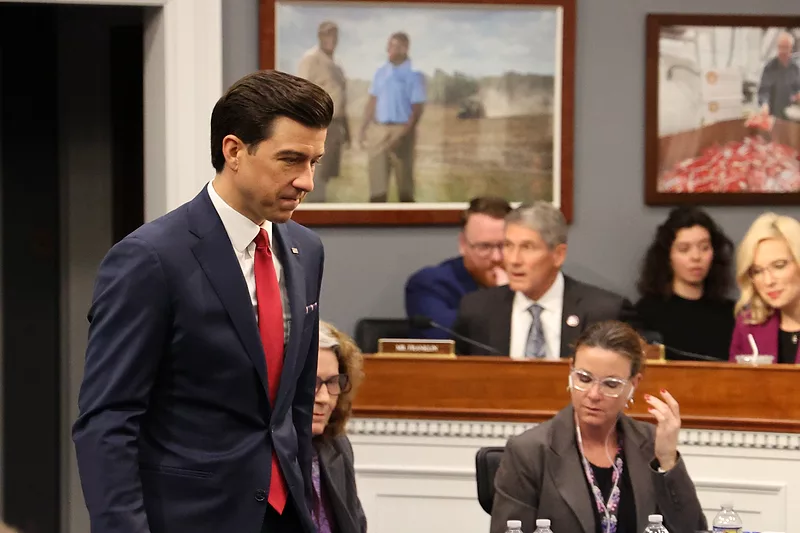
USDA’s undersecretary for trade and foreign agricultural affairs, Luke Lindberg, told lawmakers Wednesday the department will hire additional staff to help administer foreign food aid.
The administration temporarily transferred the Food for Peace program from the State Department to USDA late last year. The program had previously been housed at the U.S. Agency for International Development until its closure last summer.
At the time of USAID’s elimination, former contractors and officials expressed concerns about USDA’s capacity to administer the program effectively. At a House Agriculture Appropriations Subcommittee hearing on Wednesday, multiple Democrats reiterated those concerns, particularly given USDA’s workforce has shrunk in the interim.
Florida Democratic Rep. Debbie Wasserman Schultz pointed out that USAID’s Humanitarian Assistance bureau had more than 1,000 staff before its closure, “including hundreds contracted on the ground” to administer aid programs.
USDA employs around 150 Foreign Agricultural Service officers posted abroad, who “focus on trade policy, not humanitarian assistance," she said.
Lindberg said the department does also have locally employed staff, which “significantly outnumber” the FAS personnel. But he added that the department is planning on taking on more employees to help administer the international food aid program.
The undersecretary told Agri-Pulse after the hearing that officials are still evaluating their staffing needs and that the volume of additional staff, and their roles, will depend on which countries become the focus of future food aid efforts.
The administration is planning to issue additional notices for funding opportunities, Lindberg said, and the department plans to “put in place the necessary team to build around those awards.”
During the hearing, Lindberg also argued that the UN World Food Program, which is partnering with USDA to distribute the more than $400 million in food aid purchases that already been announced, would also provide some of the food aid functions previously carried out by USAID.
The contract with WFP “allows them to take on some of the responsibilities of our initial work to get these American commodities into these seven different countries around the world,” he said.
The top Democrat on the subcommittee, Rep. Sanford Bishop, D-Ga., was not satisfied with the lack of specificity in the administration’s staffing plans, however.
Interested in more news on farm programs, trade and rural issues? Sign up for a four-week free trial to Agri-Pulse. You’ll receive our content - absolutely free - during the trial period.
“It's concerning that you don't have basic details about how you will be able to successfully run the program when you've already begun making decisions about it,” he said. “It seems to me that you need to have in place how it's going to be implemented … before you actually make the award.”
Lawmakers also pressed Lindberg for details on the administration’s priorities in the upcoming U.S.-Mexico-Canada Agreement review, including plans for how to address rising imports of fresh produce from Mexico. Rep. Scott Franklin, R-Fla., argued for seasonal tariff-rate quotas on imports to protect Florida growers.
Lawmakers also asked for additional details on ongoing agricultural trade negotiations with U.S. trading partners, including India.
Bishop pointed out that the administration has published a joint statement teasing Indian tariff reductions on products like tree nuts and fruit, but has not provided concrete details.
Lindberg, however, said that the agreement is still being finalized and offered to provide a copy of the terms of reference once it is completed.
One U.S. export that is getting plenty of airtime in trade discussions, Lindberg said, is biofuels.
“There's been no topic that I've talked about more in my international travels than biofuels,” he noted. “We are working every day with the U.S. Grains and BioProducts Council and other industry players to ensure that biofuels are at the table."
For more news, go to Agri-Pulse.com.

