
A dozen Senate Democrats are aiming to break up the Big Four meatpackers by limiting them to producing meat in one category and, in the beef sector specifically, putting hard concentration caps on regional and national markets.
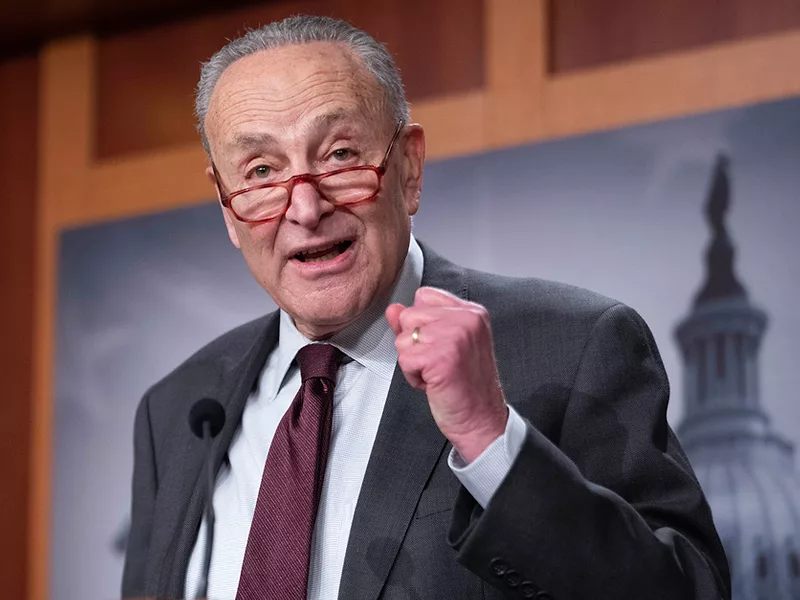
Senate Minority Leader Chuck Schumer, D-N.Y., on Thursday unveiled a bill aimed at de-consolidating the beef, pork and poultry sectors. According to a section-by-section summary, it would make it unlawful "for a major meatpacking conglomerate to control more than one major type of meat, forcing the biggest players to choose a line of business instead of sprawling empires across beef, pork, and poultry." The Federal Trade Commission would be tasked with designing and enforcing divestiture plans.
In an interview with Agri-Pulse, the head of the principal trade association for the meat industry called the proposal unworkable.
"Forcing a business to choose and not to choose what it sells is so anti-American to me that I can't even believe that we're having this conversation," Meat Institute CEO Julie Anna Potts told Agri-Pulse of the legislation.
She later added: "It will drive up prices for consumers. It will make the U.S. meat industry less competitive. It will cause chaos in the marketplace. And it is bad policy."
At an event Thursday, Schumer called for the breakup of the dominant meatpackers, noting that the four companies – JBS, Tyson, Cargill and National Beef – and control 85% of the market for beef, 67% of the market for pork, and 60% of the market for poultry. Schumer also referenced Tyson Foods' decision to close a plant in Lexington, Nebraska, which he said accounts for around 5% of America's meat processing capacity.
Hitting on affordability, which figures to be a major issue in the mid-term elections, Schumer took note of increases in the price of beef and other groceries. Beef and veal prices are up 15% year over year, according to the latest Consumer Price Index from the Bureau of Labor Statistics, but fell 0.9% from December to January. Pork is up 1.4% in the last year and chicken 1.1%, according to the CPI.
While Schumer said a variety of factors, including tariffs and supply chain disruptions, can contribute to the price hikes, he also claimed "a handful of powerful corporations have turned food and farming into a rigged game."
He called for a renewal of a national focus on antitrust in the sector reminiscent of 1914, when Congress passed the Packers and Stockyards Act after publication of Upton Sinclair's The Jungle, a book describing meat industry practices at the time.
"It is time for Congress to do what progressive areas of the eras past did so well, take action to break the monopoly powers, bring the cost down through true competition," he said, according to a transcript of the event. "My bill will do exactly that. It's part of our Democratic agenda. We get the majority and we're going to get this done."
Other sponsors of the bill are Peter Welch of Vermont, Cory Booker and Andy Kim of New Jersey, Elizabeth Warren and Edward Markey of Massachusetts, Bernie Sanders of Vermont, Ruben Gallego of Arizona, Jeff Merkley of Oregon, Brian Schatz of Hawaii, and Dick Durbin of Illinois.
In the beef sector specifically, the bill would impose "hard caps" on market concentration at both the national and regional levels, "relying on standard competition metrics to trigger mandatory deconcentration." According to the section-by-section summary. FTC could order the companies to deconcentrate by "selling off plants, facilities, or business units, or spinning off new independent firms" until "markets are competitive again."
The bill would also limit how much of any single large feedlot's cattle a packer can slaughter in a year and create "remedies and penalties when those limits are violated." This takes aim at the use of captive supply agreements, which are meant to ensure plants can operate at capacity through purchasing agreements and forward contracts.
Interested in more news on farm programs, trade and rural issues? Sign up for a four-week free trial to Agri-Pulse. You’ll receive our content - absolutely free - during the trial period.
The bill would give the FTC the authority to force the divestiture of foreign-owned meatpacking and processing assets in the U.S. It also seeks a "comprehensive study" on foreign processors like Smithfield Foods, which is owned by the WH Group, a Chinese company.
It also would adjust FTC's authority to allow it to "investigate meat pricing" and "challenge unfair methods of competition and price discrimination."
More broadly, the agency would be given the power to enforce divestitures, with noncompliance subject to "civil penalties tied to violators’ revenues and enhanced penalties for knowing violations, as well as equitable remedies such as specific performance and appointment of monitors."
Potts said forcing some processors to pick certain species "makes no business sense" and would limit the places livestock producers can sell their animals. On the concentration cap in the beef sector specifically, she noted that processors already operate on tight margins and are able to stay in business because they are efficient and "get ... what they need" through high-volume sales.
Potts also said having packers operate across meat sectors diversifies risk, offering stability. Forcing them to stick to one industry could reduce that stability, she added.
She also said it could be a problem to find willing buyers for divested plants, saying "there are not a whole lot of folks out there who are looking to buy and run large slaughter plants."
"It's a tough business and that's why economies of scale have worked so well at keeping food prices down," she said.
Glynn Tonsor, an economist at Kansas State University, told Agri-Pulse that larger cattle plants generally can harvest an animal more cheaply than smaller ones, often as a result of different procedures and labor distributions. He said if restrictions are set on size and ownership, it would limit some of the "economies of scale" benefits that larger beef processors have been able to provide.
Derrell Peel, a professor of agricultural economics at Oklahoma State University, said consolidation has occurred because it's "cost effective." If the meatpackers were broken up, "you will lose that cost efficiency," which will raise costs in the middle of the industry, above producers and below consumers. When those costs rise, he said consumers tend to pay more, and producers tend to get paid less.
He also said beef packers specifically were currently losing "tremendous amounts of money" in the present cattle market amid a combination of low inventory and high demand.
"This is a horrible idea," he said of the proposal. "It will make prices for consumers go higher. It will make cattle prices ... go lower, and it will infinitely extend the amount of time it would take to rebuild this industry to get to a point where there would be larger supplies."
He added: "There will be no winners in this, other than a bunch of lawyers. That's the bottom line."
For more news, go to Agri-Pulse.com.

