
As the nation’s leading pork producing state, raising roughly one-third of the nation’s pigs, Iowa farmers are hit first and hit hardest by policy changes that can upend our industry, just as we’ve seen with California’s Prop 12 — a mandate driven more by politics than by sound veterinary science or animal-care expertise.
That is why the misinformation being pushed by the American Meat Producers Association is so concerning, and why Iowa’s congressional delegation has stood with farm families, including Rep. Ashley Hinson, who introduced the Save Our Bacon Act after hearing directly from Iowans about Prop 12’s consequences, from the farm gate to the grocery aisle.
Iowa’s 5,172 pig farms help create more than 120,000 jobs, from hog production to processing, and the pork industry contributed $15.4 billion in value added to Iowa’s economy in 2024. The pork industry provides $8 billion in household income while contributing $2.7 billion in taxes paid, according to a recent study from the Iowa Pork Producers Association.
Iowa is the long-established leader in pork production for good reason. Our pig farmers build on generations of experience while embracing the latest research and technology to produce safe, nutritious pork and provide quality animal care. Iowa’s abundant supply of essential feedstuffs also makes our state an ideal place to raise pigs responsibly and efficiently.
Agriculture and pork production are vital to Iowa’s economy and communities, so when the ag economy struggles, all of Iowa feels it. During a multi-year downturn, livestock has provided one of the few bright spots for farmer profitability. That makes it especially frustrating to see out-of-state special interests spend millions on a dishonest pro-Prop 12 campaign targeting our federal officials under the guise of protecting Iowa farmers and promoting animal welfare.
Make no mistake, the group behind the $30 million ad blitz does not represent American agriculture, and their false claims certainly don’t reflect the views of Iowa pig farmers. Iowans know that our state’s congressional delegation are loyal supporters of agriculture, and the Save Our Bacon Act reflects the concerns they have heard from farm families, processors and consumers who understand the negative consequences of Prop 12.
When states impose different rules for how agricultural products must be produced before they can be sold within their borders, farmers are forced to navigate a costly and confusing patchwork of laws. That dangerous precedent can push smaller farms out of key markets, limit consumer choice and drive up grocery prices. And agriculture would not be the only industry at risk; any business that depends on a reliable national marketplace could face the same threat to interstate commerce.
A 2024 study showed that California’s share of national fresh pork consumption fell from roughly 10% prior to Prop 12’s implementation to about 8% afterward — a significant drop in demand in a state of nearly 40 million consumers. At the same time, data from the USDA and market analysts indicate that prices for certain pork products increased between 10% and 40% in the short term. Over the long term, research from North Dakota State University’s Agricultural Risk Policy Center estimates that covered pork products in California will average about 20% higher than they would have without Prop 12, costing California consumers an estimated $350 million more.
But the greater threat reaches beyond one state or product. Prop 12 forces farmers, processors, distributors and retailers to redesign facilities, certify practices, segregate supply chains and track products by destination. For many farmers, those costs are hard to justify without guaranteed contracts or premiums, especially when future state mandates remain uncertain. If more states adopt conflicting standards, businesses could face a maze of rules just to move goods across state lines.
The threat extends beyond agriculture: if one state can dictate how products are produced elsewhere as a condition of sale, the same approach could apply to countless goods and industries that depend on a free, predictable national marketplace.
Iowa agriculture is proud of our elected federal officials and their track record supporting farm families. In the face of outside pressure and dark money attacks, their support hasn’t wavered, and we commend the Iowa delegation for standing strong in support of Iowa agriculture and our farm families.
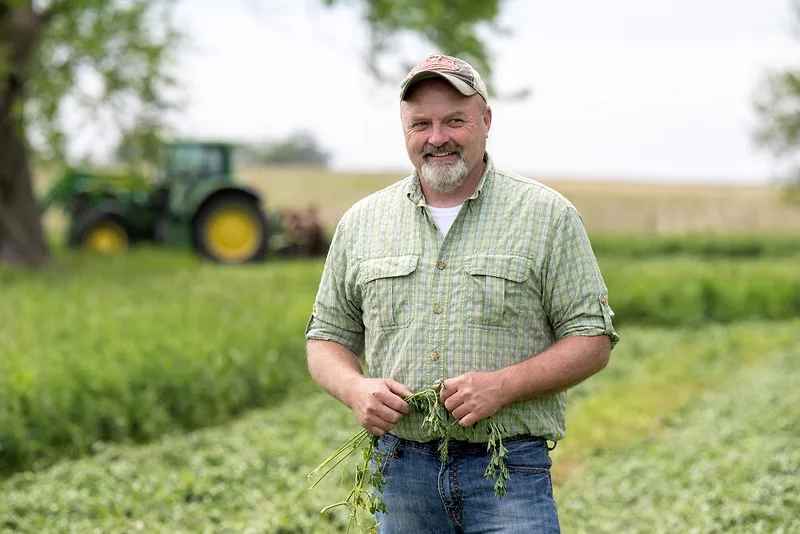
Brent Johnson of Manson, Iowa, has served as president of Iowa Farm Bureau Federation since 2021, and previously served as IFBF Young Farmer Committee Chair and was first elected to the state board of directors in 2016. Johnson grows corn and soybeans on his Calhoun County farm.