
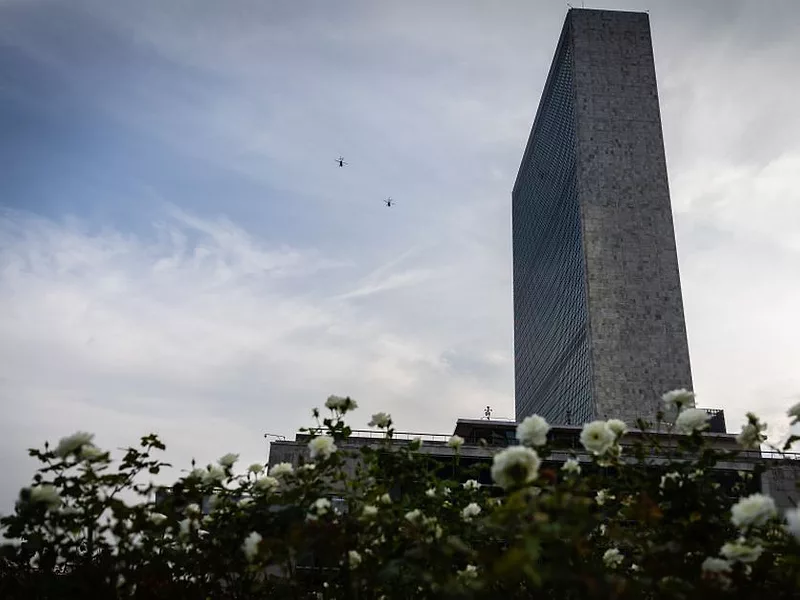
Almost 100 agricultural groups and companies from across the sector are urging the Trump administration to back a U.S. candidate to lead the UN Food and Agriculture Organization.
In a letter to President Donald Trump on Friday shared exclusively with Agri-Pulse, the coalition argues that current Deputy Director-General Beth Bechdol could reform the organization to better support U.S. ag.
“An American has not led FAO in more than 70 years, even as the United States remains its largest financial contributor,” the letter reads. “With Beth at the helm, FAO becomes a practical tool for delivering results for rural America.”
China’s Qu Dongyu is currently director-general of the organization. His final term ends in summer 2027, when there will be an election by secret ballot for a new DG.
An American has not led the organization since the 1950s. In recent decades, the position has been filled by other nationalities to provide some balance to U.S. leadership in other groups, including the World Food Programme.
“[T]his is the moment for the United States to back a candidate who will strengthen science-based policies and expand opportunities for trade in U.S. dairy products,” Nicholas Gardner told Agri-Pulse in an email. Gardner is senior vice president for multilateral affairs at the U.S. Dairy Export Council, one of the signatories.
Take note: Europe also has its eye on the FAO top spot. It has been 50 years since a European led the organization. The Irish government said last week that its nominee, former European Union Trade Commissioner Phil Hogan, has the backing of EU partners.
Hormuz closure hits fertilizer market
The U.S. military and Israel continue to pound Iran, dropping thousands of bombs in an assault that began Feb. 28.
A second week of military strikes on the country has resulted in the effective closure of the Strait of Hormuz, a shipping lane for about a fifth of the world's oil and natural gas and a third of its fertilizer. Energy and fertilizer prices are rising.
“From urea to phosphates, global supply disruptions are already creating pressure on availability and prices,” The Fertilizer Institute said on social media.
Commodity prices rise: Just ahead of the attack, the FAO reported the benchmark measure for world food commodity prices rose in February.
It was the first increase in the FAO Food Price Index in five months, “as higher quotations for wheat, most vegetable oils and several meat types outweighed declines in cheese and sugar prices,” FAO’s update said.
Wheat production likely to drop: FAO also released new wheat production forecasts for 2026. The early picture points to a likely global decline of around 3% to 810 million metric tons. The amount is still above the rive year-average.
Industry coalition calls for restored Food for Peace funding
A coalition of ag, maritime and labor groups and companies is calling on Congress to restore international food aid funding to fiscal year 2024-2025 levels in the next funding bill.
In a letter to top lawmakers on the Senate and House Agriculture Appropriations subcommittees obtained by Agri-Pulse, the signatories note that food aid purchases have helped support rural economies while helping vulnerable populations.
“Food for Peace, Food for Progress, and McGovern-Dole not only benefit their recipients, but also U.S. economic and national security interests,” the letter reads.
Congress allocated $1.2 billion for Food for Peace — which has been rebranded as “America First International Food Assistance” — in fiscal 2026. In FY24-2025, the program received more than $1.6 billion. The McGovern-Dole program also got $240 million.
Ultimately “these kinds of humanitarian assistance programs help create a firm foundation for vulnerable communities to grow and prosper, which is why many former food aid recipient countries are now among the most important U.S. trading partners,” the letter argues.
Customs official says agency is working on tariff refund system
A senior U.S. Customs and Border Protection official says that the agency is developing a system capable of administering refunds for recently axed emergency tariffs. The automated system could be ready in 45 days, they noted.
In a court filing Friday, Brandon Lord, CBP’s executive director of trade programs, said that the agency doesn’t have the ability to swiftly issue refunds but is working on it.
The existing system would require the agency to manually issue more than 53 million individual refunds, Lord said. But CBP is working on a process to automate and consolidate refunds by importer — with added interest.
“The process will be simpler and more efficient than the existing functionalities, and CBP will provide guidance on how to file to refund declarations in the new system,” Lord said.
WASDE probe sought
Corn farmers are giving a vote of no confidence to crop reports from the U.S. Department of Agriculture.
The Iowa Corn Growers Association tells Agriculture Secretary Brooke Rollins it wants to work with USDA and Congress to investigate and fix what it calls “flawed reporting.”
The claim comes after USDA’s January crop estimates, known as the WASDE, unexpectedly raised 2025 corn acreage and yield figures. Crop prices then plummeted “to the point of no return,” Iowa Corn President Mark Mueller writes in a letter to Rollins.
Iowa Corn member Lance Lillibridge says USDA is using practices “from the 1970s and they’re not working.”
The National Corn Growers Association last month adopted a resolution saying members expect USDA to come up with new methodology.
"There's always room for improvement," USDA tells Agri-Pulse in response to the corn groups' criticism. "The corn futures market has adjusted, rising over 9% in the past 6 months," it adds.
“It is the job of USDA statisticians to report data using the information they receive from farmers via surveys even when it’s not the news policymakers may not want to hear," an agency spokesperson says in a statement. "While the data and statistics used to inform these reports are often considered the benchmark for other agricultural forecasts, there is always room for improvement to further enhance accuracy and usefulness."
"The department remains committed to providing timely, accurate, and useful statistics in service to American agriculture and we encourage all stakeholders to comment on the open `Request for Information' on USDA data products to ensure we receive constructive feedback."
USDA is set to release the next monthly WASDE on Tuesday.
Bankrupt Midwest chicken processor issued fine
A state court in Wisconsin has ordered chicken processor Pure Prairie Poultry to pay $13,575 under state animal mistreatment laws for abandoning chickens when it went bankrupt in late 2024.
Buffalo County Circuit Judge Thomas Clark found Pure Prairie guilty of 30 counts of mistreatment of animals. Pure Prairie did not contest the charges, and Clark ordered the default judgment after Pure Prairie failed to appear in court, according to a summary on Wisconsin’s court website.
Pure Prairie filed for bankruptcy in October 2024 and stopped providing feed for the birds under its ownership, leaving growers across the Midwest with little guidance on what to do with their chickens. The state of Iowa took over custody of birds in its borders, though Minnesota and Wisconsin lacked laws allowing them to do the same.
Final word
“What you're seeing is emotional reactions and fear that this is a long-term war. This is not a long term-war.” – Energy Secretary Chris Wright on CBS News’ Face the Nation about the impact of the Iran conflict on oil prices.
For more news, go to Agri-Pulse.com.

.webp?t=1762183428)


