
|
Fuel prices are rising as the war with Iran stifles vessel traffic through the Strait of Hormuz, and the added costs will be felt across the agricultural transportation chain, experts and ag industry leaders say.
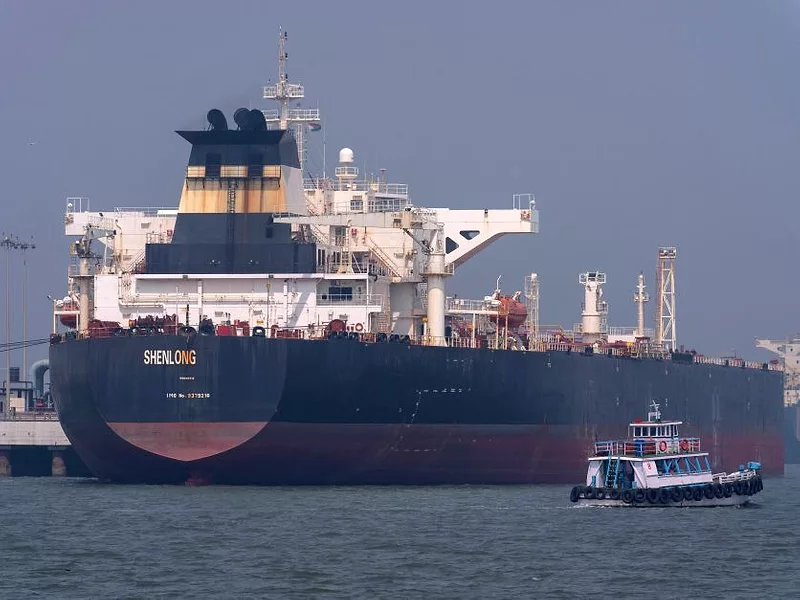
Shipping in the Strait of Hormuz has come to a near-standstill since the beginning of the conflict between Iran and the U.S. and Israel. According to data from Hormuz Strait Monitor, which tracks the strait, only nine ships had transited it on Tuesday.
“Looking at the last few days’ worth of data, we’re down to almost nothing coming out of the Strait of Hormuz,” said Joe Glauber, a research fellow at the International Food Policy Research Institute and former USDA chief economist. “That’s clearly affected fuel and fertilizer prices a lot.”
President Donald Trump on Monday called for other countries to assist with reopening the strait, and said the U.S. has destroyed 30 Iranian mine-laying ships with aims of “hammering their capacity to threaten commercial shipping.”
An average of 20 million barrels per day passed through the strait in 2024, or about 20% of global petroleum liquids consumption, according to the Energy Information Administration.
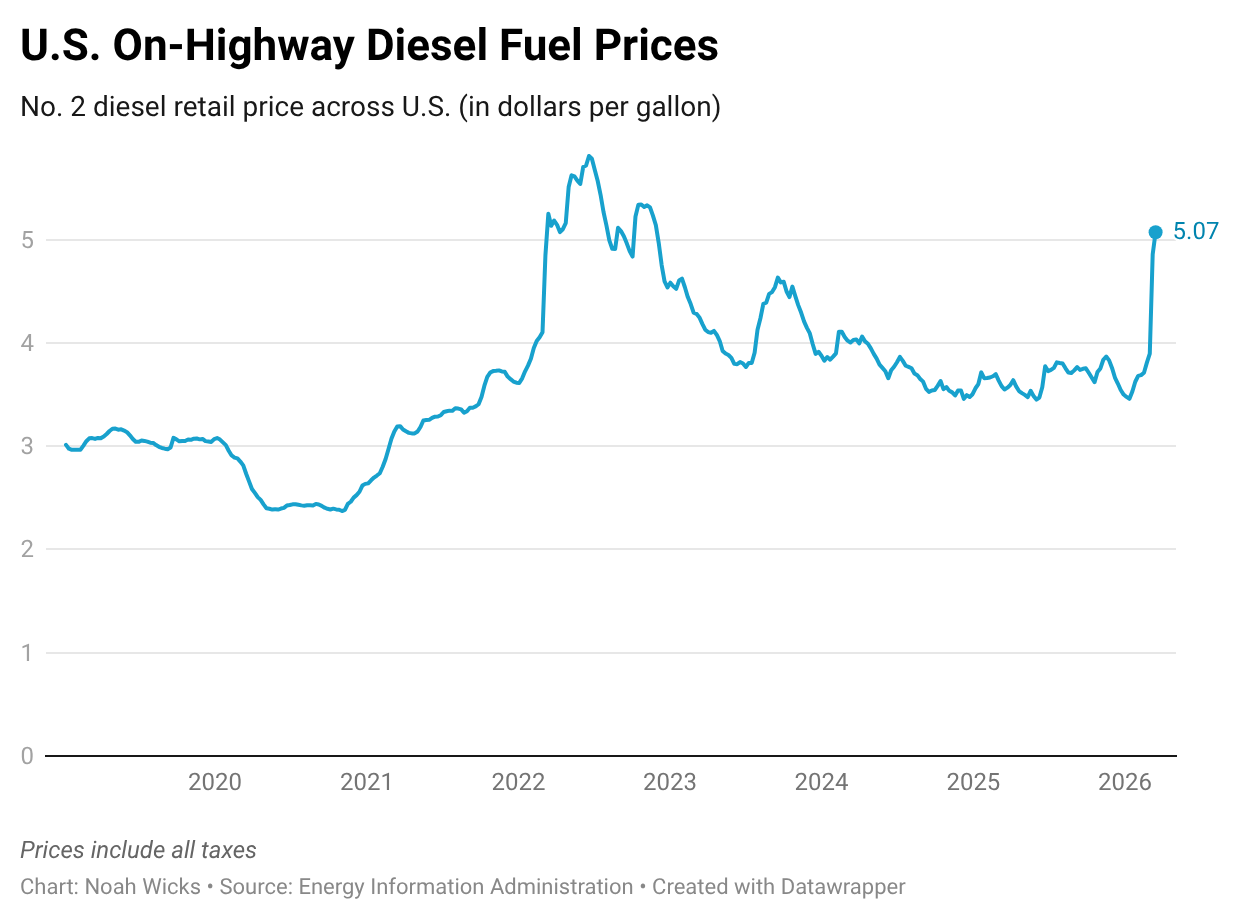
The EIA pegged average U.S. on-highway diesel fuel prices at $5.07 per gallon on Tuesday, a 4.5% increase from last week, and a 30% increase from the average two weeks ago of $3.89 per gallon.
Gasoline prices, meanwhile, averaged $3.72 nationwide on Tuesday, a 6% increase from $3.50 last week and a 23.5% increase from two weeks ago.
Elevators will feel rising prices — and so could farmers
The Agriculture Department’s grain transportation cost indicators index for trucking costs rose to 183 for a 7-day span ending March 11, up from 147 the week prior. The reading for Pacific freight rates rose from 148 to 157 during that period, while the reading for Gulf freight rates increased from 139 to 147.
The reading for rail grew only slightly, going from 119 to 120 during that span. Meanwhile, the reading for inland barge rates fell from 209 to 186.
The index, compiled by the Agricultural Marketing Service, seeks to gauge shipping cost changes using diesel prices, secondary rail market rates, Illinois barge rates and ocean freight rates from the U.S. Gulf and Pacific Northwest to Japan as proxies. On the scale, a reading of 100 represents the average cost of each mode of transportation in 2017.
Frayne Olson, an agribusiness and applied economics professor at North Dakota State University, said railroads tend to add service charges when diesel prices rise, a cost felt by local elevators looking to ship grain. Companies that barge grain down the Mississippi river may add similar charges. Elevators then face a decision: They can either absorb the costs or pass them on to farmers in the form of basis. Basis is the difference between the local cash price for grain and the futures market price.
“If you’re an elevator, this is a big deal,” Olson said of the additional shipping costs, noting that elevators generally have a net profit of only a few cents per bushel. “If you’re a farmer, you may or may not feel the difference in local basis."
However, Olson said at the moment, the segments of the chain “feeling the pain” of the fuel costs are the railroads, truck drivers, and barge lines. Many haven’t yet instituted the additional surcharges, though he added that they can only absorb the costs in the short term. He expects they will eventually have to “pass some of that along” even if the disruption ends soon, though there will be a lag before the costs appear.
“In my opinion, the increased fuel prices we’re seeing right now will eventually get passed through," Olson said. "But the longer they stay high, the more of that will get passed through."
The most recent rail traffic data released by the Association of American Railroads suggests agricultural rail shippers have still been active in recent weeks. Railroads shipped 25,313 carloads of grain the week of March 7, a 16.9% from the same period in 2025, and 18,306 carloads of food and other farm products, an 8% increase from the year prior.
Costs could add up, ag leaders say
Mike Seyfert, president and CEO of the National Grain and Feed Association, said there’s an expectation that some of these additional rail costs will appear in May “due to the way contracts are set up,” and he emphasized that they will differ based on carrier and region.
However, using back-of-the-envelope calculations, he estimated that around 25% of the additional cost of diesel fuel would be passed on through a surcharge. Using that formula, he said a $1 increase in the price of diesel would likely mean an additional 25-cent-per-gallon cost for the elevator.
Expanding on that hypothetical, a shipper facing a current surcharge of 15 cents could see that become 40 cents by May, if the 25-cent increase is passed on, he said. That increase would add up to an extra $375 per rail car, or 11 cents per bushel, to transport grain approximately 1,500 miles. For a 100-car shuttle, that may be around $41,000 in additional cost, he said.
“Without a doubt, that begins to impact grain elevator, grain co-ops’ bottom lines and margins, and it can have an impact on their profitability,” Seyfert said. “It certainly can impact what the farmgate price may be for producers as well.”
When it comes to ocean vessels, Seyfert said some NGFA members report seeing additional premiums of $1 million to $1.5 million for export out of the Center Gulf, opposed to what prices looked like prior to the start of the war in Iran.
As far as trucking, Sey Mike Steenhoek (Soy Transportation Coalition photo)fert suggested shippers could see an extra two cents per bushel in costs. And he said the varying additional costs between modes of transportation could stack, meaning that shippers could see an additional 60 cents per bushel or more just moving between road, rail or vessel.
“When you add it all together, you’re starting to talk about some very real numbers in terms of increased transportation cost,” he said.
Under one hypothetical scenario raised by Mike Steenhoek, the executive director of the Soy Transportation Coalition, a single grain elevator delivering 2 million bushels of soybeans and 4 million bushels of corn on a 40-mile journey by truck could pay almost $100,000 more than usual in diesel fuel cost due to higher fuel prices. He also estimated that a farmer transporting 500 bushels of soybeans and 500 bushels of corn to an elevator by truck on a 40-mile journey would see around $1,950 in additional diesel cost.
His calculations used $3.62 per gallon as the price of diesel.
“This is real money that farmers are going to be paying,” Steenhoek said.
Economist Dan Basse, president of AgResource Co., said rising transportation costs will likely hit Brazilian producers harder than U.S. ones for the time being, since the South American nation is currently in the midst of its harvest season.
He added that importers appear to be “starting to back off a little bit in terms of their forward coverage” as they wait for rates to settle.
“Seems like things are slowing down now,” Basse said. “People are taking a wait-and-see kind of mentality and saying, ‘well, when’s this war going to be over?’”

