
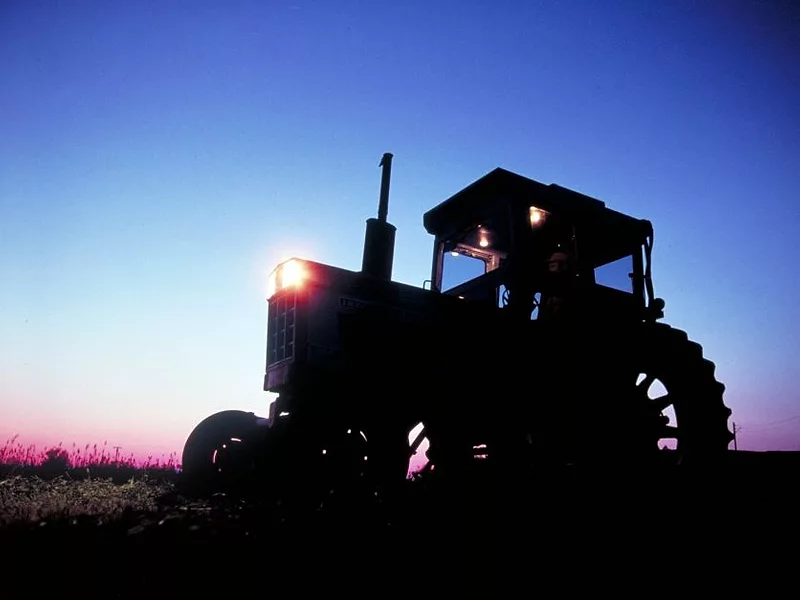
Spring is officially here, typically a time when all eyes look to the sky as key plantings begin across the Northern Hemisphere.
Yet as war in the Middle East enters a fourth week, producers are also watching fertilizer and fuel costs climb higher.
Since February, the average farm diesel price is up more than $1 a gallon in both Iowa and Illinois, according to USDA data. For fertilizer, Illinois saw a whopping increase of more than $230 a ton for urea.
Such historic increases will impact farmers this spring, says John Newton, vice president of public policy and economic analysis at the American Farm Bureau Federation. Newton is discussing ag trends at the annual Agri-Pulse Ag & Food Policy Summit today. Other speakers at today’s summit include EPA Administrator Lee Zeldin, chief ag trade negotiator Julie Callahan, and leaders of the House and Senate Agriculture committees.
The average price for U.S. diesel was $5.25 a gallon as of Sunday, up from $3.71 last month and $3.60 a year ago.
“We're dealing with hyperinflation and low commodity prices and the two don't mix,” John Schroeder, a corn and soybean farmer in Ohio, tells Agri-Pulse. “It's a setup for disaster.”
Pivotal week ahead
The week is full of events with ag, food and energy leaders weighing in the outlook for policy, supply chains and consumer trends. Lobbying fights around pending biofuel regulations also are in full force.
But, but, but: What happens with the Strait of Hormuz as U.S.-Iran tensions climb over the crucial global chokepoint for fuel and fertilizer shipments will hang over everything this week, including an event with potentially hundreds of farmers at the White House on Friday.
For more on this week’s D.C. policy agenda, read our Washington Week Ahead.
Farm-state Dems say Argentina beef measure brings volatility, not lower prices
Two Ag Committee Democrats will argue to President Donald Trump and Agriculture Secretary Brooke Rollins today that recent efforts to increase imports of Argentinian beef will do little to lower prices while spurring market volatility.
Last month, the administration temporarily increased a tariff-rate quota for Argentinian beef for 2026 by 80,000 metric tons.
“Only two percent of imported beef came from Argentina in 2024, and economists indicate higher imports are unlikely to reduce prices meaningfully, though they may boost margins for major food companies,” Reps. Sharice Davids, D-Kan., and Gabe Vasquez, D-N.M., write in a letter shared exclusively with Agri-Pulse.
The announcement, they argue, is “increasing market volatility at a time when American producers need support, not sabotage.”
Take note: During the recent House farm bill markup, lawmakers on both sides of the aisle expressed concern over the administration’s decision to increase imports of Argentinian beef.
Potash miner to USTR: US needs critical minerals for food security, too
Successive administrations have prioritized addressing chokepoints in critical mineral supply chains as the U.S. seeks to strengthen its national security and reduce reliance on China.
In a submission to the Office of the U.S. Trade Representative, Michigan Potash Co. argues that food security should “rank equivalent to defense” in these efforts.
The U.S. imports more than 90% of the potash it needs, and the global market is controlled by a handful of foreign players, the company argues.
“A commercially viable and fully permitted domestic deposit exists in the United States corn belt,” the company notes, but price volatility makes investors wary of new projects.
Price floors and border adjustment measures would facilitate extraction, the company says.
Take note: USTR has been collecting public comments on how to design a plurilateral critical minerals agreement to foster supply chains among like-minded partners.
Both potash and phosphate were added to the critical minerals list last year, and could stand to benefit from recent efforts to shore up domestic supply.
Dairy plant workers to go on strike
Workers at a Minnesota dairy processing and shipping facility are striking over wages and other issues, a local Teamsters Union division announced Friday.
In a press release, Teamsters Local 471 Secretary-Treasurer Lyndon Johnson said workers at an Associated Milk Producers Inc. dairy facility in Paynesville, Minnesota, are striking over wages, health care, and job protections. Workers are also seeking a guarantee that they would be able to keep their jobs and union contract if the plant's ownership changes.
According to AMPI’s website, the facility processes up to 4 million pounds of milk daily and produces up to 340,000 pounds of barrel cheese.
Rollins seeks to bolster US fertilizer production
Ag Secretary Brooke Rollins is emphasizing the importance of reshoring fertilizer production in the U.S. as the war with Iran continues.
She told Fox News’ Peter Doocy Sunday that “a super-majority, almost all of our farmers” put their fertilizer orders in last fall, leaving 20-25% with decisions to make about what they want to plant. Some could pivot to soybeans, she said.
“We’ve got to reshore our fertilizer back into America,” Rollins said. “We're going to be working on that for the long term.”
She also reiterated the Trump administration’s position that the hostilities with Iran are a “temporary conflict” that should have no long-term effect on food prices.
Censky talks RVOs, year-round E15 on Open Mic
The head of the American Soybean Association says higher biofuel blending requirements from EPA would set a floor that would be difficult to reduce.
“There's always the possibility” that renewable volume obligations could go down under a new administration, ASA CEO Steve Censky tells Jeff Nalley on this week’s Agri-Pulse Open Mic. “But I think once you demonstrate that you can produce, and people make the investments, I think it's very hard to lower them.”
EPA proposed a total RVO of about 24 billion gallons in June, above industry requests. The final rule is under review by the Office of Management and Budget.
But Censky also warns that if year-round E15 legislation contains permanent wholesale exemptions for small refineries, that would undermine the value of the renewable volume obligations “by hundreds of millions of gallons.”
Censky says it’s important that supporters of year-round E15 have to hold fast and “make sure that we don't agree to almost anything.”
Final Word
“I think you’re seeing the industry trying to rebuild as a whole. Does this put a damper on things? You bet. You’ve got to reassess everything. But I don’t want to speak for them because I know how hardy the cattleperson is.” — Nebraska Cattlemen’s Association President Craig Uden on whether the recent fires that have scorched rangelands in Western Nebraska could affect producers' plans to begin rebuilding the shrunken U.S. beef herd.
.webp?t=1762183428)


